I flew into Corfu expecting a Greek island and found something closer to a palimpsest—a place where four centuries of Venetian rule left their signature and never quite got painted over. Corfu Town announces this the moment you step into it: pastel facades in faded ochre and rose, shuttered windows, arcaded streets that could be mistaken for a back alley in Venice itself if not for the blaze of bougainvillea spilling over every wall.
The island was never conquered by the Ottomans, a fact locals mention with quiet pride, and the architecture is the proof. Narrow kantounia (alleyways) opening onto campielli, church bell towers standing in for minarets, the old fortresses squatting at either end of town like bookends on a very long, very layered story. The Liston, that arcaded promenade built by the French during their brief occupation, still hosts the same unhurried people-watching it was designed for two centuries ago. Cricket is played on the green beside it, a strange and delightful British leftover, and it captures the whole island in miniature: Venetian bones, French flourishes, British habits, all of it unmistakably Greek in spirit.
But Corfu's real magic, for me, was outside of town. Drive 20 minutes in almost any direction, and the architecture gives way to something wilder. The island is famously green, fed by winter rains most of the Aegean islands never see, and that abundance turns the interior into something close to an enchanted forest. Cypress trees stand sentry up every hillside, silver-leafed olive groves roll on for what feels like miles, some of the trees reportedly hundreds of years old, gnarled and silvery and still bearing fruit. Wild capers grow underfoot without anyone planting them. Villages appear suddenly out of the tree line: a chapel, a taverna, a few houses the color of old parchment, and then disappear again behind the canopy. It is a landscape built for slowness, for long lunches and longer views, and after a few days, I understood why so many people who visit Corfu want to return.
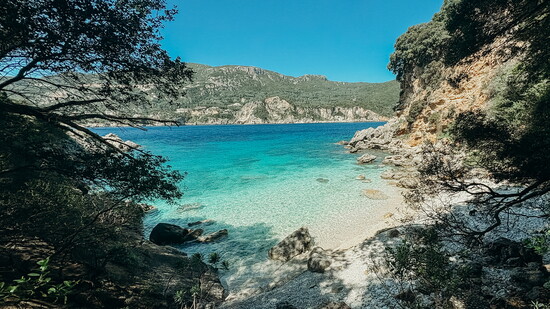
The swimming, though, is what I'll remember most. Corfu's coastline is cut with coves of impossibly clear, emerald-to-sapphire water tucked beneath limestone cliffs, the kind of color you assume has been enhanced in a photograph until you're standing in it. Paleokastritsa, on the west coast, is the postcard version. Turquoise water framed by cliffs and an old monastery watching from above, but the real find was a boat trip south to the Blue Caves near Paxos and Antipaxos. The caves themselves are otherworldly, sea-carved chambers where the water glows an almost electric blue, and the marine area is protected as a habitat for Mediterranean monk seals. We swam at Antipaxos afterward, at a cove called Voutoumi, sand so pale and water so clear it's been compared, fairly, to the Caribbean.
Threaded through all of this was a visit to a longtime Boulder friend, Edie Ure, who has settled into a house on the central coast she's named Villa Eumelia. Anyone who knows Edie's eye will recognize the house the moment they see it. It is unmistakably hers. Villa Eumelia sits in the middle of that same island fecundity, surrounded by kumquats and olives, succulents pushing through cracks in the garden wall, a long laundry line hung with white sheets, a hammock strung under the trees. Inside, it reads as pure Edie: relaxed but never careless, elegant without a hint of stiffness. Anyone who has spent time in her past homes, or knows her textile and surface design work from Calvin Klein to Ralph Lauren to her own botanical-dye practice, will recognize her particular alchemy of comfort and intrigue. A handwoven textile draped just so, a found object given pride of place, a color choice that feels more like instinct than decision.
Edie has begun opening the house to small groups and individual artists for informal residencies. A looser model than the standard retreat, closer to the way artists have always gathered: drawn together by a place and a host with a strong sensibility, then left to find their own way into the work. Sitting with her on the terrace at golden hour, cypress on one side and sea on the other, it was easy to see why she chose this particular corner of a very layered island to finally build a home entirely on her own terms.
Inquiries for residency can be sent to Instagram: @eumelia_corfu
Also stay tuned for a sailing adventure in the Ionian Sea next summer with www.peggymarkel.com