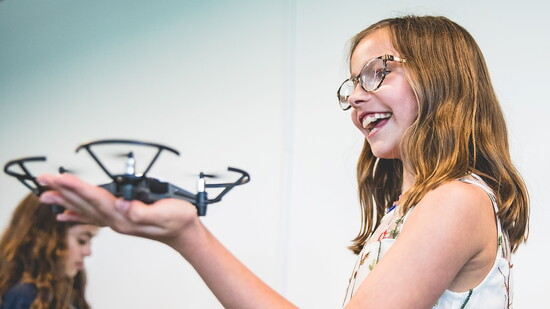
For families in The Woodlands, the back-to-school conversation centers on a familiar set of choices, each with a well-earned reputation. This fall, a new option enters the mix. Alpha School opens its K-8 campus in The Woodlands on August 12, occupying the former Glade Cultural Center property, built around a model that looks different from anything currently in the area.
The premise: students complete core academics in the morning using AI-powered learning platforms, then spend the afternoon in workshops focused on leadership, communication, entrepreneurship and real-world problem solving.
Over a Decade in the Making
Alpha School launched in Austin in 2014, founded by MacKenzie Price and Brian Holtz. What started as a single campus has grown to 12 locations nationwide, expanding to 50 this fall—in cities from Manhattan to Palm Beach to Santa Barbara.
The concept draws on decades-old research. In 1984, education researcher Benjamin Bloom found that one-on-one, individualized instruction produced dramatic results: students outperformed 98 percent of peers taught by conventional methods. The obstacle was always scale. Not enough tutors existed to make it work. Alpha's model positions AI as the solution, using adaptive platforms to deliver personalized instruction to every student.
Learning at the Right Pace
A student's morning at Alpha looks different from a conventional classroom in one significant way: the child moves at his or her own pace. Not the pace set for the class. Not the pace of the child sitting at the next desk.
The AI figures out what a student knows, where the gaps are and what should come next, adjusting constantly based on how the student performs. A student who hasn't mastered fractions doesn't get swept into pre-algebra. One who has already grasped a concept doesn't sit waiting for the group to catch up.
But students are not alone with a screen. They are on a real campus, in a real building, with peers and a full school community around them. Guides—the term Alpha uses for its educators—work alongside students throughout the day, coaching, motivating and building relationships that technology can't replicate. The ratios show it: 1-to-5 in the younger grades, 1-to-8 in middle school, 1-to-15 at the high school level, which Alpha The Woodlands plans to add next year.
The two-hour block of core academics strips out the friction: the waiting, the repetition, the one-pace-fits-all instruction. That freed time gets used differently. Alpha treats workshops, group projects, public speaking and collaborative challenges as equal in importance to academics, not as add-ons.
A Heart for The Woodlands
Rachel Goodlad, Alpha's head of expansion, grew up with a particular tie to The Woodlands. Her grandfather was part of the original team that developed the area and named its streets.
"This school will be part of the community," Goodlad says, "caring about community, giving back—that's key to student success and integral to building the school."
Students will connect with local nonprofits, with dedicated time during the school day focused on identifying specific local needs and combining efforts with organizations doing the work.
That ethos shows up in the classroom, too. When a group of boys at Alpha Austin developed a deep interest in World War II history, the school leaned in. Students partnered with a veterans organization, did substantive research and earned an expense-paid trip to Normandy. Goodlad points to that outcome when describing what effective use of academic time makes possible.
Seeing It to Believe It
Like many Alpha parents, Goodlad didn't take the model on faith. She experienced it. She took her son to a summer program at Alpha Austin, designed not as a typical camp but as a full week of school. They were immediately sold. For The Woodlands’ campus inaugural year, Goodlad and her husband enrolled both their son and daughter at the new campus.
The summer program revealed passions the family never knew existed in their son—art being chief among them.
"He found things he cared about," Goodlad says, "that his traditional school, although outstanding, never gave him room to find."
That summer program now comes to The Woodlands. Hosted at The Woodlands Resort, it gives local families a front-row seat to the model—a full week of the Alpha experience before making any commitment.
What's Ahead
The Woodlands campus launches at capacity. All 60 seats across K-8 have been claimed, with families driving in from Cypress, downtown Houston, and beyond.
Alpha The Woodlands targets 250 students for the following school year and 1,000 longer term. High school grades launch in 2027-2028, with this year’s eighth graders among the first to enter the high school program.
Tuition covers everything. No added fees, fundraising galas or auction nights. Even earned trips, like the Normandy example, fall within tuition.
Part of Something Larger
The Woodlands campus arrives as Alpha builds momentum nationally. This fall, the network expands into Puerto Rico, Chicago, Atlanta and North Carolina. That growth comes with selective hiring: 80,000 applications arrived for 200 guide positions nationwide. Beyond a bachelor's degree and three years with K-8 students, Alpha looks for one thing: "favorite teacher energy"—the adult who challenges a child and makes them feel supported at the same time.
The student experience resonates. In an internal survey of roughly 1,000 K-12 students across Alpha's 12 campuses, 94 percent said they love school. Sixty percent said they would rather spend a school day at Alpha than go on vacation.
The Longer View
Goodlad carries particular weight opening a school in the community her grandfather helped build—and a mission that extends beyond academics.
"We're not just building a school," she says. "We're becoming part of this community for the long term."
Learn more about Alpha The Woodlands at Alpha.School/the-woodlands.
A student's morning at Alpha looks different from a conventional classroom: the child moves at his or her own pace.
Beyond a bachelor's degree and three years with K-8 students, Alpha looks for one thing: "favorite teacher energy"—the adult who challenges a child and makes them feel supported at the same time.