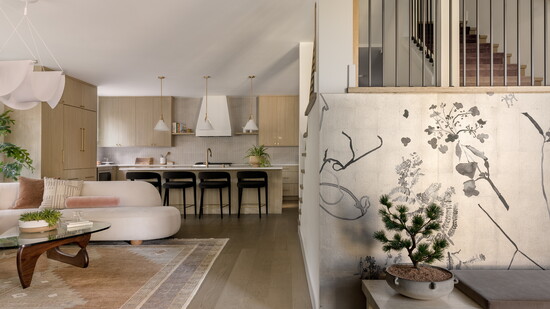
In today’s fast moving world, the home carries more than it once did. It is where work happens, where people gather, and where the day winds down, often within the same rooms. As a result, there has been a shift in how these spaces are considered, less as fixed functions and more as environments that support different moments throughout the day.
For Anu Kurup, founder of Persimmon Design, this way of thinking begins with observation.
“We usually begin by mapping the emotional rhythm of a typical day in the home. Mornings often require clarity and focus, afternoons involve productivity or creativity, and evenings shift toward relaxation and connection.”
Rather than treating a home as a collection of rooms, this perspective allows each space to take on a more intentional role. Workspaces are shaped around clarity, with access to daylight and organization that supports focus. Living areas are arranged to encourage conversation, while spaces intended for rest are quieter, with fewer visual interruptions and materials that feel calm and tactile.
This approach is especially relevant for homeowners balancing work, family life, and constant digital input.
“One of the most helpful things design can do is create a sense of transition between the outside world and the home. When people walk in the door after a long day, the environment should signal that the pace of life can slow down.”
That transition often begins at the entry. A place to sit, a surface for everyday items, and a shift in texture underfoot establish order. When surfaces are calm and objects have a place, the home feels more settled. Natural materials and subtle references to the surrounding landscape further reinforce this sense of grounding.
Much of what shapes a room is not always immediately visible.
“These elements shape the sensory experience of a room, often in ways people feel before they consciously notice them.”
Light plays a central role, influencing how a space is experienced. Diffused light softens a room, while directional light highlights texture and depth. Color establishes a baseline, with deeper tones creating intimacy and lighter palettes offering openness. Material choices add contrast and presence, from the warmth of wood to the refinement of glass or metal, while texture ensures a space feels layered rather than flat.
For homeowners looking to apply this thinking, the starting point is often simple.
“A helpful starting point is to identify the primary purpose of each room and remove elements that work against that purpose.”
Often, small adjustments are enough to shift how a space is used. Reorienting furniture can encourage connection, while simplifying what is visible can create a greater sense of ease.
Certain spaces naturally carry more weight in shaping how a home is experienced.
“Kitchens and dining areas are often the emotional center of a home because they host everyday rituals, morning coffee, shared meals, and informal conversations.”
Living areas support time spent together, while bedrooms provide a place to withdraw at the end of the day.
“When a bedroom feels calm, ordered, and comfortable, it supports better sleep and provides a place to retreat at the end of the day.”
Seen this way, design becomes less about a singular aesthetic and more about shaping environments that respond to daily life. The result is a home that feels considered, because each space supports the life unfolding within it.
We begin by mapping the emotional rhythm of a typical day.
The environment should signal that the pace of life can slow down.