“There is so much fascinating history in Hunterdon County,” says David Harding, executive director of the Hunterdon County Historical Society. “You can have a deeper appreciation if you know the stories, so we share them.”
Founded in 1885 and supported by more than 500 members, the Hunterdon County Historical Society is one of many nonprofit organizations dedicated to preserving local history and bringing it to life.
There is no shortage of stories to tell in Hunterdon County, which was established in 1714. “In 2026, we are celebrating the 250th anniversary of the American Revolution,” Harding shares. “People don’t realize that several major turning points actually happened in Hunterdon. For example, the site where Washington crossed the Delaware to attack the Hessians at Trenton was in Hunterdon County. That area did not become Mercer County until 1838.”
The society maintains three buildings that are free to the public and open periodically or by appointment: the 1940s Hiram E. Deats Memorial Library, named for the civic leader and historian who donated land and his personal collection; the adjacent 1845 Doric House Museum in Flemington; and the HCHS Archives in Raritan Township.
The society’s mission is to accept, preserve and catalog donations of documents, photographs and objects related to Hunterdon County. Its collection, portions of which are available online, includes Lenape artifacts, genealogies of Hunterdon families, records of local businesses, churches and civic groups, historical manuscripts, more than 5,000 printed volumes, photographs, maps and county newspapers dating back to 1825.
History also comes alive through innovative rotating exhibitions. Last year’s “Love Unveiled: 250 Years of Saying ‘I Do!’ in Hunterdon County” featured wedding dresses worn by local brides, a recreated groom’s room, wedding gifts, a trousseau display and an anniversary section. The exhibition opening included a string trio, wedding favors and a lecture. “A young woman came here to see her late grandmother’s wedding dress,” Harding says.
“Lindbergh’s Flemington 1935: Businesses, Bars and Boarding Houses,” on view this spring, examines life in Flemington during the Charles Lindbergh baby kidnapping trial at the Hunterdon County Courthouse. The exhibition explores how a relatively quiet town became the focus of worldwide attention, inundated with journalists, celebrities and curious onlookers. Visitors will see a recreated boarding house room similar to where reporters stayed, along with period artifacts including a typewriter, maps and photographs from the private collection of James Davidson, Hunterdon County’s Lindbergh historian.
Additional programming includes a history challenge contest for children and guided tours of Rosemont Cemetery. Updates are shared through the society’s Instagram and Facebook pages. In partnership with the Flemington Community Partnership, the society also offers a free, self-guided, 30-stop walking tour of historic Flemington, available on its website. The tour highlights architecturally significant buildings, public spaces, a horse fountain and a gravesite dating to 1750.
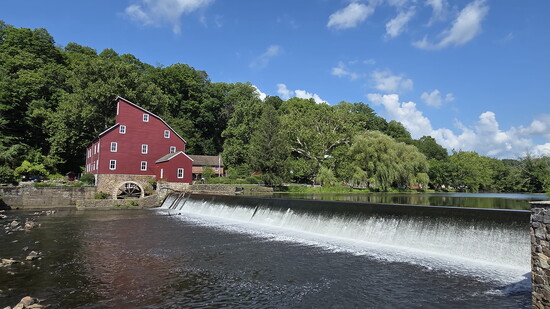
The Hunterdon County Historical Society is not alone in preserving the county’s past. In Clinton, the 10-acre Red Mill Museum Village is dedicated to bringing history to life. The grounds feature 12 historic buildings that commemorate an era when the mill and limestone quarry formed the heart of the town.
“I want visitors to get excited about history,” explains Gina Sampaio, executive director of the Red Mill Museum Village. “So much of this area’s history focuses on the Revolutionary War—where George Washington slept and the battles that took place—but history is more than wars and dates. It’s real people who had to innovate and survive, who experienced drama, laughter and love.”
The museum offers Hands-On History programs, allowing visitors to participate in activities such as candle-making, spinning and leatherworking. It recently partnered with archaeologist Thor Giese, host of Thor’s Outdoor Science Academy, on a 10-part video series exploring the quarry’s history through the Red Mill’s free digital guide.
Exhibits on the first, second and fourth floors of the mill, which is listed on the National Register of Historic Places, trace its ownership, evolution and role in Clinton over the centuries, including its contribution to the town’s electricity supply beginning in 1892.
The museum’s collection includes approximately 40,000 artifacts, ranging from hand-cranked fruit sorters and 2,000-pound millstones to a circa-1897 dog treadmill once used to power butter churns, fanning mills and corn shellers. The grounds are also home to what is believed to be Hunterdon County’s oldest school bus—a horse-drawn carriage used to transport Readington Township children to school in 1924.