Robert Heineman is not given to grand gestures for their own sake. As one of the “founding fathers” of The Woodlands and the man behind its physical design language, he spent nearly five decades shaping a place meant to feel inevitable rather than imposed. Streets that curve instead of cut, water that becomes a civic spine, neighborhoods that unfold gradually and generously. His own home reflects the same sensibility. It doesn’t announce itself loudly. It reveals itself over time.
Heineman’s background reads like a blueprint for the life he would go on to build. A Bachelor of Arts and a Bachelor of Architecture from Rice University, followed by a Master of Architecture in Urban Design from Harvard. A summer spent crossing Europe in 1964, camping night after night with his brother, sleeping above the Arctic Circle in Norway, then stepping through Checkpoint Charlie into East Berlin at the height of the Cold War. These were formative experiences, lessons in scale and the quiet resilience of well-considered places.
When George P. Mitchell began assembling the vision for The Woodlands, Heineman became its interpreter and steward. As Vice President of Planning and Design for over 40 years with The Woodlands Development Company, he helped guide the town from idea to lived-in reality. In 2010, that contribution was recognized with the George Mitchell Award for laying the groundwork for Town Center and The Woodlands Waterway. Civic honors followed—Volunteer of the Year, Citizen of the Year—but the real measure of his influence is less formal. It’s felt in the way the community works.
The Heineman Home
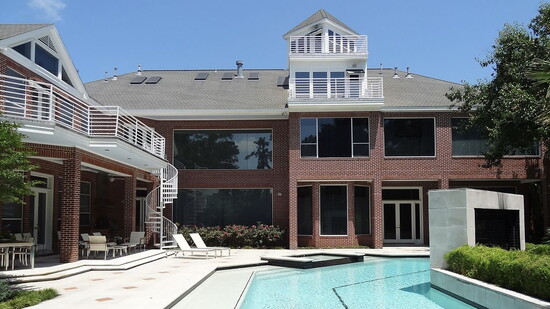
That same long view defines the Heineman residence. From the street, the house presents a composed, almost classical face. Common-size Boston red brick laid with white Portland cement grout gives the façade weight and permanence. Quadruple corbelled brick arches frame the front porch, while arched transoms soften the entry and windows. Horizontal courses of rough-cut brick add texture without ornament. There is a fourth-story tower, reminiscent of a widow’s watch, that hints at both vigilance and leisure. It’s a house that belongs comfortably among older traditions, even as it signals something more modern within.
The approach is ceremonial without being stiff. A gated circular drive marked by brick columns leads across pavestones set over reinforced concrete, a detail that speaks to longevity as much as aesthetics. Walkways repeat the brick-over-concrete language, and mature trees are illuminated at night with carefully placed LED lighting, turning the landscape into an extension of the architecture. Beyond the house, the land opens toward two holes of a local golf course, with long views over the pool, the fairways, and the preserved forest beyond. Nature is not borrowed scenery here, it’s a partner.
Crossing the threshold, the house shifts register. The two-story entry hall is both welcoming and quietly dramatic. Underfoot, a three-dimensional tumbling block pattern in marble and granite recalls Venetian mosaics from the 1500s, a subtle nod to history rendered in contemporary materials. Overhead hangs a 1920s Art Deco pendant light salvaged from a Los Angeles theater, its geometry crisp, its glow warm—the first signal that the home is layered with stories.
The interior unfolds as a modern open plan, filled with light and air. Twelve-foot ceilings on the first floor and 10-foot ceilings above create a sense of ease rather than scale for its own sake. Panoramic industrial windows, many with ½ inch butted-glass edges, dissolve the boundary between inside and out. Skylights and light wells pull daylight deep into the house, while indirect coffered ceiling lighting adds a calming warmth as the sun fades.
In the living room, maple floors ground the space, their warmth offset by granite tile surrounding the fireplace and its corbelled mantel. The room is visually connected to the dining area, reinforcing the idea that rooms should converse with one another. The dining room itself seats 12 comfortably, anchored by another antique pendant, a hand-painted pair of spectacles, this one from an 1890s New England optometrist store.
The library may be the most personal room in the house. Mahogany paneling and window shutters give it a club-like intimacy, while maple floors keep it from feeling heavy. Built into the bookshelves is an 1880s fireproof safe salvaged from a saloon in Fulshear. It weighs thousands of pounds and carries the quiet authority of an object that once guarded something valuable. There is also a hidden compartment tucked behind a secret door—less a gimmick than a private smile shared between house and owner.
A Collector’s Eye
Throughout the house, signs of Robert and Pamela Heineman’s collecting instinct appear. His passion for antiques began modestly with a rolltop desk. It continued with driving along Westheimer in Houston. It followed him in Boston during his Harvard years, when he would load an old window van and spend weekends combing flea markets and antique stores. Later came eBay, another tool in the hunt. Each piece was chosen not for trend, but for character, mechanical ingenuity, or honest craftsmanship.
That appreciation for mechanics finds expression in unexpected ways. Antique ceiling fans designed as airplanes—part artifact, part graphic punctuation. Antique safes appear more than once, functional sculpture embedded into daily life. The furniture throughout the home spans centuries. Some pieces are a couple hundred years old; others belong to the clean-lined optimism of the Art Deco period, including a significant presence of Heywood-Wakefield furniture. Restored by Heineman himself, each piece carries both its original intent and a renewed usefulness.
The family room rises two stories, anchored by maple floors and flooded with light from three skylights. A wall of cabinets and shelves displays objects accumulated over a lifetime, arranged with the familiarity of old friends. From here, the house opens toward the breakfast and dining area and the kitchen, all oriented toward the pool and golf course beyond. Modern European cabinetry, granite countertops, and commercial-grade appliances support a space designed for real use.
A Study in Stewardship
One of the most revealing areas is the garage and workshop, a four-car tandem space that functions as studio, laboratory, and refuge. Natural light pours in through skylights, including a dramatic 12-foot barrel-vaulted skylight. There is a professional paint booth with a sliding curtain, overhead steel I-beams with mechanical and electric lifts, extensive storage, and 10-foot-high garage doors capable of accommodating boats or trailers. This is where restoration happens.
Among the projects housed here is a 1932 split-cockpit mahogany Chris-Craft runabout, its lines as elegant today as when it first skimmed the water. Upgraded with a 285-horsepower motor, it balances historic beauty with modern performance. Nearby, a 1968 Airstream Safari trailer stands as another testament to mid-century design: polished, purposeful, and ready for the road. These are not trophies. They are working objects, kept alive through care and use.
At the very top of the house is the observation tower, a captivating sleeping loft. Operable windows on all four walls catch breezes from the southeast, drawing air through the space. Indirect lighting and a vaulted ceiling create a sense of retreat, while the exterior balcony offers sweeping views over the grounds and golf course. It’s a place to think, read, or simply watch the weather move across the landscape.
Pamela Heineman’s presence is felt as well, not as a counterpoint, but in harmony. The house supports shared life, travel stories, long conversations, and quiet evenings. Their journeys together across the United States and abroad to Canada, Mexico, Europe, and Australia inform the home’s global sensibility. This is not a themed house, but a lived-in one.
Heineman describes his style as “eclectic,” though the word hardly captures the discipline beneath it. Clean lines, modern design, mechanical honesty. A preference for things that work well and age with dignity. He restored every furnishing in the house himself, not as an exercise in nostalgia, but as an act of stewardship. Because objects, like communities, need care.