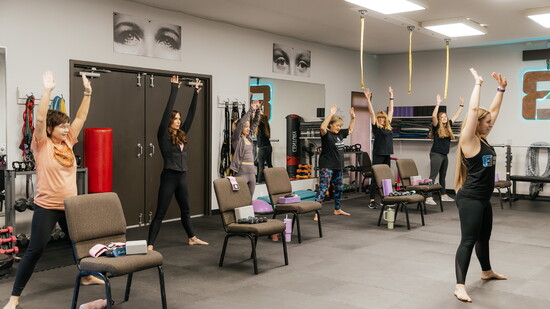
When asked how to stay healthy as you age, personal trainer Mollie Estes is blunt: “Let’s stop blaming age for what inactivity caused,” she says. “Stillness ages you, motion heals you.”
It’s a simple but radical mindset shift. Yes – aging is inevitable, but certain factors become ever more important as the decades pass: Flexibility. Balance. Muscle and bone building. Hydration.
“We think that losing your balance happens because you’re old,” says Estes, the owner of boutique gym F8 Training & Wellness Studio in Springfield. “The truth is you lose your balance because you stopped moving and challenging your body to balance.”
Her philosophy comes alive through her clients. Take Ellen Magers, 75, who was always physically active—she is a former aerobics instructor—but found her knee was slowing her down. After three arthroscopic surgeries on her knee over the past several decades, Magers decided to strengthen her bones and muscles to stave off knee replacement surgery.
“When you’re younger, you don’t pay as much attention to doing things correctly and don’t take care of your body like you should,” she says.
Magers joined the Gentle Stretch class at F8 two years ago and quickly saw improvements in her movement and balance. She added the Barre class, with Estes advising her on modifications to protect her knee, and Women & Weights for strength training. “I faithfully do two classes of each a week,” she says, adding that every morning and throughout the day she does the stretches and exercises she learned.
“The damage has been done, but I feel my muscles that allow me to squat and stand up are definitely stronger,” she says. “I wear a compression knee sleeve to stabilize my knee, but I’m still able to go on walks and play with my grandkids on the floor.”
Estes recommends simple, daily routines that can help you stay fit as you age. Strength-building activities—with weights or resistance bands—can help work both your fast twitch muscle fiber (used when you brush your teeth) and slow twitch muscle fiber (when you stand for long periods) and build bone, she says.
“Motion is the lotion. By moving your body even with gentle calisthenics, you wake the joints up and activate your core, boosting balance. Planks are a power core exercise to work your deep abdominal muscles. If you are on the floor, rest on your forearms and on your knees or toes,” Estes says. “I also like ‘dying bugs’ over ab crunches: Lie on your back with your head on the ground. Raise your arms and legs in the air like a dead bug. Extend your opposite arm and leg out as you inhale and exhale, then bring them back to the start.”
Research suggests that moving for three minutes every half hour can offset the harmful effects of continuous sitting. “Get up for three minutes and take a brisk walk, do a few squats, light jumping jacks or march in place,” she says. “It does not matter what you do. Just get your heart rate up. In a normal eight hour day, you’ll get about an hour of exercise.”
She also emphasizes the importance of breathing and hydration. “You want to breathe diaphragmatically, taking big, deep breaths to oxygenate your body,” she says. “Also, drink 16 ounces of water when you wake up.”
As for balance – it is all about muscle memory. Estes recommends standing on one leg for at least 10 seconds and then incrementally increase the time. Want a challenge? Try closing your eyes.
“You need to have 360 awareness of your body. Walk backwards down a hallway or walk sidestep,” Estes says. “That way, if you get off balance, your foot will know to step to the side or step backwards.”
Learn more at F8Training.com.
Let’s stop blaming age for what inactivity caused. Stillness ages you, motion heals you.