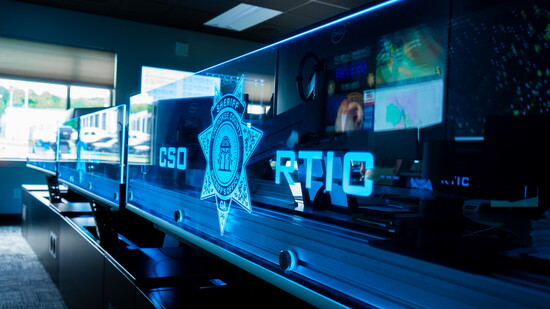
There's a room on Chattin Drive in Canton that most Cherokee County residents will never see. From the outside, it looks like any other county building. But step through those doors, and you'll find something that feels less like North Georgia and a lot more like a scene straight out of CSI Miami. Screens line the walls from floor to ceiling. Maps pulse with live data. Analysts sit focused at their workstations, eyes moving between multiple feeds at once. And somewhere outside, a drone waits on a docking station, ready to fly at a moment's notice.
This is the Shaw-Woodard Real-Time Intelligence Center, and since opening its doors in January 2026, it has already changed the way Cherokee County keeps its people safe.
Commander Lindsay Harris has been building toward this moment for eight years. She came to the Sheriff's Office from a narcotics background, where the work demanded creative thinking, deep dives into data, and the ability to connect the dots quickly. She brought every bit of that with her. "We had a crime analyst doing traditional intelligence gathering," she says, settling into a chair in the center she helped build from scratch. "Looking at stats, crime trends, trying to figure out what might happen next. That was the old way. The world changed and we had to change with it."
The shift happened gradually. A license plate reader here, a camera partnership with a local business there, a growing relationship with the school district and the hospital. But the real turning point came during a murder investigation at a local business. Harris was pulled in to help the Criminal Investigations Division, and for the first time, intelligence and investigative work fully merged. Tower dumps. Phone records. Surveillance footage. It worked. "Once the detectives got a little bit of it," she says with a smile, "they wanted it on every case. Every theft. Every missing person. Because once you've seen what it can do, why wouldn't you use every tool available to protect this community?"
That question drove everything that came next.
The numbers alone are striking. In its first operational year, the RTIC assisted in 521 public safety incidents. License plate readers logged 569 successes, including locating missing persons, identifying hit-and-run drivers, and tracking down wanted criminals across county and state lines. Drones flew 228 hours in the air and completed 81 missions. These are not abstract statistics. Each one is a real person, a real moment, a real outcome for a family somewhere in this county.
But ask Harris what she is most proud of and she doesn't reach for a spreadsheet. She reaches for a story.
Not long ago, a dangerous inmate escaped, roughly 90 miles south of Canton. Word came in that he had ties to Cherokee County and had climbed into a pink taxi. It was a Sunday, and the center was not yet officially operational. Harris and her team got on it anyway. "We started searching, and within moments we could see that the taxi was traveling all the way from Troup County up to Cherokee County," she recalls. When the vehicle moved into an area without license plate readers, they switched to intersection cameras and tracked him straight into a local trailer park. Deputies went to the door. He was captured.
No one got hurt. A dangerous man was back in custody. And it happened because a small team cared enough to show up on a Sunday.
The center's technology works in ways most people would never expect. Every incoming 911 call feeds directly into the system, which immediately flags how many camera assets are within a half-mile of the incident. Analysts can read the call notes in real time, pull up nearby cameras, and begin building a picture of what is happening before the first deputy even arrives on scene. A reckless driver on the highway. A suspicious figure near a school. A dump truck with its bed raised, reportedly knocking down power lines. The RTIC pulls up the cameras, takes a look, and gives officers real information, or clears the call entirely. "We use technology to find things," Harris says, "but we also use it to debunk things. Sometimes we can look and tell dispatch that the truck bed is already back down. Everything looks fine."
And then there are the drones. Pilots work from dedicated stations inside the RTIC, flying aircraft remotely from docking stations positioned across the county. The coverage is remarkable. From a single launch point, a drone can reach Cherokee High School in minutes, four miles away, zoomed in close enough to track a vehicle or identify what someone is wearing and which direction they are heading. That kind of overwatch changes everything on the ground. When a deputy approaches a house from the front, an analyst at the RTIC may already be watching someone climb out a back window. It is, as Harris puts it, a completely different view of the same moment.
One of the most common questions Harris gets is about privacy. She doesn't dodge it. She leans right into it. "The number one thing we want to do here is never overstep our bounds," she says plainly. "We are very protective about what we do and when we do it."
The school camera program is a perfect example. Cherokee County schools are fully integrated into the RTIC mapping system, complete with floor plan overlays. But those interior cameras are locked and not locked in the way that requires a few extra clicks. Locked, as in Harris herself cannot access them without a 911 call or a formal Code Red declaration. "It will be restricted for me until one of those events is triggered," she explains. When a teacher activates a Code Red in her classroom, only then do those hallway cameras appear on the analysts' screens, and nothing beyond that. "We don't take medical calls, we don't do anything outside of that critical Code Red," Harris adds. In a genuine emergency, responders have eyes inside the building before anyone sets foot through the door. In a swatting call, something the center encounters regularly, they can scan those hallways, see calm and ordinary life happening, and relay that to officers heading in. That information alone can change how a response unfolds.
The facial recognition question comes up too. Harris is clear. There is no proactive face scanning happening inside this center. None. "If you commit a crime and you show up on a Walmart surveillance image, we can use that image reactively to identify you," she says. "But we do not scan faces proactively. We are not watching you walk down the street."
Chief Deputy Thomas Pinyan is equally direct on license plates. "A lot of people think we just sit here scanning plates all day. We do not have time for that. These are investigative tools. When something has happened, we go back and look."
Since the Intelligence Division deployed its first license plate reader, it has located missing persons, tracked suspects from neighboring states, and assisted in hundreds of active investigations across 434 square miles of the county. The center now operates Monday through Friday with three full-time analysts and one civilian drone pilot. The goal is 24/7 coverage within five years, a timeline that feels well within reach for an agency serving nearly 300,000 residents and growing. The people running this center are not slowing down.
"Don't come to Cherokee County and commit a crime," Harris says without blinking. "Because we will find you." She means every word. And the numbers back her up.