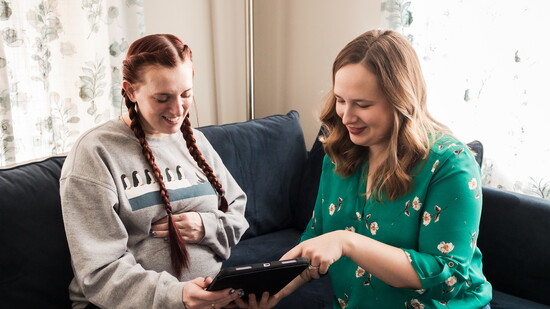
Certified doulas Emily Kaiser and Veda Weinert don’t want your business forever; in fact, they’d be more than happy to be phased out of the marketplace. They hope that one day the information they teach in birth education classes will be so widely available—taught in schools, discussed openly, and supported by communities—that every woman will have access to everything she needs to feel supported throughout pregnancy and motherhood.
But, in the meantime, they are here to help. Their company, Women to Women Informed Health, grew from personal experience.
“I have four children,” Veda said. “After the birth of my third child, I had finally figured out that I had postpartum depression, and that I had had it with my first two as well, but I just didn’t know.”
The realization was especially surprising given her background. Veda grew up surrounded by birth education. Her mother taught childbirth classes, and home births were common in her family.
Even with those experiences and resources, the signs had gone unnoticed. As she began speaking with other mothers, a pattern emerged. “I kept hearing, ‘If I had known, I would have done it differently,’” she said. “So many women had their first baby and just had no clue what was in store.”
In the meantime, her sister-in-law Emily was experiencing similar feelings. “My dad is a doctor, and he works at a very, very good hospital,” Emily said. “So I am super comfortable in hospitals.” But after her first child was delivered, she was surprised to realize how much she hadn’t known ahead of time.
Several of her friends were pregnant. “I just wanted to go up and shake them and say, ‘Here’s all the things you need to know. Here’s how it’s going to be. Mine wasn’t good. It wasn’t bad, but it wasn’t great. And yours could be great if you just have what you need to know.”
Then came Veda’s idea.
Emily said, “I went to Veda’s place one day. She said, ‘Emily, I think I need to start a nonprofit that teaches birth education.’” Emily remembers thinking, “This is what I’ve been sitting here for months trying to figure out.”
She told Veda, “I know exactly how I would like to contribute to this.”
“We had a ‘zing,’ is what we call it,” Veda said, and they just knew: “We’re supposed to do this together.”
Together, they created a research-based childbirth class designed around a simple principle: education without an agenda.
Their course, called “Find Your Fit,” encourages women to explore the full spectrum of birth options. “A lot of the other birth classes we've heard of can have an agenda one way or the other—a ‘You need to follow my path because my path is what’s best.’ We just believe in whatever is best for you. If you want a hospital birth with an epidural, if you want a scheduled C-section, if you want a home birth—whatever you want, that’s fine,” Veda said. “Our hope is that you move from a passive participant to someone who actively chooses their experience.”
Sometimes that empowerment begins with something as simple as recognizing personal choice.
For instance, many women don’t realize they can switch healthcare providers if they don’t feel comfortable with their current one.
That sense of participation can make a meaningful difference in birth outcomes. Research shows that when women feel involved in decision-making during birth, they tend to report more positive experiences overall, even when events don’t unfold exactly as planned.
Another lesson the class emphasizes is the importance of the birth environment itself. Feeling supported by the people in the room—whether they are nurses, doctors, midwives, or partners—affects comfort, and by extension, outcomes.
“The more relaxed you are, the better your outcome will be,” Veda explained.
In addition to the six-week Find Your Fit course, Women to Women offers a range of related programs, including a one-night postpartum planning class that helps couples prepare for the weeks after birth, discussing emotional needs, recovery, and practical support. It’s not limited to just couples, either. You can bring a friend, your mom, or anyone who is going to support you.
Recently, the nonprofit adopted a pay-what-you-can model in an effort to make birth education accessible to more families. They are also developing a class specifically for partners.
“We’re going to be releasing a class just for men,” Emily said. “Women talk differently when they’re with just women, so we wanted to facilitate something from a man’s perspective. Women who have a supportive and educated partner have way better outcomes for birth experience and postpartum anxiety and depression.”
Beyond formal classes, the Women to Women doulas also host regular community gatherings—informal girls nights out designed to help women connect, share experiences, and build supportive friendships.
Research backs up the importance of those connections. Strong social networks are one of the most reliable predictors of women’s health and well-being.
“You have to be intentional about creating the village,” Emily said. “The village is really great in theory, but it doesn’t just exist.”
At its heart, Women to Women is meant to feel less like a lecture and more like a conversation among friends.
“We very much want to feel like we are all sisters together,” Veda said. “We called it Women to Women because it’s to women, by women, for women.”
"They say it takes a village, but navigating your reproductive years can sometimes feel more like being stranded on a desert island. You don’t know what to expect. You don’t feel like yourself. And you don’t always know who to turn to for support. We’re on a mission to change that.
Through comprehensive health education and in-person gatherings, Women to Women Informed Health empowers women to confidently navigate their reproductive years, finding clarity and building community every step of the way.
Women to Women Informed Health is the community-centered educational resource for women and their partners to access the tools and knowledge they need to take up space and advocate for their needs with menstruation, pregnancy, childbirth, and postpartum."