In the Parkland, we often don’t think about hospitals until we need them. But when a situation turns urgent and every minute begins to matter, the importance of having local access to care becomes clear.
In many rural communities, those moments now come with a different reality. Since 2010, more than 140 rural hospitals across the country have closed, and hundreds more remain at risk. When they do, the loss reaches far beyond healthcare. Jobs disappear. Local economies shift. And the quiet sense of security a community depends on begins to erode.
Here in the Parkland, care is still within reach.
In communities like ours, access to healthcare does not happen by accident. It is built over time, strengthened through investment, and sustained by people who understand what is at stake.
Healthcare here has grown alongside the community it serves. What began in 1911 with Bonne Terre Hospital and continued with the opening of Farmington Community Hospital in 1969 has evolved over decades of care and commitment. Together, these foundations shaped what is now Parkland Health Center, including a full-service acute care hospital in Farmington and Missouri’s first designated Rural Emergency Hospital in Bonne Terre. Both hospitals are a part of BJC Health, one of the largest non-profit health care organizations in the United States, and the largest in the state of Missouri.
Each step forward reflects a shared commitment to keeping care close to home.
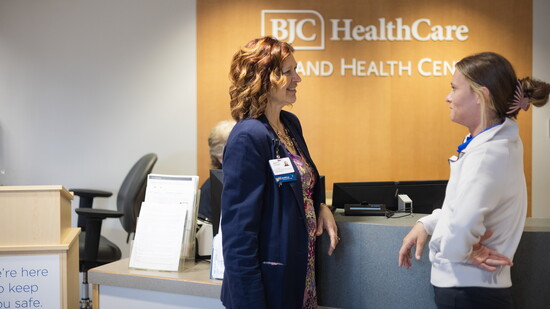
That commitment continues today through President Annette Schnabel.
She leads Parkland Health Center, but leadership, to her, is not about title or recognition. It is about responsibility. Making sure the people around her have what they need to do their jobs well, especially when it matters most.
That perspective did not begin in a hospital, it began on a farm.
Annette grew up in Southern Illinois, one of fourteen children, in a community that looks a lot like ours. Life revolved around responsibility. Work came first, not by demand, but by necessity. Everyone had a role. Everyone contributed. You learn quickly in that kind of environment that things only work if people show up for one another.
Annette carries those same principles with her into healthcare.
Her career began in physical therapy, moving between schools, hospitals, and clinics, learning the system from the inside out. After ten years in patient care, she stepped into leadership, not to step away from patients, but to reach more of them.
“In leadership, you can impact more than one person at a time,” she says. “You can impact an entire community.”
That belief was tested almost immediately.
She arrived in Farmington in 2020, in the middle of COVID, when hospitals were overwhelmed, families were separated, and staff were carrying far more than anyone had prepared for. The pandemic reshaped healthcare changing the way hospitals operate, how care is delivered, and how teams show up for one another.
Some services paused while others expanded, and new programs were built in real time to meet rapidly changing demands. There was no clear roadmap, only decisions made quickly and often without certainty.
Yet in the midst of the chaos and uncertainty, it brought clarity to what mattered most: presence, care, and compassion.
Today, the impact Annette and Parkland Health Center continue to make is evident.
Outpatient services have grown significantly over time, reflecting the increasing needs of our community. Hospital outpatient visits have risen from approximately 83,000 to over 144,000 each year, while clinic visits have grown from 96,000 to over 151,000 annually. Patients who once had to leave the area for care can now stay closer to home.Thanks to Parkland Health Center we have local access to cardiac procedures, specialty care providers, expanded therapy services, and even robotic-assisted surgery, something that once felt out of reach for a community this size.
But proximity in healthcare is not just about convenience, it is also about timing.
Last year, 150 patients came through Parkland Health Center with stroke symptoms. In 84 of those cases, they were able to receive clot-busting medication, a treatment that must be administered quickly to be effective – that kind of time cannot be recovered on the road.
Hospitals carry more weight than we often realize, especially in places like this.
And so do the people leading them.
Outside of her role, Annette remains involved across the community through organizations like Saint Francois County Rotary Club, local Chambers of Commerce, and Impact100. Different spaces, same purpose: Contribute where you can, and be part of something bigger than yourself.
This is how she was raised, and now how she leads.
When asked what she hopes to leave behind, Annette’s answer is simple. “Expanded services, strong outcomes, and care that makes a difference.”
And here, that difference is already being felt; In the lives that are cared for sooner, the families who don’t have to travel farther for care, and in the moments when time matters most. Because in communities like ours, access to healthcare is not just important. It’s essential.