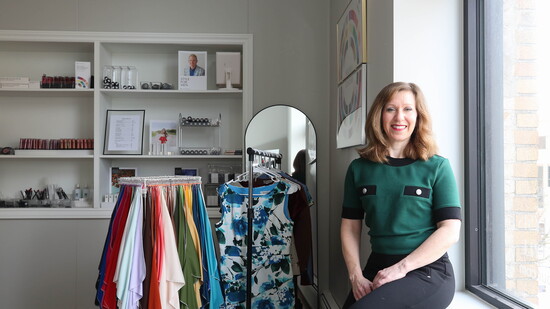
For a long time, Dee Pineau didn't want to be noticed.
An engineer in corporate America, Dee found herself looking at herself on Zoom during COVID, and thinking, I don't look great.
"I was wearing a lot of black," she says. "I wanted to fade into the background. I was just kind of unhappy with where I was. ‘Don't look at me’."
It's a feeling she hears from clients every week now.
Dee bought House of Colour in Royal Oak by serendipity. She'd finally booked a color analysis, the kind she'd been hearing about for years. The woman who did her colors happened to be selling her franchise.
Dee had already been asking herself the big questions, about her career and her life. And suddenly the answer was right in front of her, wearing the right shade of raspberry.
"It was artsy, it was fun, it was helping people feel good about themselves," she says. "In a time when a lot of people weren't feeling good about themselves."
Dee’s Royal Oak roots go back 30 years. Her studio is right across from the Royal Oak Music Theatre (and she remembers when it was a dance club on Friday nights).
The roots of color analysis trace back even further. In 1928, Swiss-born Bauhaus artist and educator Johannes Itten was teaching color harmony when he noticed his students were choosing colors that showed themselves "as they are.” That led him to formulate the seasonal framework: spring, summer, autumn, winter.
Image consultants have been around since 1940s Hollywood, when color film was exploding. Studios suddenly had to understand why actors looked luminous in some costumes and washed-out in others.
Clients arrive at House of Colour without makeup, hair pulled back. Dee drapes them in a series of precision-dyed fabrics. Warm versus cool. Depth versus brightness. The skin either comes alive or recedes. The mirror doesn't lie.
The consult has to happen in person, with no phone screen shifting the undertones. "When we held the drapes up on video during training," Dee says, "the colors looked different on every screen."
She's quick to tell clients when they look anxious. "We're not talking about weight. We’re talking about the actual shape of your face, the width of your shoulders—what actually exists. And how to honor it."
She calls her approach a tool, not a rule. The goal is to hand someone factual information about themselves so that getting dressed in the morning doesn't feel like a pop quiz they keep failing.
Most women, she observes, have never really been taught. They've absorbed messages— black is slimming, match everything, stay neutral—and those messages calcify into a wardrobe full of clothes they never wear.
"We just gravitate toward black or gray," she says. "And sometimes that's because something isn't right and we don't want to be seen."
She pauses when she says things like that. She knows the territory.
When clients finally see themselves draped in their actual colors, the reaction is almost always the same. Not what I expected. But I see what you're doing. And then, often: I have a dress in that color.
"Of course you do," Dee tells them. "Deep down, you knew."
Her new clients tend to be at turning points. A woman who'd lost fifty pounds and wanted to "get it right" before buying anything new. A client going through cancer treatment who didn't feel great — and then put on red lipstick and smiled so wide her teeth looked white. "She loved it," Dee says. "Just that big, huge smile."
When someone comes back a year later, bringing their mother or daughter or girlfriend, Dee reads it as the truest kind of testimonial.
"They feel lighter," she says. "More uplifted. They want somebody else to have that experience."
The style work goes deeper than color. Dee also conducts style analyses—drawing, of all things, on the personality archetypes of famed psychiatrist Carl Jung. The premise: who you are should show up in what you wear.
The woman who runs a yoga studio and drops kids at school should not be handed a blazer and four-inch heels. A person who loves bold prints should not be sentenced to neutrals because someone once told her she was "too much."
"It's like personality with clothing," she explains. "You can let it shine through."
Asked what it means for a woman to be truly seen, the woman who once wanted the opposite gives me a philosophical answer.
"It's like a personality test," she says. "Some people are great at inventing things. Some people are great at solving problems. To be truly seen is like, Where do your real talents lie? And the way you show up in the world, with your clothes and your hair, should reflect that."
Before a client leaves, Dee gives them a swatch fan: a small, foldable palette of their seasonal colors. You walk into Nordstrom, you open the fan, you stop standing in the dressing room hating yourself.
"I want them to feel confident going to a store," she says, "and picking out clothes they'll actually wear."
Style, she'll tell you, should feel like you. Not the version of you that's fifteen pounds lighter, or ten years younger.
The actual you. Right now.
House of Colour Royal Oak is in downtown Royal Oak. For color analysis, style analysis, and wardrobe edit appointments, call (248) 571-4294 or email dee.pineau@houseofcolour.co
"I was wearing a lot of black. I wanted to fade into the background. I was just kind of unhappy with where I was. ‘Don't look at me’."