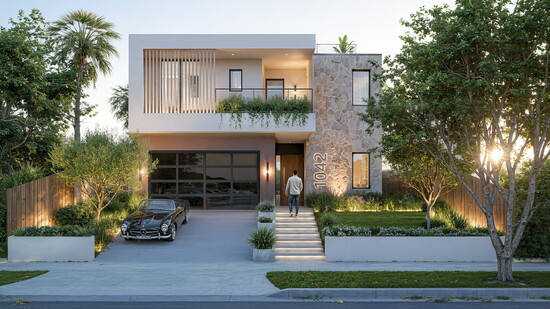
For decades, the Pacific Palisades was the kind of place people rarely left—neighbors waved from their driveways, kids drifted between houses and daily life unfolded with a village-like ease that felt almost improbable for Los Angeles. For Bill Bodine and Beth Andersen, that rhythm stretched across forty years in the Alphabet Streets, where they raised their child, grew their careers, expanded their modest home over time and eventually built the house they believed they would live in forever. “We loved the neighborhood—it was such a fantastic place to raise a kid and so friendly,” says Beth, a musician who taught voice and piano lessons to children in the community for years (Bill is a producer and composer). “We were well-positioned to quietly live out our remaining years there—until everything went away.”
Just up the same street, Katharine Newman and Stephen Kremser were living a parallel version of that life. For fifteen years, they raised their four children in a pocket of the Palisades defined by proximity and connection. “It was this crazy feeling that you could live in the second-largest city in the country and still feel like you lived in a village,” Stephen says. Katharine describes a daily rhythm built around schools, sports, the library and the Palisades Recreation Center, all within walking distance. When the fire began in the hills on January 7th, neither family believed their homes would be lost. Fires had happened nearby before. This one felt distant—until it wasn’t.
What followed was disorientation layered onto loss. “Once your house burns down, you have a new full-time job,” Beth says. "People tell you to get a desk, and it's true." Policies shifted constantly. Decisions felt urgent and permanent at once. “At that point, we just assumed there was nothing left,” Katharine says. Stephen puts it bluntly: “It’s a zero-or-one situation.”
Both families knew almost immediately that they wanted to rebuild and return to the community that shaped their lives. What they didn’t know was how to navigate a process that felt unprecedented emotionally, logistically and financially. “We didn’t sign up for this process,” Katharine says. “We needed people who would guide us through it.”
That search led them to Westside Design and Build, a firm co-founded by best friends Rob Kilian and Chris Kabatsi, whose origin story is inseparable from the community it now serves. The pair met while studying architecture and engineering at Rensselaer Polytechnic Institute in upstate New York, and later co-founded Arktura, a design and fabrication company that evolved into a global architectural products manufacturer. “That company was sold in 2020,” Rob says, “and at that point it had about 200 people and international offices.”
After starting families—Chris in the Palisades with his wife, a local real estate agent, and children and Rob in Santa Monica with his partner and twin boys—their focus shifted to high-end residential building on the westside. When the fires hit, the work became personal overnight. Chris lost his own home, and the pair immediately sprang into action. “We were out in the Palisades on January 8th in our water trucks trying to protect clients’ homes, as well as countless others,” Rob says. “We needed to turn this bad energy into something positive and figure out how we could actually help.” Within days, they formed Westside Design and Build, partnering with longtime local builders DM Premier Group to respond thoughtfully to the scale and urgency of the rebuild.
Today, that urgency is supported by infrastructure. Westside Build operates out of a 6,000-square-foot design studio in Santa Monica and a 20,000-square-foot warehouse and fabrication facility in Gardena, along with multiple logistics and staging sites throughout the Palisades that allow the team to manage construction flow independently of shifting city constraints. Additional offices in Calabasas and Córdoba, Argentina support design and planning, creating a vertically integrated operation rarely seen in residential construction.
For Bill and Beth, the difference was immediate. In the days following the fire, Beth watched a late-night webinar hosted by Westside Build. “They really believe in the Palisades,” she says. “I remember thinking, ‘These guys sound pretty good—pretty together.’” From the first meeting, the tone felt different. “There was no ‘adapt to our concept,’” Bill says. “It was strictly, ‘What do you want?’” When he challenged early renderings, the response wasn’t defensive. “They heard what worked and what didn’t and they responded to it,” he says. Beth agrees: “Every time we challenged them, they just made it better.”
Katharine and Stephen felt that same sense of being heard. After speaking with more than a dozen architects and builders, they were drawn to Westside Build’s local presence and integrated approach. “This is a massive decision,” Stephen says. “You’re spending millions of dollars. You have to trust the team.” Katharine describes the process as collaborative and grounding. “If something doesn’t work, they come back with thoughtful options and know when to push back in a way that makes sense.”
At the core of Westside Build’s model is a mission to fix what Rob describes as a long-broken residential system. “The gap between the designer, the architect, the consultants and the builder—that’s what’s broken,” he says. Using advanced technology more common in commercial construction, the team creates fully coordinated digital models of each home to eliminate guesswork and control quality. “It reduces fixes, saves time and saves money,” Rob says, “and guarantees a solid house that lasts.”
For homeowners navigating trauma and uncertainty, that clarity matters. “I don’t have to worry about what the builder’s saying to the architect,” Beth says. “They’ve got it all covered.” Rob adds, “We’ve shed a lot of tears at the table hearing people’s stories. It was important to us to help people whose hearts are really in this place make it back.”
For both families, rebuilding isn’t about recreating what was lost—it’s about returning to a place that still feels like home. “Our kids love living here,” Katharine says. “Our youngest—this is all she knows.” Beth echoes the sentiment simply: “We really wanted to come back. This is home.” They know the Palisades that returns won’t be identical. “People worry it’ll be soulless,” Bill says. “Well, it’ll be new. You have to put soul on it. And we will.” Beth adds, “We’ve all lived through this—that’s where the soul comes from.”
Rob sees that future clearly. “What’s coming back is a stronger, more accurate version of the Palisades,” he says. “Homes that reflect the people who live in them.” Westside Build’s role, he explains, is not to impose a formula. “We’re not doing any two houses the same. Everything is designed from scratch for each family.”
“I feel really comfortable telling people, ‘You can trust these guys,’” Beth says. “They’ll take care of you.” Bill puts it more simply: “They’re good people.” In a moment defined by loss, that trust—and the shared commitment to rebuilding thoughtfully—has become the most meaningful thing being built of all.
Westside Design and Build
1548 16th St., Santa Monica
310-708-4556
westsidebuild.com
“We loved the neighborhood and were well-positioned to quietly live out our remaining years there—until everything went away.”
“What’s coming back is a stronger, more accurate version of the Palisades. Homes that reflect the people who live in them.”