Connectivity. It’s a word we use often, and yet, somewhere along the way its meaning has shifted. We think of it in terms of Wi-Fi signals and constant reachability, as if being accessible at all times means we are truly connected.
But we know better.
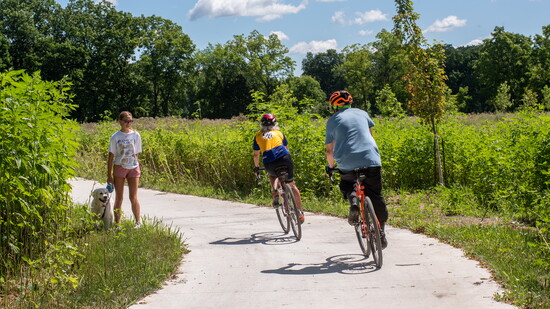
Real connection doesn’t come from a screen. It comes from time away from it. From stepping outside. From a walk along the river, an impromptu run with a friend, exploring a new place on a bike or pushing a stroller, and simply moving through nature.
Creating more opportunities for that kind of connection — to nature, to each other, and to our communities — is at the heart of the Border-to-Border (B2B) Trail and the public-private partnerships helping bring it to life.
The B2B Trail is a 55-mile, non-motorized paved pathway connecting Stockbridge, Chelsea, Dexter, Ann Arbor, and Ypsilanti. Nearly 43 miles are complete, with just 6 miles remaining along the main east-to-west corridor, bringing the vision of a continuous route across Washtenaw County within reach. Linking parks, trails, and downtowns, it allows people to move seamlessly between communities. Built for people of all ages and abilities, the trail is designed to be used in whatever way fits your day, whether that’s a short walk, a long ride, or something in between.
Bringing a project of this scale to life is no small undertaking. What feels simple and intuitive on the trail is the result of years of coordination, planning, and persistence behind the scenes. The effort is led through a partnership between the Washtenaw County Parks and Recreation Commission (WCPARC), which oversees planning, construction, and maintenance of the trail, and the Huron Waterloo Pathways Initiative (HWPI), a nonprofit focused on accelerating progress through private funding, community engagement, and ongoing coordination.
We spoke with Kiff Hamp, executive director of HWPI, about the ambitious work underway to turn a long-standing vision into something people can experience across the county. His eyes light up when he talks about what’s already been built.
“There are so many ways to experience it,” he says. “It depends on your interests, your time, whether you’re out with your family, training for a marathon, or going for a ride. It’s hard to paint just one picture, because you really want to be able to paint a thousand different ones.”
While there are many places across the county to experience the trail, for those looking to start close to home in Ann Arbor, Hamp recommends the “Ann Arbor Corridor,” beginning at Gallup Park (3000 Fuller Road) or, for a quieter and equally beautiful option, Parker Mill (4650 Geddes Road).
At Gallup Park, you’ll find playgrounds, river access for non-motorized boats, and wide, scenic paths that make it easy to settle into the experience. Continue along the trail, and you’ll reach Parker Mill, a lesser-known stretch where deer move through the trees and wooded paths open into a peaceful marsh, offering a completely different, more secluded feel.
That’s what’s already built. What remains is the hardest part.
The final stretch of the east-to-west connection, roughly three and a half miles along the Huron River between Dexter and Ann Arbor, is where the project becomes most complex. “That’s the real crux of what we’re trying to do now,” Hamp explains, noting that this section is “by far the most expensive, by far the most complicated.” Running alongside the river and the Amtrak line, with limited space and significant environmental considerations, completing it will require not just engineering solutions, but sustained funding, coordination, and community support.
There is a clear desire to connect these two cities in a way that reflects how people want to experience them. Today, many run or bike along Huron River Drive. It’s easy to understand why. The route is beautiful. But it’s also unsafe — for runners, cyclists, and drivers alike. A dedicated pathway through this corridor, separate from the road itself, would change that, creating a safer, more accessible connection between two deeply linked communities.
“We’re building things where they don’t exist,” Hamp says. “A trail over a river, through the woods, by a downtown. It’s a super hard thing to conceptualize, to engineer, to permit, and to fundraise for, even to fully articulate what it is.”
Completing this trail will not be easy, but it will be worth it. Because, in the end, the importance of this work extends far beyond the miles themselves. It’s about what this becomes for the next generation. A place to step outside, to explore, and to connect — with people, with communities beyond their own, and with nature. Away from screens. Closer to each other.
To get involved visit hwpi.org, and to explore the trail visit b2btrail.org.
“It’s hard to paint just one picture, because you really want to be able to paint a thousand different ones.”