It starts with a whisper. A subtle shift — persistent bloating, unexpected fatigue, a sudden change in routine that’s easily dismissed. But when that whisper becomes a diagnosis of ovarian cancer, the resulting silence can be deafening.
In 2009, Pam Dahlmann’s mother heard those devastating words. Despite a family history of the disease, her symptoms had been minimized. As with many women, the signs were easy to overlook — part of what makes ovarian cancer so difficult to detect early. Nearly 80 percent of cases are diagnosed beyond stage one, when treatment options are more limited. By the time she was hospitalized, the reality was grim; she would live just a year and a half after her diagnosis.
Amidst the shock, Dahlmann and her mother faced another chilling reality: they were completely alone. “A lot of isolation, especially living in Ann Arbor where there's so much that we have for medical care,” Dahlmann recalls. “We were like, what do you mean there's nothing for ovarian cancer?”
Sitting in that void, a homegrown mission took root. If they couldn’t find the support they desperately needed, they had to create it themselves.
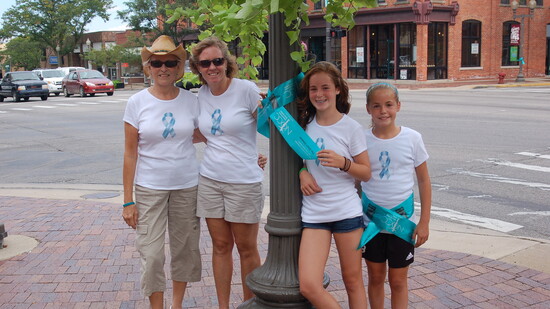
What began as a grassroots effort — volunteers hand-tying ribbons for awareness campaigns — blossomed into the Michigan Ovarian Cancer Alliance (MIOCA), a lifeline for women throughout Michigan. After a decade of tireless, volunteer-led advocacy, Dahlmann realized they needed to scale. Megan Neubauer, who joined the organization in 2020, stepped into the role of executive director in 2022, moving programs virtual and helping transition this personal mission into a professional powerhouse.
Today, MIOCA offers an array of programs that replace isolation with tangible comfort. There are Teal Sisters support groups open to all survivors; specialized circles for younger survivors; and dedicated caregiver, family member, and loved one support circles. For those in the thick of treatment, the connection is even more physical: patients receive Support Totes filled with blankets, information, resources, and comfort items that serve as a soft reminder that a whole community is standing behind them. This community spirit culminates in annual events like the signature Time to Teal gathering. Born from Dahlmann’s first year navigating Mother’s Day without her mother, the event has transformed into a massive celebration that draws hundreds to honor their shared journey and turn the room teal.
That sense of community has been a source of comfort for many, including Linh Cundiff. Diagnosed in 1985 at just 12 years old, her journey began with severe bloating and lack of energy. Just two days after visiting the emergency room, she underwent surgery to remove a tumor the size of a football. Compounding her physical pain was a language barrier and a devastating prognosis: doctors told her she wasn’t going to make it. With her father still stuck in Vietnam, a terrified Cundiff made a "deal with God" to survive long enough to see him again.
And she did survive — enduring nine surgeries and six rounds of chemo. But the emotional scars lingered. Recalling the bullying she faced as a sick teen, she kept her diagnosis a secret for decades. "For the longest time, I didn't want people to know...I felt like I must’ve done something wrong. I was ashamed,”she admits.
Many years later, when she finally decided to seek out a support group, a Google search led her to MIOCA. Overcome with "survivor guilt," Cundiff arrived 45 minutes early to her first meeting and sat frozen in the parking lot. Then, a woman tapped on her car window.
“We need you in there. Come in," she said.
“Without MIOCA, I don’t think I would open up,” Cundiff reflects today, recognizing the organization as a family that embraces the “good, bad, and ugly stories.”
But MIOCA’s mission extends far beyond emotional support. When the non-profit launched in 2011 with zero dollars in the bank, the idea of providing direct financial relief felt like a distant hope. Today, Executive Director Neubauer proudly shares that the Financial Assistance program has made that dream a reality. The initiative provides tangible aid to patients, easing the heavy “financial toxicity” that so often follows a diagnosis.
This rapid growth is driven by a sobering reality: there’s still no reliable diagnostic early detection test for ovarian cancer — making education and awareness critical. Programs like "Teal Attack," which engages young high school and college athletes, underscore that this disease can impact people at any age. Until science provides a reliable screening method, education is the strongest weapon.
“Knowing the symptoms can make a critical difference,” says Dahlmann, whose nursing background shaped MIOCA’s educational blueprint. She urges vigilance for the four most common signs: bloating, abdominal pain, changes in urination (urgency or frequency), and feeling full quickly. “If these symptoms are new, persistent, or unusual for you, see a gynecologist and ask about ovarian cancer.”
As MIOCA celebrates 15 years and looks toward the next 15, their goals remain steadfast. By their 30th anniversary, they hope the headline will feature an early diagnostic test, a cure, and the guarantee that no one in Michigan walks this path alone.
When asked to describe MIOCA in just one word, Dahlmann, Neubauer, and Cundiff don't hesitate:
“Dedicated.”
“Hope.”
“Family.”
They have proven that from a profound void, a few determined women can build a family without limits. For those navigating the terrifying unknown of ovarian cancer, that family is waiting with open arms.
Learn more, donate, or sign up to volunteer at mioca.org.
Until science provides a reliable screening method, education is the strongest weapon. “Knowing the symptoms can make a critical difference,” says MIOCA founder Pam Dahlmann.