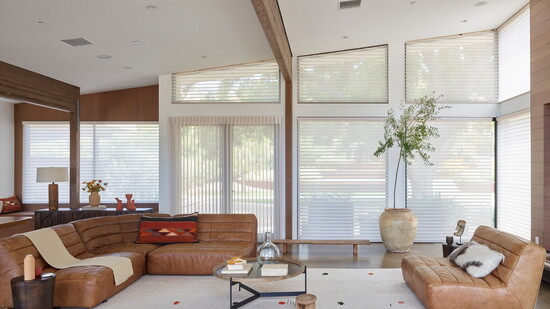
In Arizona, sunlight dictates how a home performs. It affects temperature, longevity of materials, privacy, and daily comfort. Yet window treatments are still treated as an afterthought in many high-end builds, addressed late rather than designed intentionally.
Jennifer Savio knows this better than most.
Jennifer is the owner of Desert Shades & Drapery, a custom window treatment studio located in the Biltmore, and the owner of Beach Drapery in Orange County, her family’s business of more than 55 years. What began as a small investment between her grandparents and parents evolved into a full custom drapery workroom that still operates today with much of the same hand-crafted process it used decades ago. Jennifer stepped into the business after building a successful career in homebuilding and design centers, choosing legacy over convenience and bringing a builder’s understanding into a trade often treated as decorative.
That dual perspective shapes everything she does.
“People don’t realize how foundational window treatments are,” she explains. “They think of them as something you deal with at the end. But in a desert environment, they’re doing real work. They control heat, glare, privacy, insulation, automation, and longevity. Design is only part of the equation.”
The desert demands more than aesthetics. West-facing glass, unshaded elevations, long summer absences, and expansive openings require solutions that perform as well as they present. A shade that looks beautiful but fails to insulate or protect interiors is not luxury. It’s a liability.
Jennifer sees this mistake often. Homeowners opt for minimal screen shades because they cut glare, only to discover they do little to protect furniture, art, or interior temperatures when the home is closed up for weeks at a time.
“Form over function is one of the biggest issues... especially here. You need to understand what the window is exposed to, how the home is oriented, and how the homeowner actually lives.”
That understanding is where Desert Shades & Drapery operates differently.
Jennifer works with direct homeowners, designers, builders, and developers, often stepping in late in the construction process when decisions are rushed and budgets are strained. Her role, she says, is to slow things down and educate. Not to sell, but to explain.
“This isn’t a dish towel. It’s not even a sofa. You’ll make this investment maybe a few times over the life of a home. You should know exactly why you’re choosing what you’re choosing.”
True custom drapery, she explains, is not about panels on a rod. It’s about proportion, pleat style, lining, stackback, fullness, and how fabric interacts with light. It’s an accessory in the truest sense, meant to enhance architecture, soften space, and add warmth and texture that hard materials can’t provide.
In Valley homes, that personalization becomes even more important. Theater rooms, wellness spaces, yoga studios, Pilates rooms, bars, and lounges are where Jennifer sees homeowners allowing themselves to be more expressive. Rich velvets, dramatic blackout drapery, layered sheers, and tactile fabrics create mood and intention.
“Those are the rooms where drapery really makes the space. You can have fun there. You can be bold.”
Elsewhere in the home, restraint often wins. Clean lines, ripple-fold drapery that disappears into the ceiling, neutral linen textures, oatmeal tones, soft creams, and fabrics that feel timeless rather than trendy.
“Neutral will never go out of style. It's always a safe investment.”
Still, trends do matter when they’re handled intelligently. Jennifer is seeing a resurgence of texture and pattern, not loud or chaotic, but intentional. Moss greens, rich earth tones, layered sheers paired with structured drapery, brass hardware used strategically to echo other finishes in the home. Patterns are returning, particularly florals and large-scale prints, used sparingly in powder rooms, bars, or intimate spaces where personality matters more than permanence.
Motorization, however, is no longer optional.
“Motorized everything,” Jennifer says simply. “You wouldn’t crank your car window down. Why would you do that in your house?”
From battery-powered systems to full home automation integration, shades and drapery are now expected to respond to lifestyle. Homes are programmed to close up when owners travel, to manage light automatically throughout the day, and to integrate seamlessly with systems like Hunter Douglas, Lutron, Crestron, Apple Home, or Alexa.
In its highest form, luxury window treatment is invisible. One button opens the garage, adjusts lighting, closes drapery, and sets the mood. Shade widths expand to accommodate larger expanses of glass. Fabrics are engineered for UV stability. Systems are designed for longevity, not novelty.
Jennifer is careful to set expectations here.
“There’s no such thing as a lifetime warranty on exterior shades in Arizona. The sun will win. Our job is to explain that honestly and design systems that perform as long as possible, with service and support when things inevitably need attention.”
That long-term relationship is something she emphasizes repeatedly. The industry, she notes, has seen its share of instability.
“You want a partner. Someone who will be there when motors need servicing, when technology evolves, when styles change. That's us."
It’s why Desert Shades & Drapery continues to operate with a full custom workroom and an experienced team that has been in the industry for decades.
“We haven’t replaced craftsmanship with convenience. We’ve layered innovation on top of it.”
Looking ahead, she believes the future of window treatments lies in deeper integration, wider capabilities, and continued emphasis on texture, color, and design as the finishing layer of the home.
“Drapery and shades are the accessories,” she says. “They’re what pull everything together. They bring warmth. They bring softness. They complete the room.”
desertshade.net
“You’ll make this investment maybe a few times over the life of a home."
“Form over function is one of the biggest issues... especially here. You need to understand what the window is exposed to, how the home is oriented, and how the homeowner actually lives.”