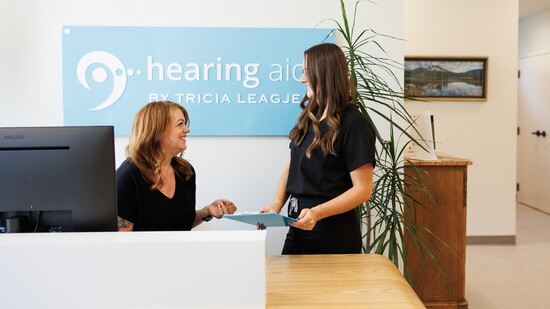
While most people go to the doctor every year for their annual physicals, and have their eyes and teeth checked regularly, many others overlook a critical step in their healthcare routines – hearing tests.
Because hearing loss is usually a gradual process, it is often something people don’t notice for a while. Some issues may stem from years of working in a noisy profession or from attending concerts and other loud events. For some, hearing loss may be due to hereditary factors.
Of course, any sudden hearing loss can be due to a more serious issue, and after a hearing test and a check for wax buildup, patients are often referred to an ENT doctor for further testing. That’s why it’s essential to consult a hearing professional.
“Research shows that the average person waits seven years before seeking help with their hearing,” says Tricia Leagjeld, HIS (Hearing Instrument Specialist) and owner and founder of Hearing Aids by Leagjeld. “They learn to get by for a while, and it's usually family or friends that recognize they’re not doing well.”
Leagjeld wants to change this, and it’s one of the reasons she decided to follow in her family’s footsteps. Her grandfather, Glen Leagjeld, was profoundly deaf, and after being fitted with hearing aids in the early ‘50s, he went on to become licensed as a hearing specialist. In 1955, he opened his own business, Leagjeld Hearing Aid Center in Bend. His son, and Tricia’s father, Jim Leagjeld, started working with him in 1968 and eventually took over the business in 1974.
“My father did this for 50 years, so he's well known in the hearing community,” reflects Leagjeld. “He really learned a lot from my grandfather, and I learned a lot from my dad.”
Leagjeld also spent some time in corporate America as a regional director, managing 30 doctors of audiology and their offices, but later decided to return to her family’s roots. Hearing Aids by Tricia Leagjeld, which opened in 2014, now has two offices—one in Northwest Crossing in Bend and one in Redmond.
“My talent is fitting hearing aids and running a business,” she states. “We follow best practices, making sure that patients understand every aspect of their hearing aid fitting. Along with hearing testing, evaluation, and counseling, we do real ear measurement, or verification, as it’s called.”
Follow-up care includes annual hearing tests and reprogramming, if necessary. The goal, explains Leagjeld, is not just to fit hearing aids and have people go on their way, but to understand the whole process.
“We educate them on how to clean their hearing aids, or we can do it for them. Customer service is really important to us and always has been. It’s part of my family tradition.”
Unfortunately, many people still feel there’s a stigma when it comes to hearing aids. “They think well, if I wear hearing aids, I'm old,” Leagjeld says. “But I believe that’s changing now since people are more aware of the research being done about the relationship between hearing and cognitive function. A lot of our technology today is the result of that research, and development is being targeted around deep neural networks, or DNNs, which are advanced AI that work to make speech clearer and listening less tiring, which supports cognitive health by making conversation easier in any environment.”
Others, after trying the one-size-fits-all, over-the-counter hearing aids, have had bad experiences. “When people come in for a prescriptive hearing aid fitting, they’re amazed at the difference,” notes Leagjeld. “Our hearing aids are quiet. Patients are not bombarded by background noises and other sounds that can be pretty sharp.”
The technology has definitely come a long way. “Hearing aids communicate with each other, and they can determine soft speech versus noise or wind. The technology is a lot more AI now.” Most are small and hardly noticeable, and many have Bluetooth and apps, so adjustments can be made right on a cell phone.
While hearing aid fittings and programming are the practice’s primary functions, other services include hearing protection, such as earplugs for musicians and others who work in noisy environments, and treatment for tinnitus.
Leagjeld and her team embrace the family business dynamic among themselves and with patients. “My team understands how I run the business, and everyone in the office is proficient at being super accommodating, friendly, and understanding of everyone's needs,” she emphasizes.
One of her team members is Shayne Blanton, HIS, whom she trained to assist her with patients. “He's amazing,” says Leagjeld. “Shayne is really good with people and understands my whole process. He really abides by the whole family tradition as well.”
Both offices are fully staffed five days a week. “Shayne and I take turns going back and forth between the offices, so there's always a provider and a front staff person.”
After being in the hearing business for 32 years, Leagjeld still finds it immensely rewarding to educate people, help them hear better, and improve the overall quality of their lives. “They’ll often say, ‘Wow, I'm hearing things I've never heard before.’ That's the reward right there.”
Hearing Aids by Tricia Leagjeld offers complete support for your hearing health, including the following services: hearing tests, hearing aids, tinnitus management and ear cleaning. To ensure you don’t miss a sound and to stay on top of your hearing health, schedule an appointment soon.
Offering two full-service locations:
- Bend – 695 NW York Dr., Ste. 110; 458.202.4947
- Redmond – 708 11th St.; 541.316.5064
HearingAidsbyTriciaLeagjeld.com
Signs of Hearing Loss
Hearings loss is often gradual and, therefore, its effects are not immediately obvious. It is not easy to recognize change in one’s own hearing. Most often, it will be a friend, family member or loved one who will notice subtle changes in your behavior, such as:
- Missing parts of conversations
- Difficulty hearing in noisy environments
- Complaining of muffled speech
- Straining or difficulty understanding words
- Asking to turn up the volume on the TV or radio
Benefits of Treating Hearing Loss
- Relationships – Relationships rely on good communication. Hearing loss can hinder the potential for responsiveness, but using hearing aids is the start to repairing communication.
- Cognitive Skills – Studies show that seniors with hearing loss are more prone to dementia, but by using hearing aids, they likely can improve their cognitive skills
- Earnings – Hearing is critical to meeting one’s full potential at work. Studies show that risk of income loss can be reduced by hearing aids.
- Happiness – Hearing loss can make people feel frustrated and alone. Restoring the ability to engage socially and live confidently boosts quality of life.
- Self-Confidence – Using hearing aids to bring back the gift of sound can improve one’s sense of control and self-confidence.
Your Ears. Your Brain. Your Hearing.
Johns Hopkins University study indicates untreated hearing loss affects brain structure and function. You hear with your brain, not your ears. This direct relationship between your hearing and brain function is disrupted when you suffer from hearing loss. Studies show that individuals with hearing loss can experience 30% - 40% accelerated rate of cognitive decline. This decrease in brain stimulation may contribute to brain atrophy. The greater the rate of hearing loss the faster the decline of memory and thinking. Exciting new hearing aid technology works to augment these natural processes for clearer, better hearing, just like the brain intended.