Staying relevant for over four decades requires more than good timing—it takes foresight, flexibility, and a genuine commitment to serving people where they are. Some businesses grow because the market demands it; others endure because they listen to their community. First Institute has done both, by evolving with the needs of the people it serves—adapting, pivoting, and reimagining its role, while staying grounded in its goals: provide practical education, open doors to meaningful careers, and give back to the community that made it possible.
In the late 1970s and early 1980s, Ron and Judy Beier ran a husband-and-wife travel agency. When they struggled to find well-trained travel agents who shared their commitment to quality service, they made a pivotal decision. Instead of continuing to search for talent, they decided to create it. In 1982, that choice led to the launch of an accredited training program, Travel First—setting the foundation for what would eventually become First Institute.
As industries changed, First Institute evolved alongside them. When the rise of the internet transformed the travel world, the school pivoted to meet growing demand for IT professionals. Later, as healthcare careers surged across the region, the institute expanded again—this time into hands-on allied health and wellness programs, including Medical Assisting and Office Staff, Dental Assisting, and, most recently, Massage Therapy.
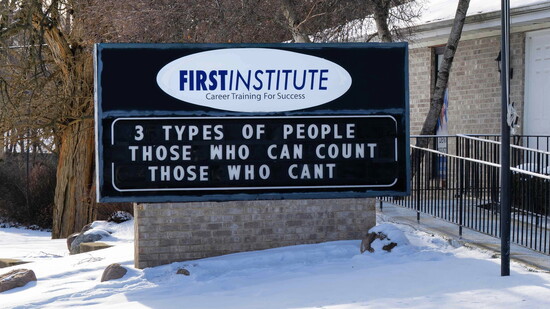
Today, First Institute is a private, career-focused training school, with campuses in Crystal Lake, Libertyville, and Aurora. Perhaps at first glance recognized more for its sign on McHenry Avenue with quirky quips than for the community and students it serves, its programs are designed to move students efficiently from the classroom into the workforce through hands-on certificate and diploma programs. With open admissions, small class sizes, financial aid options, and a strong emphasis on real-world preparation, the institute offers an accessible pathway for students looking to start or pivot their careers.
Over the years, leadership of the business has passed to the founders’ two sons, Eric and Kurt Beier, who have brought fresh perspective while honoring the values that built the organization. Their approach favors connection and culture over corporate formality—with students and staff alike—to stay genuine and personal. Both Eric and Kurt bring quick-witted energy to the office, known for keeping things light even while tackling serious decisions. Their leadership style is approachable and intentionally human—marked by humor, honesty, and an open-door culture that invites conversation rather than hierarchy.
Kurt is open about the fact that stepping into the family business wasn’t seamless or automatic. Early on, he made the difficult choice to step away for a time—allowing space for clarity on both sides. That pause helped define his value, strengthen trust, and ultimately shape the leader he is today.
Eric balances energy with a steady warmth—often smiling, always welcoming, and deeply invested in people. His presence sets the tone for an environment where staff feel seen and students feel comfortable walking through the door.
Spending time at First Institute during our photo shoot offered a firsthand look at what sets it apart. Conversations are easy, laughter is common, and the environment feels relaxed yet purposeful. In the classrooms, Medical Assisting students practiced drawing blood on one another, calmly coached by instructors who treated the moment with both precision and reassurance. In the Massage Therapy program, a classroom was filled with massage tables where therapists-in-training worked with real clients while an instructor moved quietly from table to table, offering guidance in real time. The Dental Assisting classroom felt less like a school and more like stepping into a functioning dental office—complete with equipment, layout, and the rhythm of a professional practice.
What stood out most was the confidence and camaraderie being built alongside the skills. Students were practicing what it feels like to do the work, with support close at hand. By the time students graduate, they’re ready to encounter real-world environments because they’ve already been immersed in them.
While there, we couldn’t let the opportunity to talk about their sign pass us by. If you’ve driven past First Institute, chances are you’ve noticed it. Not a digital marquee or scrolling LED display—but the old-school kind, complete with individual plastic letters that have to be changed by hand. Each week, the sign delivers a new phrase: clever, funny, occasionally groan-worthy, and sometimes thought-provoking. It’s the kind of message that makes drivers slow down just a bit, chuckle to themselves, or relate it later at the dinner table.
As Eric explains, “The sign isn’t about marketing–it’s about giving people something to smile at on their way through town.” And its magic isn’t just what it says—it’s how those words get there. The process is delightfully non-technical. Admissions Advisor, Scott LeRette, keeps a running list of possible phrases. Some are his own, others come from coworkers, friends, or conversations overheard in everyday life. No formal meeting. No committee approval. No spreadsheet. Instead, the decision often happens organically—like it did on the day of our photo shoot—when staff members gathered casually in the hallway.
Scott rattled off the contenders. Groans were as valid as laughs. A strong cringe earns just as many points as a loud “YES.” The phrase that sparks the biggest reaction wins. Decision made.
Every Friday—rain, snow, heat, or wind—Scott heads outside to swap out the letters, keeping the tradition alive week after week. It’s a small act, but one that perfectly reflects the culture inside First Institute: collaborative, lighthearted, and rooted in connection. A simple, shared moment offered to the community—one phrase at a time.
Each training year, students and staff often become a close-knit community—one that feels less like an institution and more like a family working toward shared goals.
That closeness is often felt most clearly at graduation. Tricia Maxim, Director of Career Services, shared that she is often brought to tears watching students walk across the stage—many of them the first in their families to pursue advanced training. Over her 15 years at First Institute, she has seen siblings enroll together, or one after another, and now, even the children of former students returning to begin their own journeys. What starts as career training often becomes something generational. "You don’t just watch them graduate, you watch entire families change,” she said. “That never gets old.”
The sense of belonging extends beyond graduation. Through externships, employer partnerships, and placement assistance, First Institute remains connected to students long after they complete their programs. Alumni can access support, preparation, and job placement help whenever they need it—reinforcing the institute’s role not just as a school, but as a long-term community resource.
Beyond the walls of the institute, both Eric and Kurt are deeply involved in the community, serving on boards, volunteering at local events, maintaining strong involvement with the Chamber of Commerce, and most recently, Cars and Caffeine which will bring car shows back to downtown Crystal Lake and benefit a variety of charities throughout the year.
Giving back isn’t a checkbox—it’s woven into the culture they’ve created, one that encourages staff to engage, volunteer, and lead in the community as well. It’s another example of how leadership at First Institute looks outward as much as inward—supporting causes, strengthening connections, and investing time and energy where it matters most.
At its core, First Institute is more than a training facility. It has become a meaningful part of the community—rooted in the belief that education can open doors, preparing students for in-demand careers while fostering a workplace culture that feels more like family than corporate structure. It is a place where education, connection, and community intersect—guided by a steady commitment to serving the community it calls home.