Every dancer knows the sentence. "Take the week off, then we'll see."
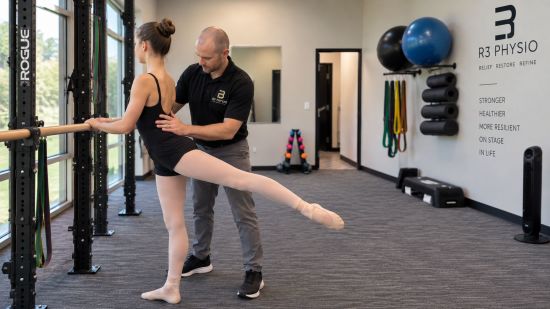
I wrote that note myself recently — for my own daughter. She'd started having low back pain with the things dancers can't avoid: walking, leg extensions, high kicks. There's an old joke in this profession that treating your own family never goes well, and I'd normally agree. But she was hurting, and I know what the standard path looks like from here. A week out of class. Then a week or two of modifications, standing off to the side marking choreography while everyone else rehearses. For a teenager in the middle of a season, three weeks of not-quite-dancing is an eternity.
She was back in four days.
One hands-on treatment session, two sessions of Frequency Specific Microcurrent, and she returned to full class without modifications. I'm not telling this story because it's remarkable that it worked. I'm telling it because of why it worked — and that part applies to almost everyone reading this, dancer or not.
The problem with treating the spot that hurts
When a dancer says "my low back hurts," the reflexive response is to treat the low back. Stretch it, strengthen it, rest it, ice it. Sometimes that's enough. Frequently it isn't, and the pain comes back the moment the demand goes back up — because the low back was never the problem. It was the place that finally complained.
A dancer's body is a chain. Hip mobility, rib position, how she breathes, how her nervous system handles a heavy rehearsal week, where an old ankle sprain quietly changed how she loads one side. Any of those can end up showing itself as back pain during a high kick. If you only treat where it hurts, you're negotiating with the symptom while the cause keeps operating.
That's the philosophy the whole practice is built on: your body isn't broken, it's misunderstood. Our job is to find the system that's actually driving the pain — fascia, breathing mechanics, an old scar, a nervous system stuck in high alert — and address that. It's also why every session here is 60+ minutes one-on-one with your therapist, not fifteen minutes of attention split across three patients and a stack of exercise sheets. You cannot find a systems problem in a hurry.
Where FSM comes in
Frequency Specific Microcurrent is the piece most people haven't heard of. It uses extremely low-level electrical current — well below what you can feel — delivered at frequencies matched to specific tissues and specific conditions. Inflamed tissue, irritated nerve, scarred fascia: each responds to different pairings.
Patients are usually surprised by how uneventful it feels. You lie there. Little to nothing is happening as far as your senses can tell. What it's doing is giving the tissue a reason to calm down — reducing inflammation and supporting the body's own repair process at a speed manual therapy alone can't match.
Here's the important part, and the reason I'm careful about how I describe it: FSM is not a replacement for skilled hands-on work. It's what makes the hands-on work hold. I can free up a restriction in a session, but if the tissue is still inflamed and the nervous system is still guarding, the body reverts within days. That's the frustrating cycle a lot of people know well — feeling great leaving the appointment, back to square one by Thursday. Pairing manual therapy with FSM is what shortened my daughter's timeline from three weeks to four days. Not one or the other. Both.
If you're the one sitting out
Whether it's dance, running, golf, or picking up a grandchild without bracing for it, the questions worth asking are the same. Has anyone looked at more than the spot that hurts? Has anyone asked why it started — not just what to do about it? And are you being handed a rest timeline because that's genuinely what your tissue needs, or because that's the default when nobody has found the cause?
Rest isn't a plan. It's a pause. Sometimes it's the right pause — but it should be a decision, not a shrug.
My daughter didn't need three weeks. She needed someone to figure out what was actually going on, treat that, and give her body real support while it recovered. That's not a special case. That's just what care looks like when someone has the time and the tools to look at the whole system.
Jason Racca, PT, DPT, is the founder of R3 Physio in Keller, serving Keller and North Fort Worth with one-on-one holistic physical therapy for dancers, athletes, and people with pain no one has been able to explain.
Article by Jason Racca, PT, DPT, CFMT, OCS, FNCP
Photography by undefined