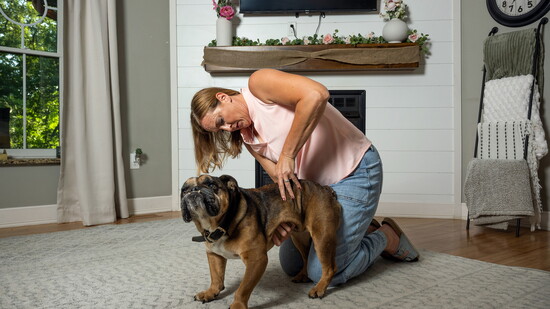
The veterinarian lowers herself beside the dog with the quiet patience of someone who knows her patient cannot explain what hurts. Her hands move slowly at first, feeling along the spine, shoulders, ribs and legs, searching not for drama, but for movement. When a joint does not move the way it should, she makes a small, precise correction.
“And that was the adjustment right there,” she says after one gentle movement. “Very, very gentle.”
For the animal, the moment is quick. For Dr. Jennifer Akers, D.V.M., it is the result of years of veterinary training, careful observation and a career that has grown into a divine calling.
She still does a small amount of general small animal medicine, working a day and a half each week at Green Valley Veterinary Services in Wamego, but animal chiropractic now makes up the vast majority of her practice. On any given week, her patients may include dogs, cats, horses, show pigs, show lambs or other animals whose owners have noticed something seems off. Her job begins with listening, though not always in the usual sense.
“They will tell you when something doesn’t feel good if you listen,” she says.
With dogs, that may look like a limp, a cry when lifted, or a sudden reluctance to jump onto the couch. More often, the signs are quieter: a dog laying differently, losing interest in play, or simply not moving with the same ease. Cats, Akers says, are even more subtle. They often do not limp or complain. They simply get quiet.
Horses tell their stories through performance. A barrel horse may struggle turning one direction. A stock horse may hesitate when something comes tight on the end of a rope. A saddle fit issue may leave evidence across the back and create problems that show up in movement long before they become obvious lameness.
Animal chiropractic care, as Dr. Akers explains it, centers on finding restrictions in the spine and joints. In chiropractic terms, she is looking for vertebral subluxation complexes, or areas where the vertebrae are not moving appropriately. Those restrictions can affect normal neurological communication, blood flow, lymphatic drainage, local tissue comfort and even discomfort referred into the limbs.
Her approach is specific and controlled. She motions the joints, determines what is not moving, and adjusts only what needs help. The technique is not the same as the forceful “pop” many people associate with human chiropractic care. Animal adjustments are often described as high-velocity, low-amplitude and low-force, applied to a specific contact point.
Akers grew up in Southwest Iowa, near Anita, and attended Iowa State University. There, she pursued a mixed animal veterinary education, expecting to work in mixed animal practice. She also had an early interest in what was then often called holistic medicine, but at the time, there were few clear paths for education or implementation.
After marrying Dr. Brian Lubbers, a K-State graduate and board-certified pharmacologist who is currently serving as an interim department head at the university, she moved to the Manhattan area in August 2005. After having her two children, Liv & Brock, years later, around 2014, the next part of her professional path began to open. She first studied acupuncture through the Chi Institute in Florida, then discovered Options for Animals, a veterinary chiropractic school in Wellsville, Kansas. She completed that program and became certified through the International Veterinary Chiropractic Association (IVCA) in 2016.
Since then, she has built her business gradually and intentionally.
That pace was important. Akers says she wanted the practice to grow organically, without pushing too much advertising, because she never wanted it to grow faster than her ability to do the work well. The result is a practice rooted in trust, word of mouth and the kind of care that makes animals happy to see her arrive.
“I love what I do,” she says. “I am so blessed. I get to do what I love and my patients actually look forward to seeing me.”
Her work also includes acupuncture, which uses specific points along meridians to influence biochemical responses and the nervous system. Like chiropractic care, it complements traditional veterinary medicine rather than replacing it. For Akers, both disciplines fit into a broader view of animal care: look closely, move carefully and respect what the body is trying to communicate.
Animals do not speak in sentences. They speak through posture, gait, hesitation, expression and trust.
Thankfully for animals in the Manhattan area, Dr. Jen has learned how to listen to them.
To schedule an appointment in the Manhattan area with Dr. Akers, text 785-341-1836.
“Animals will tell us when something doesn’t feel good, but we have to listen closely, watch how they move, and trust the quiet signs they give us every single day.”