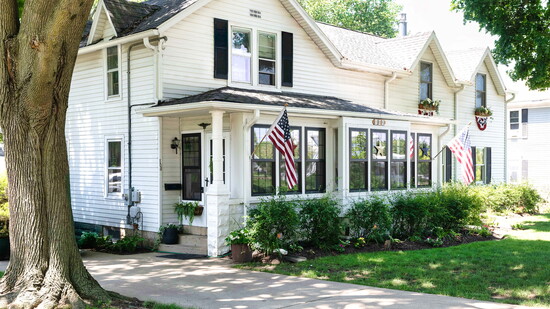
At first glance, the neighborhoods just beyond downtown Crystal Lake look settled and familiar. The houses line the streets where they have always been, or so it seems. But a closer look at historic records, old maps, and preservation files reveals a more complicated story. Some of these homes did not simply age in place. They were lifted, hauled, and set down somewhere new as the town reorganized itself around growing businesses, changing roads, and expanding communities.
Much of what we know about these quiet relocations has been preserved through the careful work and generous assistance of the Crystal Lake Historical Society, whose archives make it possible to trace buildings across time, and, in some cases, across town.
That quiet reshuffling is easy to miss if you only look at what stands today. However, it is all part of how Crystal Lake developed, not by repeatedly clearing away the old, but often by reusing and relocating what it already had. Tracing the paths of these moved houses offers more than an architectural curiosity; it shows how earlier residents balanced progress with practicality and preservation.
One of those traveling houses now sits at 108 N. Caroline Street.
Today, the house at 108 N. Caroline Street blends easily into Walkup’s Addition, but it did not begin its life there. Historical records show it originally stood on Minnie Street in the early days of the village of Nunda. Around 1900, local businessman Fred L. Colby chose to have the house physically moved rather than see it lost as the town’s layout changed.
The structure made the journey to Caroline Street, where it has remained ever since, passing through several early Crystal Lake families, including the Kardas family, longtime fixtures in the downtown business community. Historic fire insurance maps confirm that the house standing there today is the same one that was relocated more than a century ago.
Now firmly rooted in its second location, the home continues to evolve. The current residents have expanded the house with care, designing additions that respect its original character. Inside, antique dressers have been repurposed as bathroom vanities, old pantry doors have been preserved, and a kitchen island was designed and built by the homeowners to match the home’s historic feel. They also hope to one day restore the front porch to better reflect what it once was.
More than a century after it was moved, 108 N. Caroline remains a lived-in example of how Crystal Lake grew, by adapting what it already had, rather than starting over.
The Finch House at 115 Elmhurst Street offers a more personal example of how early Crystal Lake homes continue to reveal their stories over time. Built during the town’s early years and tied to one of its first families, it reflects the kind of well-built, practical homes people relied on as Crystal Lake grew from a railroad town into something larger. It is also my home, a reminder that these houses are not frozen in time. They are lived in, adjusted, and cared for, often without the full story being immediately obvious. Once standing on the corner of Woodstock and Grant St. the Finch House (named for its first owner) was moved onto a waiting foundation at 115 Elmhurst St. in the spring of 1945. The true reason for the move is lost to time, however we can presume that as the downtown grew, the owners chose to keep what they had and move down the street in the name of progress.
The practice of moving houses was not limited to Crystal Lake’s earliest years. As late as the mid- and late-20th century, relocation was still used as a practical solution when modernization threatened existing homes. Two notable examples involve houses connected to the Genung family. The Belle Genung House, built in 1913 on McHenry Avenue, was moved in 1983 to 296 S. Oriole Trail to make room for a library expansion. Earlier, in 1966, the Frank L. Genung House which was originally located at 100 W. Paddock Street, was relocated to 140 McHenry Avenue, again to accommodate growth at the Crystal Lake Public Library.
That these homes were moved for two separate library expansions underscores how common and accepted the practice remained, even in relatively recent history. Rather than erase the past, the community repeatedly chose a path that allowed both preservation and progress to coexist.
Together, these houses illustrate that Crystal Lake grew not only by building new structures but by rearranging existing ones. Some houses stayed rooted while the town changed around them. Others were physically moved to make room for what came next, while still preserving what came before.
Crystal Lake’s moved houses are practical reminders that growth does not always require erasure. Sometimes a community advances by carrying pieces of its past forward, setting them down in new places, and allowing them to continue serving new generations while quietly strengthening the sense of continuity that helps a town know where it has been, and where it is going.
It’s easy to assume you know the history of the place you live, especially when the information seems straightforward. When we bought the Finch House in 2016, we were told it had been built in 1920. That date stuck. We didn’t question it.
A few years later, a loose nail in the floor caught my eye. It seemed older than it should have been, and curiosity got the better of me. What started as a quick search turned into something much larger. With the help of a friend on the Historic Preservation Commission and the work of a member of the Crystal Lake Historical Society, we began uncovering parts of the home’s history that had quietly faded from memory.
That experience reflects what the moved houses of Crystal Lake show us. Much of a town’s history isn’t obvious. It doesn’t announce itself. It sits beneath layers of everyday life, sometimes literally underfoot. Buildings get reused, relocated, added onto, and adapted, but their earlier chapters don’t disappear, they just become easier to overlook.
If you’re curious about your own home, the Crystal Lake Historical Society is a good place to start. Their archives, research, and volunteers make it possible to piece together stories that might otherwise be lost. Understanding where your house (and your town) came from doesn’t change how you live in it, but it does change how you see it. And that awareness has a way of strengthening the connection between people, place, and the community they share.
Tracing the paths of these moved houses offers more than an architectural curiosity; it shows how earlier residents balanced progress with practicality and preservation.