FALLING BRANCH BREWERY
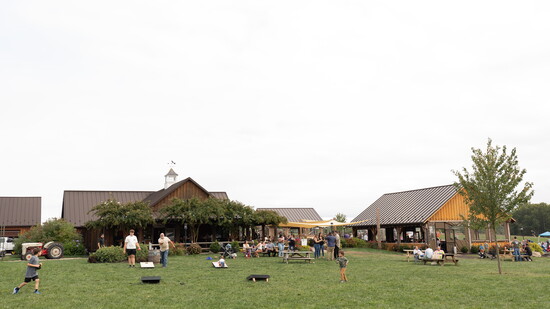
At Falling Branch, every pint tells a story a hundred years in the making. Falling Branch Brewery founder Alex Galbreath says the farm has been a pillar of his family since his great-grandfather purchased it in 1924. It’s seen many transformations: it was a swine farm, a dairy cattle farm, and a creamery. Galbreath, the fourth generation to own it, remade it yet again, this time into a thriving brewery. The 100-acre farm brewery in Street is Harford County’s first, opening just a few years after the passing of a 2012 law that allowed farms to brew and sell beer on-site as long as they used an ingredient they grew.
“I grew up 200 feet from the taproom,” Galbreath says. “I worked on this farm as a little kid, feeding and milking the cows. I spent countless hours out here. It’s so much a part of who I am.”
When Galbreath graduated from college in 2013, “I found myself 21 years old and falling in love with craft beer,” he says. “I also knew I didn’t want to be a dairy farmer.” Under the new state law, he applied for a grant for funds to plant hops on the farm. “They take a couple years to fully establish themselves, and in 2015, we started brewing.”
Galbreath admits he wears a lot of hats at the brewery, but brewer isn’t one of them. “Let’s say my brewing skills weren't up to par for commercial brewing,” he says. “I partnered with a local brewer. That's one aspect where I am the least involved, besides obviously taste-testing it and loving it.”
In 2016, Falling Branch opened its doors with an outdoor-only beer garden. Soon after, they refurbished a stunning 1800s barn into the year-round taproom. The brewery started with a half-barrel brewing system that produced just 15 gallons at a time and scaled up to a 15-barrel system in 2021, which increased production 30-fold. This expansion has allowed them to distribute their beer to over 100 locations across Harford County, Baltimore County, and Baltimore City.
Fall at Falling Branch is particularly hopping, with PumpkinFest every weekend through October: pumpkin patch, corn maze, hay rides, build-your-own scarecrows, live music, vendors, food trucks, face painting, and, of course, a slew of seasonal-inspired brews.
"For our beer, we try to have classic styles that are executed really well, but we also like to push the envelope a little bit and get creative," Galbreath says. On the more creative side, check out That’s My Uncrusted, a PB&J-inspired sour.
Visitors are welcome to roam the farm and see the animals, which include goats, sheep, and cows. “This is an unbeatable one-of-a-kind farm atmosphere,” Galbreath says. “It’s laid back, relaxing, family-friendly. It's not just a brewery. It’s a place where you can feel connected to the land and the community that has grown around it.”
SLATE FARM BREWERY
Kiel Brown and his brother Sam Brown were once masters of the home brew. They started with a kit, graduated to purchasing their own equipment, and soon were bottling and sharing their concoctions with friends and family. “One day, we thought, ‘You know what?’ Let’s give this a go for real,” Kiel Brown says.
The initial “go” in 2018—when the brothers, their mother, and their uncle opened Slate Farm Brewery—looked like this: “We didn’t have walls or bathrooms,” Brown says, laughing. “We had a pavilion and a trailer that served beers. We opened on a shoestring budget.”
Seven years later, with a tap room with 30 options, Slate Farm Brewery in Whiteford has made a name for itself as small but mighty. While many breweries chase scale, Slate's smaller size is its secret weapon. With a five-barrel system, Slate Farm has the freedom to experiment and create beers that larger breweries may not risk. “If it doesn’t work, they have to throw out so much more beer,” Brown says of his larger counterparts. “We like to make very cool, very different beers. We’re not afraid to try new things.”
This philosophy has led to a constantly rotating selection of vibey beers on tap, like Strawblurry, a hazy Strawberry blonde fermented with an “absurd” amount of strawberry puree, orange peel, and coriander; or Loops, inspired by your favorite fruity childhood cereal. "I think that's what keeps bringing people back: constantly having new and different beers available,” Brown says.
Beyond the adventurous spirit of its brews, Slate is also known for its sours and slushies, and even hosts an annual sour fest. The adorable goats and chickens hanging around the farm to say “hi” help, too. With a food truck on site, Slate has you covered with specialty sandwiches, seasonal favorites, and more.
Visiting for the first time? Brown admits the expansive tap list might leave you a little dizzy, but in the best possible way. “The best beer is the one you like, and it is a very personal choice,” he says. “But our most popular is the Nine Pound Hammer, a big double IPA.”
What's next for Slate Brewing? Brown’s goal is to remain rooted in their existing community of beer fans. "I just want to continue to make great beer, and be a part of the wonderful community we’ve built,” he says.
HOPKINS FARM BREWERY
Like Falling Branch, Hopkins Farm Brewery in Havre de Grace also boasts a family story that spans nearly 100 years. Founder Aaron Hopkins grew up watching his dad work the farm. “It was a really cool way to grow up, playing on the farm, working with my dad with the dairy cattle,” he says. “I always knew from then I wanted to do something with farming.”
As an undergraduate student at the University of Delaware, Hopkins was working on a project that required him to come up with a business plan. “I was going to do a farm-to-table restaurant,” he says. “But then I met Sam Calagione.” Calagione, founder of Delaware-based Dogfish Head Brewery, changed everything for Hopkins. “I had the dream then: maybe a brewery is something we could do on the farm.”
The dream became a reality when the whole family got on board, including his parents, aunts, and uncles. When the brewery opened in 2020, during the COVID-19 pandemic, Hopkins says their spacious outdoor area was a "blessing" that allowed people to feel safe while regaining a sense of normalcy.
What truly sets Hopkins Farm Brewery apart, Hopkins says, is its deep connection to the land and the farm-to-table philosophy. The farm has its own malting operation, allowing brewers to use barley, corn, and wheat grown directly on the farm. "Our goal is that around 30 or 40 percent of the barley, wheat, and corn grown on the farm goes into every beer that we brew,” he says. “We recently released a cantaloupe beer, and I think we used a couple hundred pounds of it from the farm.” The commitment extends to collaborating with local orchards for ingredients like peaches and cider.
The brewery is powered by a 10-barrel system that yields about 300 gallons per batch. The personality of the beer is all about its hyper-local ties to the land. “That’s how we add our unique character,” Hopkins says. “It’s also a very collaborative effort, with bartenders, staff, and customers coming up with fun ideas.” To wit: The Hamilton, a classic Pilsner named after Hopkins’ friends and favorite local auto shop.
For Hopkins, the best part of the farm, which will turn 100 next year, is the chance to be with his family. “My two kids run around the farm and have the time of their lives,” he says. “It's a cool gathering place, whether it's friends, family—we all love each other, and we love good beer.”
“We like to make very cool, very different beers. We’re not afraid to try new things.”