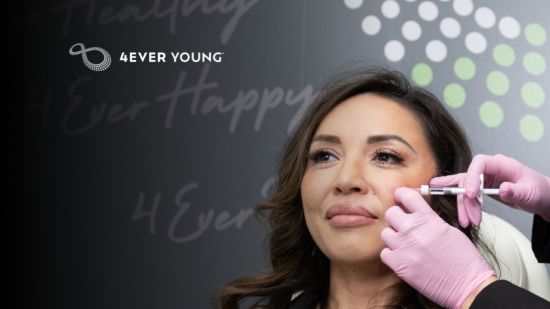
Many people notice their skin starts to change faster in their 40s and 50s. Lines stay even when your face is relaxed, the cheeks look a little flatter, and the skin feels drier and less firm. These changes are normal, and they happen in a few layers of the face at once.
Collagen loss and menopause
Collagen is the protein that gives skin its structure and firmness. We make less of it with age, but for women, the drop in estrogen at menopause speeds this up. In one study, skin collagen and skin thickness declined by about 1 to 2% per year after menopause. Lower estrogen also reduces the skin's water content, which is why many women notice their skin feels drier during this time.
Volume loss
Underneath the skin, the fat in the face sits in separate sections called fat compartments. As the deep fat in the midface loses volume, the cheeks can look flatter and the under-eye area can look more hollow. The bones of the face also slowly change with age, especially around the upper jaw, the edges of the eye sockets, and the jawline. When that foundation shrinks, the fat and skin on top have less support, which adds to sagging and deeper folds.
Sun damage
Many of the changes that show up in this stage are from sun exposure years before. In a study of 298 women, researchers estimated that UV exposure was responsible for about 80% of the visible signs of facial aging they measured. Sun damage is the part of aging we have the most control over, so wearing sunscreen every day still makes a difference at any age.
Treatments that help
Since these changes happen in different layers, most people get the best results from using more than one treatment. For example, Botox can soften lines while Sculptra or filler replaces lost volume.
● Botox and Dysport relax the muscles that cause lines between the brows, on the forehead, and around the eyes. In the trials behind Botox Cosmetic's approval, 80% of patients had their frown lines reduced to mild or none at 30 days.
● Filler, like Juvederm and Restylane, restores volume right away in specific areas such as the cheeks, under the eyes, lips, and jawline.
● Sculptra prompts your skin to build its own collagen over a few months, which makes it a great fit when collagen is dropping and volume loss is spread across the face. Results typically last around two years, with a 2026 systematic review finding effects lasting up to 25 months.
● SkinPen microneedling improves texture and fine lines. In a review of 723 patients with an average age of 48, 83% were satisfied with their results.
● Morpheus8 is a type of radiofrequency microneedling, which adds heat energy to microneedling to help tighten the skin. A 2026 review of radiofrequency microneedling found consistent improvements in texture and tightening, with mostly mild, temporary side effects.
How hormones fit in
Since estrogen helps the skin hold onto collagen and water, skin health and hormone health are closely connected. Researchers have found that skin collagen, skin thickness, and bone density all decline at a similar rate after menopause, and they believe this is because skin and bone share the same type of connective tissue that depends on estrogen. Due to this, many women notice their skin changing around the same time as other menopause symptoms.
In several studies, estrogen therapy after menopause increased skin collagen, skin thickness, and elasticity, and lowered the chance of dry skin. On the other hand, results for wrinkles specifically have been mixed, so hormone therapy is not prescribed for skin alone. It is a medical decision based on your symptoms and health history, and healthier skin can be an added benefit.
At 4Ever Young, we look at both. Treatments like Sculptra and microneedling rebuild collagen and volume directly, while balanced hormones can help support the skin from the inside. If you are noticing skin changes along with menopause symptoms like hot flashes, poor sleep, or low energy, our hormone providers can check your levels and talk through whether hormone therapy makes sense for you.
Anti-aging treatments in Kingwood, TX
At 4Ever Young Kingwood, we offer Botox, Dysport, Juvederm, Restylane, Sculptra, SkinPen, and Morpheus8, as well as hormone therapy. Having both in the same office makes it easier to build one plan that covers your skin and your hormones.
Consultations are always free, with no pressure to book anything. We see patients from Kingwood, Humble, Atascocita, Porter, and the greater Houston area. Call (281) 242-1724 to schedule your free consultation, or visit us at 30130 Rock Creek Dr., Suite 300, Kingwood, TX 77339.
References
Brincat M, Kabalan S, Studd JW, et al. A study of the decrease of skin collagen content, skin thickness, and bone mass in the postmenopausal woman. Obstetrics and Gynecology. 1987;70(6):840-845. PMID: 3120067.
Brincat MP, Baron YM, Galea R. Estrogens and the skin. Climacteric. 2005;8(2):110-123. PMID: 16096167.
Calleja-Agius J, Brincat M. The effect of menopause on the skin and other connective tissues. Gynecological Endocrinology. 2012;28(4):273-277. PMID: 21970508.
Ferreira ACM, Silva LR, Espasandin I, et al. Efficacy, durability, and safety of collagen biostimulators based on poly-L-lactic acid (PLLA) and calcium hydroxyapatite (CaHA) in the face: a systematic review. Aesthetic Plastic Surgery. 2026;50(3):1291-1300. PMID: 41184662.
Flament F, Bazin R, Laquieze S, et al. Effect of the sun on visible clinical signs of aging in Caucasian skin. Clinical, Cosmetic and Investigational Dermatology. 2013;6:221-232. PMID: 24101874.
Foppiani JA, Fanning JE, Beltran K, et al. Microneedling for facial rejuvenation: a systematic review. Aesthetic Plastic Surgery. 2025;49(17):4949-4960. PMID: 40542236.
Frampton JE, Easthope SE. Botulinum toxin A (Botox Cosmetic): a review of its use in the treatment of glabellar frown lines. American Journal of Clinical Dermatology. 2003;4(10):709-725. PMID: 14507232.
Kumar N, Suh DH, Lee SJ, et al. Radiofrequency microneedling for facial rejuvenation: a systematic review. Journal of Cosmetic Dermatology. 2026;25(4):e70845. PMID: 41947517.
Mendelson B, Wong CH. Changes in the facial skeleton with aging: implications and clinical applications in facial rejuvenation. Aesthetic Plastic Surgery. 2012;36(4):753-760. PMID: 22580543.
Raine-Fenning NJ, Brincat MP, Muscat-Baron Y. Skin aging and menopause: implications for treatment. American Journal of Clinical Dermatology. 2003;4(6):371-378. PMID: 12762829.
This content is for educational purposes only and is not medical advice.