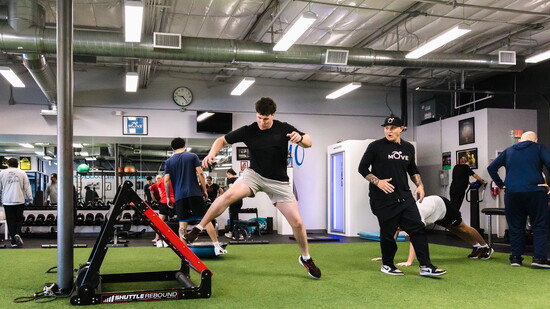
The NFL Combine is happening this month, and for a group of Valley athletes, it represents one of the most important evaluations of their careers.
The Combine is where NFL scouts and executives assess draft prospects through a series of standardized drills measuring speed, power, agility, explosiveness, and positional skill. Every movement is timed. Every rep is graded. For many athletes, it’s the first and only chance to show evaluators how their bodies perform under pressure.
That reality shapes everything happening inside the Valley’s Move Human Performance Center & Physical Therapy, where preparation is led by owner Chad Dunn.
“This isn’t football training anymore,” Chad says. “This is movement evaluation.”
By the time athletes arrive, strength isn’t the problem. Conditioning isn’t the problem. The difference between helping themselves and hurting themselves often comes down to how cleanly they move.
“The Combine isn’t about who’s the best football player,” Chad explains. “It’s about who moves the cleanest when everything is being measured.”
Scouts aren’t just watching results. They’re watching how results are produced. How force is transferred through the body. Whether mechanics stay intact when fatigue shows up. Whether movement is repeatable.
“A tenth of a second doesn’t come from working harder,” Chad says. “It comes from eliminating inefficiencies.”
That’s why training is built from the ground up. Lower body power is the foundation, but not in the way most people think.
“We focus a lot on tendon health and elasticity,” Chad explains. “Fast athletes don’t push the ground. They rebound off it.”
Force production, timing, and recovery are trained together. Fridays emphasize strength that transfers directly to Combine drills. Sundays are position specific, dialing in technique under fatigue.
Upper body work serves a different purpose.
“When they walk into the Combine, perception matters,” Chad says. “They’ve got to look like they belong.”
Athletes send Chad video between sessions. Feedback is immediate and precise.
“Your butt’s not high enough.”
“Lower your chest.”
“Ten yard get offs.”
One athlete laughs as he explains the difference from college.
“That never happened before,” he says. “Here, we actually have time. One on one time. It’s like having this wealth of knowledge.”
Chad is also careful about what not to do pre-Combine.
“You don’t introduce new mechanics late,” he says. “You refine what’s already there.”
The nervous system matters. Combine drills are repeated until they feel familiar, not exciting.
“When the moment comes,” Chad explains, “I want their body to recognize it.”
Mental preparation is built into the physical work. Pressure is simulated. Fatigue is intentional.
“For my position as a kicker, you get one shot,” one athlete says. “I started in soccer, but realized football was my thing. I need to see beyond pressure… you can’t mess up.”
Chad expands.
“A 'specialist' group including long snappers, punters and kickers approach the combine differently than the skill players. They only have one job to do, and that's perform. Many of the athletes closest to their goals didn’t arrive on a straight path. Some found their sport later. Others shifted positions or roles. Growth doesn’t always look linear, and development rarely follows a predictable timeline,” he says.
For families raising kids with big dreams of going pro, the takeaway goes well beyond football. At this level, progress isn’t about doing more drills, traveling to more camps, or stacking endless hours of training. It’s about learning how to do the basics correctly, consistently, and when the pressure is highest.
“You don’t get points for being nervous,” he says. “You get points for control. The mental game matters just as much as the physical one. Athletes who last are the ones who learn how to manage nerves, tune out noise, and trust their preparation instead of chasing perfection. Pressure doesn’t disappear at the next level it multiplies. What changes is an athlete’s ability to stay present and execute anyway.”
That mindset is the takeaway Chad wants people to understand.
“No one gets drafted on potential anymore,” he says. “They get drafted on proof. Perhaps most importantly, the strongest athletes are the ones who learn to take coaching well. They listen. They adjust. They don’t take corrections personally. They understand that refinement is not criticism, it’s progress.”
moveperformance.com