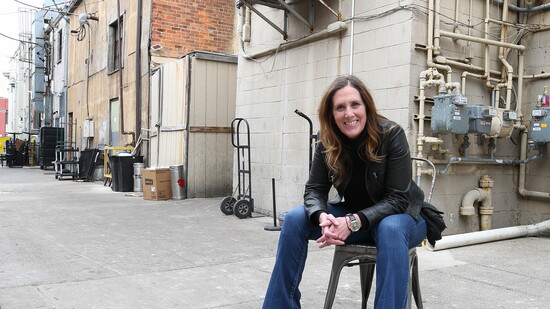
The first thing Amy Gillespie looks for when she raises a camera isn't the subject. It's everything behind the subject.
“In every shot, there’s a foreground, a middle ground, and a background," she says. "I make sure something is interesting all the way through the frame."
She learned it from meeting National Geographic photographer Sam Abell. Abell was known as the quiet photographer; his images never announced themselves.
The approach stuck with her. Every time she puts a camera to her face, she's not just capturing what's in front of her. She's looking all the way through.
It turns out that's exactly how she publishes a magazine too.
Amy Gillespie is the publisher of Royal Oak City Lifestyle—and, uniquely among the publication's national network of franchises, its photographer as well. She came to the role after decades in visual media: commercial work, catalog photography, event coverage, portrait sessions—in what she lightheartedly calls Royal Oak's one dirty alley. (“It’s got the most character," she says.)
She also holds a Certified Professional Photographer credential that fewer than three thousand people worldwide hold. She passed the exam on the first try. In the ninetieth percentile.
The credential required serious mathematics and design theory. That combination—visual instinct grounded in technical precision, artistic eye fused with analytical mind—is something she's navigated her whole career.
"There are plenty of artists that might have more raw talent than I have," she says. "I've survived because I had that combination of business acumen and determination."
For years, though, that survival looked a certain way from the outside. She was called just a photographer. To her face, by people who'd seen her work, hired her, benefited from her expertise.
It didn't stop her.
She describes herself as naturally thick-skinned. A challenge to her competency was never going to be the thing that changed her direction.
But she noticed it. You don't spend a career as a natural observer without noticing things.
"I never felt the need to defend myself," she says. "People either are smart enough to ask the right questions or they're not. I'd deliver excellent work and move on."
What surprised her, when she became a publisher, was how quickly that word—“just”—disappeared.
"It's taken me becoming a publisher for people to be like, ‘you're the expert…what do you think?’" She pauses. "After decades of working in marketing, photography, print, all of it. And I'm happily not called ‘just a photographer’ anymore."
The path to publishing wasn't linear, which if you know Amy matches her personality. She started college in forestry, drawn to something at the intersection of science and the outdoors. Then she moved out west and pivoted to art school, before coming home, working in design, going back for her undergraduate degree and eventually her MBA.
"I've always been a bit of an outsider," she says. “Maybe it’s because I’m a natural observer."
Photography was the thread that ran through all of her pursuits. As a kid, she spent her allowance on Popular Photography and read it cover to cover. She was absorbing camera equipment before she owned a camera. She wanted to be a National Geographic photographer—and a race car driver. Her father, she recalls with amusement, was not at all surprised by the second one.
When she left the corporate world and started her own photography and videography company, she kept one foot in marketing strategy and consulting. She'd worked in print long enough to know how visual and editorial language work together. What she was building, even then, was something that required the whole frame.
Her approach to photography carries the same philosophy she brings to publishing. “I shoot nouns,” she says simply. People, places, things. But she prefers people as subjects. “They have an endless amount of presence in a still frame,” she notes.
Especially when they're not looking at the camera.
"Some of the best shots are the candids," she says. "I'm still shooting even when they think I'm not. That's when the honest emotion comes through."
To get people to that place, she's been known to say a priest and a rabbi walk into a bar with no punchline whatsoever, just to watch shoulders drop. For years at events, she was known simply as the dancing photographer: she'd pack a dance floor, hand it back to the DJ, then step away and shoot.
Connection first. Image second.
Unique nods to art history run through Amy's work. One Bat Mitzvah client had a theme of “the four seasons.” Amy pitched putting four images of the girl in an homage to Magritte's The Son of Man—inside a multi-colored Warhol-style grid. The client loved it. It became the main art of the party.
Then there was the farm shoot outside Royal Oak. Touring the property, she spotted a shed, two old barns, and the right kind of couple, and quietly asked if they'd be open to a wink at American Gothic. They were. She found shovels, located something close enough to a pitchfork, and took the shot. It made our cover.
She approaches the magazine the same way she approaches every photo: what’s in the foreground, what's in the middle, what's in the back. That vision holds every issue together.
In June, Royal Oak City Lifestyle will celebrate our first full year of publication. I ask Amy what she hopes readers feel after picking it up. Her response: “proud, inspired, moved, connected… better.” She wants the magazine to become our city’s resource, for finding out about events before they've passed, for introducing neighbors who've lived on the same street for ten years without meeting, for celebrating the human beings behind every business in town.
"Every issue that comes out," she says, "more people reach out saying it makes them feel like they love their city."
She spends most of her day out in the community, meeting with business owners, asking two questions: How can I help? What are your pain points? The stories that light her up fastest are the humanitarian ones: people doing under-the-radar good in the city. The kind where you look through the foreground and find something worth staying for.
"What's good for one in the community," she says, "is good for everybody."
She still considers herself a photographer first. The publishing role has made a certain kind of anonymity harder: she’s recognized now, known as “the publisher,” less able to move through a shoot as simply the person behind the lens.
But what she's built now comes from her approach to every shot she’s ever taken.
Royal Oak in the foreground. Its people in the middle. And in the background, the stories behind the stories.
Royal Oak City Lifestyle is distributed monthly throughout Royal Oak and surrounding communities. Find it atcitylifestyle.com/royaloak and on social @RoyalOakCityLifestyle