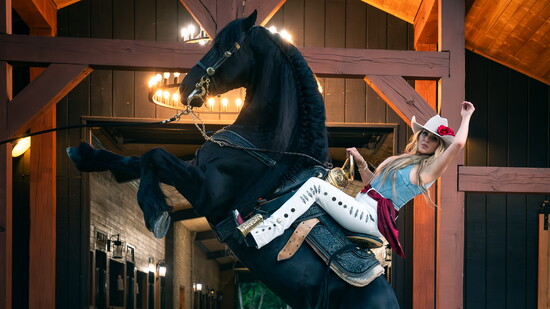
Leah Galvan Turner is telling stories. In a music genre built on storytelling, Turner is embracing bilingual lyrics and deeply personal narratives that bridge country music with Mexican culture. In this Q & A, Turner opens up about how her songwriting has evolved, the influence of her heritage, and the lessons Music City has taught her.
How has your songwriting evolved since your earliest releases?
I have been blessed to sit in rooms with writers like Hilary Lindsey, Jesse Frasure, Cary Barlowe, and the late Brett James. Getting that front-row seat taught me how to put detail and feeling into a song: real life moments, real “furniture” in the lyric, and melodies that stay with you.
I carried that foundation forward, and as I’ve grown, I’ve evolved in how I approach what I want to say and how honest I am willing to be. I write more from my own lens now: my culture, my bilingual voice, my perspective as a woman in this business, the things I’ve lived, and the things I am still living.
I have learned to protect the heart of the song, to say more with less, and to let the truth lead, whether it shows up in English, Spanish, or both.
What experiences or moments in your life have most influenced the stories you’re telling through your music right now?
A lot of what I am writing now comes from navigating this industry as a woman who is not 25 anymore, someone who has been signed to a major label, is now independent, and understands that the unknown can be scary, but fear has never stopped me.
There is pressure to stay shiny, stay new, stay “young,” while still evolving and telling the truth. That tension has shaped my writing: the resilience, the self-respect, the letting go of casi algos (almost somethings), the closed doors, the pivots, the moments where you have to bet on yourself even when you are the only one who does, the clarity that comes with age, and the peace that comes when you stop chasing validation.
My cultural identity also plays a big role. Growing up ni de aquí ni de allá (neither from here nor there), carrying both pride and faith, and watching underrepresented communities fight for space in a genre we have always helped shape shows up in my storytelling and in how I approach country music as a whole.
And I am influenced by watching women and diverse voices rise in this genre. Watching that door crack open for more representation has been inspiring, and it fuels me to keep pushing, keep creating, and keep telling the stories we have not heard enough of.
What influence does your Mexican heritage have on your music?
Everything, from the grit with heart, the passion, to the visuals and the phrasing, down to the different sounds we are using, like accordions, flamenco guitar and horns.
I grew up with rancheras, norteñas, and mariachi, and I also grew up on George Strait, rodeo culture, and country storytelling. My music is what happens when those worlds come together. Two worlds, one corazón.
The heritage shows up in the melody choices, the bilingual writing, the vaquera imagery, and the corazón behind the vocal. It gives me a unique lane, and I am proud of that. I am proud to represent Mexicanas in country music and show that la musica no tiene fronteras, music does not have borders.
As an artist in Nashville, how has the city shaped your sound, your collaborations, and your creative process?
Nashville sharpened my pen. This city does not let you get away with lazy writing. The story has to be there. You cannot hide behind production; the lyric and melody have to stand.
Being here pushed me to write with people outside my usual creative circle, which helped fuse Mexican heart with country storytelling in a very natural way. Along the way I collaborated with GRAMMY Award-winning Tejano artist Michael Salgado on my song “Para Mi,” and with Jerrod Niemann on “South of the Border,” which proved even more that two worlds can exist and thrive in one genre.
It also helped me show the world how the American cowboy and vaquero culture mirror one another: family, ranches, faith, rodeos, jaripeos, heartbreak, heart, and hard work. That is the bridge I am building between the two worlds, because American cowboy traditions come directly from vaquero culture and cultura mexicana. That fusion of Nashville lyricism, western soul and Mexican heart is where my sound really solidified.
Is there a song in your catalog that feels especially meaningful to you today, and why?
Two songs for different reasons.
“This Is Mi” was the first time I publicly claimed my dual identity without asking for permission. It was a turning point creatively and personally.
“American Made” honors both sides of my bloodline. It celebrates that we can make room for two worlds at once. It is pride, it is history, and it is a bridge. It also lets me tip my hat to mis abuelos (my grandparents), who sacrificed everything to immigrate to this nation and chase the American dream, so that I could have the opportunity to stand here today. Their journey makes the phrase “American Made” personal, because being part of this country came through sacrifice, being dreamers, and fearless love for family.
Are there any artists, past or present, who have significantly influenced your musical journey or inspired you to pursue this path?
I have been influenced by artists from both of my worlds: George Strait, Brooks and Dunn, Trisha Yearwood, The Mavericks, and Linda Ronstadt on the country side, and Vicente Fernández, Alicia Villarreal, Carin Leon and Selena on the Mexican side. They taught me about storytelling, emotion, and Mexican and Mexican -American pride, and that cowboy and vaquera culture can live in the same spaces and one voice.
Looking ahead, what can fans expect next from you, and what excites you most about this next chapter?
More bilingual music.
More vaquera country storytelling.
More visuals that reflect desert, ranch, American Dream, and cultura.
My music lives in two spaces: American cowboy and cultura mexicana, a place that has always existed, just not always recognized. That is at the core of “American Made” and “This Is Mi,” and at the heart of the new music exploring identity, age, belonging, and the pride of carrying two heritages.
I am working on an EP, and the lead single is called “Dust.” It is a bilingual song that Jerrod Niemann and I wrote together, produced by Jerrod and Lee Brice, featuring Eddie Perez from The Mavericks on guitar. What made it special was how open Jerrod was to write in Spanish with me. No ego, just curiosity, respect, and creative play. We had such a great time laughing, translating, breaking down phrasing, and letting the emotion land in two languages without forcing it.
Recording vocals at Lee’s studio with Jerrod producing the vocals was another level. Being surrounded by their success, the plaques, the songs, the history, made me want to rise to the room. I walked out of that studio with bilingual words that came alive, and a story I actually lived about leaving a relationship and leaving that person in what settled on us: dust. I left with pride and with humility for the opportunity to be shaped by talents like Jerrod and Lee.
What excites me most about this chapter is that I am not trying to squeeze into existing spaces anymore. I am building my own. While reminding myself No te rindas ( don’t give up) and saying Si se puede ( yes, it can be done) I'm inspiring others to do the same.
OfficialLeahTurner.com/@leahturnermusic
"Watching underrepresented communities fight for space in a genre we have always helped shape shows up in my storytelling and in how I approach country music as a whole."