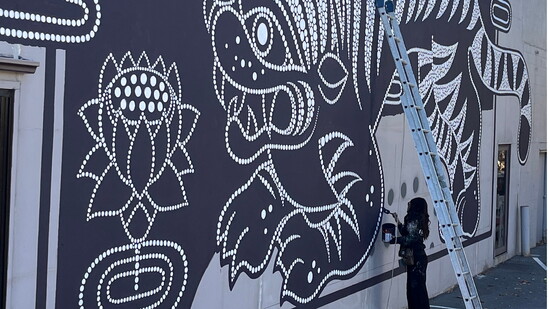
On the outside wall of Portsmouth’s Nahcotta Art Gallery, lilacs bloom, their vibrant, fanciful petals swaying in the light breeze. A few blocks away on Islington Street, a snarling tiger guards the premises of White Heron Cafe, asserting its presence. The two images are a study in contrast, yet intimately intertwined, both born of the artistic passion of Marisa Kang.
Like the connection between the two murals, Kang’s artistic soul is a shifting amalgam of free spirit and self-proclaimed control freak. While her carefree, capricious side is content like the lilacs, the serious artist at her core focuses intently on her work with the ferocity of the tiger. “We artists have visions of things and become obsessed with bringing them to life,” she says. “I am a free spirit, but when I am working on a project, I am totally dedicated to it.”
Kang, who is Jeju Island Korean, grew up in New Jersey and later New Hampshire in a household steeped in creativity. Her mother, a successful artist, is also an accomplished opera singer, and her brother a musician. Art and music flowed through the home.
While she considers herself American first, vibrations of her Korean heritage resonate in her paintings, which focus on botanicals and tigers. At the heart of her work are classic themes of Korean folk painting, or minhwa, an art form teeming with symbolism. In minhwa, specific flowers and plants represent qualities like resilience and enlightenment. Lilacs, like those depicted in Kang’s Nahcotta Gallery mural, are primarily associated with love.
But it is the tiger that features most prominently in this deeply emotional folk art. The image of the powerful striped feline is tied to Korean shamanism—a practice that connects the human and spiritual worlds—and is believed to ward off evil spirits. More significantly, the tiger is a proud symbol of the Korean people’s enduring spirit.
The tiger holds a special place in Kang’s artistic heart and was the subject of her first Portsmouth mural in 2019 on the building that housed Mr. Kim’s restaurant. The eye-catching black-and-white tiger is now gone, the victim of fresh paint applied by new owners. Kang does not mourn the loss of the mural, saying that while it would be ideal for her artwork to last forever, the notion is unrealistic. “The world is full of change and impermanence,” she says.
While the artist has accepted her mural’s fate, many Portsmouth residents expressed dismay at its loss. When Kang woke up the morning the mural disappeared, her inbox was full of emails exclaiming, “The tiger is gone! What are we going to do?” Kang believes its placement near Prescott Park, where so many people walk, gave the mural sentimental impact, something that runs deep in a small city with limited public art.
But the story does not end here for the disappearing tiger. In 2022, while researching Korean history, Kang learned that during Japan’s occupation of Korea from 1910–1945, the Japanese hunted down every tiger, obliterating the species in the country. In an ironic twist, the treaty the United States finalized in 1905 that allowed the Japanese occupation was signed in Portsmouth and dubbed the Treaty of Portsmouth.
The saga of Kang’s tiger murals mirrors history in a remarkable way—with a gratifying alternate ending. Three years before her historical discoveries, Kang painted her first Korean tiger mural in Portsmouth, home of the treaty signing. Four years later, new business developers covered the mural.
In 2025, Kang brought the tiger back—bigger and bolder—with the new mural at White Heron. “It’s funny symbolism,” she laughs. “They may have removed my first tiger, but I brought it back four times bigger!” The mighty tiger no longer roams Korea, but thanks to Marisa Kang, one is thriving in downtown Portsmouth, New Hampshire.
Portsmouth is also where Kang got her start as an artist, painting and teaching at the Button Factory from 2012–2020. She employs mosaic pointillism, the dot technique, for her botanical paintings, placing dots side by side with her finger one by one. She fills an entire canvas—or wall—with dots to create an image. For large murals like the tigers, she uses spray paint to speed up the process. With either technique, the results are striking and alive.
Pondering her future, Kang says she is on a mission. A certified welder, she dreams of someday creating a huge wind vessel, painting it, and displaying it as public art. Not your everyday objective, but not surprising coming from this complex, multifaceted artist. Kang smiles, saying, “It’s a strange path we walk to get to that certain place within.”
To see Marisa Kang’s work, visit marisakang.com.
They may have removed my first tiger, but I brought it back four times bigger!