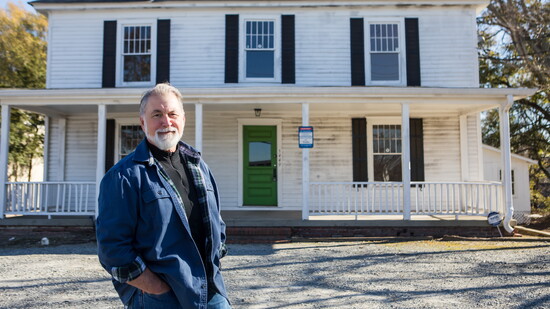
Matt Sitter admits he never cared much for history as a kid, but he says he’s a big fan of railroads and the military. So it’s no surprise the Chamblee resident and vice chair of Chamblee’s Downtown Development Authority has taken on the Chamblee History Project. And with so much new development happening in Chamblee, Matt says the time is now.
As the city of Chamblee looks to develop the seven acres across the street from Chamblee City Hall, Matt says it’s a huge project that’s going to be around for a long time. “I also look at it as an opportunity to incorporate some of the Chamblee history,” Matt says. “Because there’s no place in town to find out about our history. So we need to work on this now while we’re in the design phase.” Matt adds that when you’re walking down the street in downtown Chamblee, those buildings used to be something else. “And wouldn’t it be cool to know what they were?”
He points out that Southbound used to be the old post office, and the Norfolk Southern Station was first called Roswell Junction, and where about 46,000 troops came in and walked down to Camp Gordon, which we now know as Peachtree DeKalb Airport. And President Teddy Roosevelt once made a stop in downtown Chamblee, but there seems to be no images of the visit. Even with all we do know, there’s so much that we don’t know, and currently, there’s not much information in the way of history when it comes to Chamblee.
The Chamblee History Project wants to change this. “She doesn’t have a whole lot in the way of classic architecture, because its main claim to fame is industrial,” Matt says, talking about Chamblee. “But what we do have we are going to preserve it.”
The Chamblee History Project begins its grassroots with a solid core group of six people who are committed to keeping the history of Chamblee alive. The plan is to start with archiving a number of boxes of images and documents. They plan to have public meetings and guest speakers. Matt says they also plan to have what he calls an artifact harvesting – a call for anything anyone may have of a historical nature from a bygone era that relates to Chamblee’s history. This would include anything that’s hidden in a closet, attic or basement of historical significance that mentions Irvindale Dairies, Sinclair gas station, and the like. “We would love that stuff,” Matt says. “Our goal is to try to preserve as much of the stuff that’s worth preserving now, because once it’s gone, that’s it.”
Education outreach is another area of interest for the group, possibly partnering with area schools. And ultimately, Matt says they want to add a Chamblee Museum alongside a possible Visitor’s Center. They plan to open the organization up to Chamblee residents for memberships and other opportunities of historical interest. But first things first, the group is working through the necessary paperwork to establish the group as a nonprofit organization.
Matt talks of the evolution that has made Chamblee the vibrant, growing community that it is today. “The railroad came in and that changed everything,” he says. “It’s like getting the automobile or the internet. It was a paradigm that made a huge change in how the city existed and how life existed in the city. We had a sleepy little town with 46,000 troops and then the post WWII Era. Then we get into the Industrial Era...We’re in a development phase right now,” Matt says. “And we want to make sure that we have a balance between creating good development but also respecting the past.”
Today Matt describes Chamblee in a time of urban renewal. “One of the great things about Chamblee is that it’s very integrated,” he says. “You have a lot of different cultures. It’s a melting pot of people and cultures. That’s what defines us today.”
To learn more about the Chamblee History Project, visit chambleehistoryproject.org.
Our goal is to try to preserve as much of the stuff that’s worth preserving now, because once it’s gone, that’s it. Matt Sitter
You have a lot of different cultures. It’s a melting pot of people and cultures. That’s what defines us today. Matt Sitter