The garage door rises, and everything changes.
Military nurses and medics step from a quiet room into the chaos of a simulated battlefield. Explosions sound in the background. Pretend patients are bleeding. Somewhere amid the noise, a military working dog cries for help.
They do not know what they will encounter before the door opens. That is the point. And it’s all happening in the heart of Old Town.
In a real emergency, there is no script. There is only the training to assess, act, and remain focused when everything around you is designed to overwhelm.
At HonorHealth’s Military Partnership, those moments are recreated as realistically as possible so that military medical professionals are ready when the stakes are real.
“We want them to be able to critically think through anxiety,” says Donna Tew, MSHS, BSN, RN, NE-BC, RN-BC, CHSE, director of Military & Community Partnerships and the Bioskills Laboratory at HonorHealth. “We’re making sure whoever is on the front line is trained and ready to go.”
For nearly 20 years, the Scottsdale-based program has quietly connected military medicine with civilian health care, providing immersive trauma training to military nurses and medics from across the country. It is a mission rooted in service and sustained, in part, by generosity, making it especially meaningful during a season centered on giving and honoring those who have served.
HonorHealth established its training agreement for National Guard and Reserve members in 2005 and welcomed its first classes in 2006. Today, participants travel from across the nation, and sometimes much farther.
Many of those who attend are members of the National Guard or Reserve. While they are trained as military nurses or medics, their everyday civilian careers may look very different. A medic might work at a retail store or teach high school math. A military nurse may spend the rest of the year working in a school or specializing in infection control rather than trauma.
Their medical knowledge remains, but highly specialized emergency skills can fade without regular use.
“We call them perishable skills,” Donna says. “If you don’t use them, you can lose them.”
During the intensive two-week sustainment training, participants review trauma care, earn continuing education credits and complete hands-on clinical shifts inside HonorHealth’s Level I trauma center emergency departments. EMTs may also ride alongside Valley fire departments, while some nurses gain experience at the Arizona Burn Center.
That access is part of what distinguishes the Military Partnership. HonorHealth assumes the liability that allows participants to provide supervised, hands-on patient care within its hospitals, an arrangement Donna says is difficult for similar programs to secure.
“A gunshot in the civilian sector and a gunshot in the military is still a bullet hole. You’re still going to use the same lifesaving techniques.”
The experience also includes classroom instruction from trauma surgeons, neurosurgeons and burn specialists, followed by practice inside a $2 million simulation laboratory. High-fidelity mannequins can bleed, speak and mimic critical injuries.
“Their lungs can rise and fall independently. If a participant correctly applies a tourniquet, the bleeding stops. If a collapsed lung is overlooked, the patient may begin calling out that they cannot breathe.”
The technology forces participants to evaluate what is happening rather than simply being told what they should see.
On the final day, everything comes together in a mass-casualty exercise, and we got the opportunity to witness it firsthand. Participants wear helmets and Kevlar as they respond to multiple simulated victims amid blood, darkness, noise and confusion. They must regulate their own stress, determine who needs help first, and make lifesaving decisions without losing focus.
The scenarios may also include a K9 mannequin that barks, whines and requires emergency treatment. Participants learn to muzzle an injured animal before rendering aid, administer the correct medication dosage and perform procedures such as applying a tourniquet or placing a chest tube.
“No one goes to nursing school or EMT training to take care of a dog. It is a very unique need in the military.”
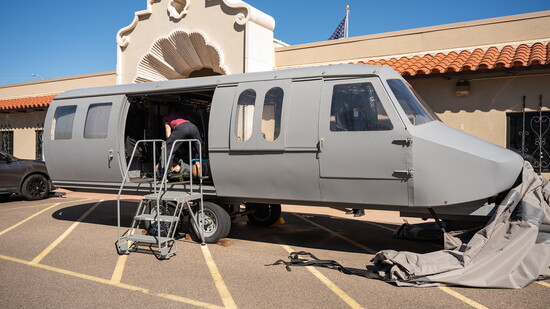
The program even has a Black Hawk simulator that allows teams to practice safely approaching a helicopter and loading patients while managing vibration, intense noise and other distractions.
HonorHealth covers the building, staff salaries and a portion of the program’s operating expenses. Philanthropic support through the HonorHealth Foundation helps provide many of the specialized resources that make the training possible.
Donors have funded high-fidelity mannequins costing between $60,000 and $140,000, classroom technology, medical supplies, helmets, Kevlar and the Black Hawk simulator. Some provide unrestricted gifts to keep the operation moving. Others are inspired to fulfill a specific need.
For Ross Elkins, a Scottsdale resident raised in Paradise Valley, philanthropy is inseparable from family. A plaque outside the Military Partnership honors his late mother and father, serving as a permanent reminder of their commitment to those who serve. After losing his father, Ross chose not only to preserve his parents’ memory, but to continue the mission that mattered so deeply to them.
“That plaque means more to me than recognition. It is a reminder of who my parents were and what they believed in,” Ross says. “They understood that supporting those who serve also means preparing them for the moments when lives are on the line. Continuing their commitment allows me to instill that importance in my son. I get goosebumps and teary every time I witness a training session.”
That continuity matters because readiness is not a one-time investment.
Mannequins must be maintained, medical supplies replenished and simulation technology updated as the needs of military medical professionals and first responders continue to evolve. The program relies on ongoing philanthropic support to keep those experiences realistic, relevant and available.
One retired Air Force donor remembered what it was like to work in heavy protective equipment following September 11 and funded Kevlar and helmets so participants could learn to deliver medical care under that additional weight. Another family stepped forward to make the helicopter simulator possible.
“We said, ‘You’re never going to get that helicopter,’” Donna recalls with a laugh. “Then we found a donor who said, ‘If that is what you need for this training, that is money well spent.’”
The impact extends beyond the military. HonorHealth’s team also provides specialized training at no charge to first responders throughout Arizona, including police officers, firefighters, paramedics, SWAT medics and members of the U.S. Marshals Service, DEA, FBI and U.S. Border Patrol Search and Rescue team.
Instead of offering a one-size-fits-all curriculum, the Military Partnership asks each agency what it needs most and develops training around that gap.
Its simulation garage can become a nightclub with fog, flashing lights and loud music, allowing SWAT medics to practice finding and treating victims in a low-light active-threat scenario. The team has worked with Scottsdale police officers on safely clearing hospital rooms and nighttime search-and-rescue training for Border Patrol personnel.
“We continue to fill in whatever gaps our military and community partners need.”
The Military Partnership also supports three Air Force nursing programs at HonorHealth. Newly commissioned Air Force nurses come to the Valley for 10 weeks of clinical experience before reporting to military hospitals. Nurses training in perinatal care spend 17 weeks at HonorHealth Scottsdale Shea Medical Center, where they gain experience in deliveries, high-risk births, cesarean sections and neonatal intensive care.
“HonorHealth is one of only four clinical sites for the Air Force’s nurse transition program, one of two for perinatal nursing and one of two for critical care and emergency trauma education,” says Donna.
For Donna, the mission is personal.
Before joining HonorHealth, she spent 24 years in the Air Force. Already an experienced ICU nurse when she was commissioned at age 27, Donna went on to complete four deployments, serve as a flight nurse during the Iraq War, work as a chief nurse and help train the Iraqi Air Force during seven and a half months in Baghdad.
She remembers speaking with her daughters over Skype on Christmas as they opened presents back home. When her chair began to move, she realized the base was taking incoming fire.
“I said, ‘Hey, girls, Mommy has to go.’”
Her most meaningful experiences came while flying aeromedical evacuation missions. She would watch the back of the aircraft open and make eye contact with every injured person brought aboard.
“That person was having a much worse day than I was. I felt privileged to be able to deliver that care and get them to the place where they could have the major surgeries and recoveries.”
Donna first arrived at HonorHealth in 2018 as an active-duty service member through a military-civilian nursing internship. She later led Air Force nursing programs within the health system and, after retiring from the military in 2023, helped establish HonorHealth’s SkillBridge program for service members transitioning into civilian careers. She became director of the Military Partnership in June.
“Our goal with this program is that participants feel confident enough to perform under pressure.”
This Veterans Day, honoring service can mean more than looking back at what our military members have already sacrificed. It can also mean investing in their readiness, supporting their future and helping ensure they have every possible resource to come home safely.
honorhealth.com/company/military-partnership