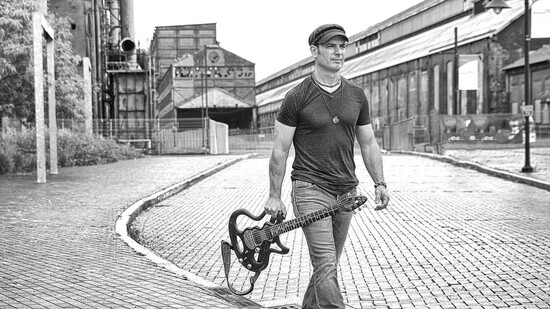
What is it about guys and guitars?
Hypothesis: A guy playing a guitar is in it to get the girl.
There is something undeniable about the sexiness of a man caressing the neck, strumming the strings, and gazing lovingly at the curvature of the body - of a guitar. Type ‘what is it about guys and guitars’ into your browser and you’ll have enough fodder to support the hypothesis.
Cue the research music.
The ‘Guitar Gods Revue’ was stop #1. The show featured two world-class players: American powerhouse guitarist Rod DeGeorge and Italian virtuoso Enrico Santacatterina. Between them, they’ve logged thousands of shows and recordings.
Their drummer for the evening was Gary Glosser. With a curious wink, he offered his back-of-stage perspective on what it is about guys and guitars, “There’s even a term for it - the Gomlich Effect. Look it up.”
The internet tells us that the Gomlich Effect is a boy band phenomenon where “the law of physics states that if one girl screams for something, it will make other girls scream, and it will grow exponentially until all girls within a five-mile radius are screaming.”
This ‘science’ is brought to us by the writers of South Park through the character, ‘Chef’. Thanks, Gary.
As with so many other assumptions we hold without diving further in, direct conversation is the way to the answer.
A chat with Santacatterina during a break in the show changed the trajectory of the story in a flash. “Why the guitar?” he repeated back. “My parents gave me a guitar when I was six years old. I really never put it down after that. Sometimes I play acoustic for myself after a stressful day.” Not romancing, unwinding. Hmmmm.
Guitar as stress-reliever.
Bend local DeGeorge, who teaches guitar to all ages, tells the story of a young student. “I couldn’t tell if he liked me, or even liked the guitar at all. He was so shy.” As is often the case, DeGeorge had to take a break from teaching to go out on the road performing. That meant several weeks without lessons. “While I was out, I got a long email from this kid,” DeGeorge tears up as he remembers, “he told me how much he missed his lessons with me.” That kid is now a professional musician who has opened for some of DeGeorge’s shows. “The guitar can give kids a level of confidence and self worth,” he notes.
Guitar as confidence-builder.
Local musician/industrial electrician Jason Schweitzer’s grandmother handed down her electric guitar to him in 7th grade. His dad showed him some chords and then gave him an acoustic guitar to add to his collection.
It was a great way to be invited to parties back then and Schweitzer immediately began writing his own music by improvising with what was happening around him. He went on to front bands and play shows. Yet it wasn’t the applause he was after. It was the crowd reactions to the music — the connection.
Life has thrown Schweitzer and his family some formidable losses. First his parents, then his teenaged son. “When my parents died, I could keep writing and playing music. It was a special connection to have, playing the guitar dad gave me.” It’s taken longer to get back to music after losing his son, however. It’s harder to be in crowds. After a couple of years, Schweitzer is resuming his lunchtime YouTube videos with new music.
“It’s like another language. I’m communicating with another part of myself,” Schweitzer says.
Guitar as therapy.
As a working musician, songwriter, radio host and program director, David Miller has been in and around performance music since childhood. “I played ‘Proud Mary’ at a school assembly and have been ‘playing out’ [performing] about once a month ever since,” he recalls.
Growing up in extremely rural and underpopulated Lakeview, Oregon, there was a need to be creative when putting together performing bands. Miller remembers, “I was 15, playing in bars with 30 year-olds because there weren’t enough musicians able to play the kind of music they were looking for.” Lakeview was more than a little bit country and Miller was more than a little bit rock and roll and metal.
Miller caught the eye of Kelly Cannon in her sophomore year at Lakeview High.
Yes! Hypothesis support! The guitar gets the girl!
Cannon-Miller (they’re married now) looks back on the beginnings of their relationship and says, “We both didn’t fit. We both loved metal music. It was as if we were in the ‘disenfranchised club’.” She instinctively knew that music was how he expressed himself — his form of communication.
So, was she all a-flutter when he’d get up there and do his lead guitar vocalist thing? Not really. “I wanted him to get the feedback he deserved. I was nervous for him,” she stated matter-of-factly. “I was never nervous,” Miller interjects. The grins of more than 40 years together ensue.
Guitar as connection.
As the co-owner of Somni Studios, a full production recording studio in Bend, Matthew Fletcher, a professional guitarist and drummer himself, has seen many bands and how members interact with each other.
“It’s like lanes in the road” for each musician in the band, Fletcher notices. “The “lane” for lead guitar and vocalist is, in a way, that they are often so talented that they can’t help but take the lead. They’ve often written the music and brought the group together. It’s not really about ego.”
Fletcher is more interested in support roles, which informs both his playing in several local bands and his work recording and mixing other musicians’ music. “I love that music is how I make my money!” Fletcher beams.
Guitar as work.
Conclusion: The guitar is an accessible instrument that produces rewarding sounds at all skill levels. It is an instrument of stress-relief, confidence-building, therapy, connection and is even used for making a living.
Anything else is an added perk.
DeGeorgeMusic.com | EnricoSantacatterina.com