Most small business owners think about compliance the way they think about traffic tickets -- an annoyance that happens to other people, and only when you are seriously out of line. The reality is different. Compliance violations -- particularly in labor law, tax classification, and workplace standards -- are among the most common and costly financial surprises a small business can face.
And unlike a slow quarter or a lost client, a compliance issue does not announce itself in advance.
What Does Non-Compliance Actually Cost a Small Business?
The costs fall into four categories, and they tend to compound:
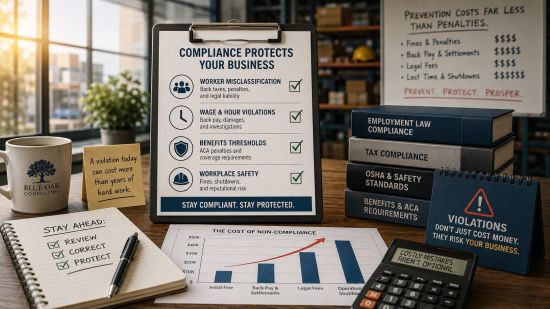
Fines and penalties. Government agencies -- the IRS, the Department of Labor, OSHA -- assess penalties that escalate with time and severity. A first-time violation looks very different from a repeated or unaddressed one. For a small business with limited cash reserves, even a moderate penalty can create a serious liquidity problem.
Back pay and settlements. Labor violations -- unpaid overtime, missed breaks, misclassified wage rates -- often result in orders to pay back wages plus damages. A single complaint from one employee can trigger an investigation that uncovers years of unpaid obligations across an entire team.
Legal fees. Even when a business wins, the cost of legal defense is real. A lawsuit that takes 12 months to resolve can run tens of thousands in attorney fees before the outcome is decided. For most small businesses, that is not an abstract number.
Operational shutdowns. Safety violations can result in a business being closed until corrections are made. Even one week of lost revenue during a busy period can create cash flow damage that takes months to recover from.
What Are the Most Common Compliance Mistakes Small Businesses Make?
Three areas account for the majority of issues:
Worker misclassification. Classifying employees as independent contractors to avoid payroll taxes and benefits is one of the most frequently penalized violations small businesses face. The IRS and Department of Labor have specific tests for worker classification, and getting it wrong -- even unintentionally -- can trigger liability for back taxes, unpaid contributions, and penalties across every worker affected.
Wage and hour violations. Overtime rules, minimum wage requirements, and break obligations are governed by both federal and state law, and Texas has its own nuances. A business owner who pays salaried employees without tracking hours may unknowingly be violating overtime requirements for workers who consistently exceed 40 hours per week.
Benefits compliance thresholds. As businesses grow, they can cross regulatory thresholds without realizing it. Under the Affordable Care Act, reaching 50 full-time equivalent employees triggers coverage requirements. Missing that threshold can result in significant per-employee penalties.
How Do You Protect Your Business Without Becoming a Compliance Expert?
You do not need to know every regulation. You need a system and the right support.
Conduct a periodic review. At least annually, review your worker classifications, payroll practices, benefits offerings, and workplace safety documentation. Catching a misclassification early -- before an audit -- dramatically reduces the cost of correction.
Stay connected to regulatory changes. Labor and tax laws shift at the state level more frequently than most business owners realize. Industry associations, a trusted HR consultant, or a fractional CFO who stays current on these issues can keep you informed without requiring you to track it all yourself.
Treat compliance as a financial investment. The cost of a compliance review is a fraction of the cost of a violation. Like an inspection before buying a building, it is the kind of expense that protects everything you have already built.
A Final Thought
Building a business is an act of stewardship -- of your time, your resources, and the livelihoods of the people who work alongside you. Compliance is part of that stewardship. It is not just about avoiding penalties. It is about protecting what you have built and operating with the integrity that gives your business a foundation worth standing on.
The businesses that get this right do not have compliance figured out perfectly. They just take it seriously.
Chris Thomas is the founder of Blue Oak Consulting, a fractional CFO firm serving small businesses across North Texas. Visit www.blueoakconsulting.net to learn more.