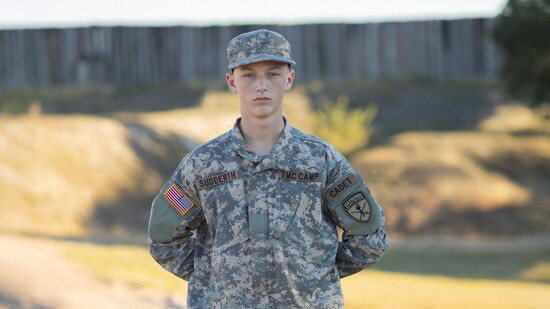
Most high schoolers spend their summers catching up on sleep, hanging out with friends, or squeezing in a family vacation. Dripping Springs student Liam Sudderth chose something dramatically different: a program designed to break down limits, test resilience, and demand absolute commitment.
This summer, Sudderth completed Extreme Military Challenge (XMC), a notoriously intense bootcamp-style program in Alabama created not for kids who need discipline, but for those who want it. Kids must choose to be there, and many don’t make it through. Sudderth did and graduated as a cadet.
From the moment he began researching “hardcore military programs,” XMC stood out. “It was one of the few meant for people who really want to push themselves,” he says. “They specifically say they’re solely for those interested in the program.”
Life at XMC started before dawn. Sudderth and roughly 30 other recruits shared a barracks as a platoon, and every day’s rhythm depended on the group’s performance.
Wake-up came at 5 a.m. with just 20 minutes to get dressed and perform basic hygiene before morning physical training (PT): an hour of pushups, running, and workouts in the dark Alabama heat. The hour between PT and breakfast wasn’t a break; it was for cleaning, barracks checks, and preparing for the day.
And then came breakfast.
Recruits entered single-file, received their food, and waited in silence until ordered to begin eating. They had exactly two minutes. Sirens blared, drill sergeants shouted, and the room pulsed with urgency. “Breakfast was meant to teach us to still function under pressure and a time crunch,” Sudderth explains.
The rest of the day layered challenge upon challenge: obstacle courses, fitness tests, military protocol lessons, marching drills, and inspections where even a minor mistake meant starting over. And lots of pushups.
Dinner was as intense as breakfast, and evenings brought whatever surprise the drill sergeants had planned. Finally, around 1 a.m., most recruits went to bed. Six remained awake for fire watch, rotating all night long until it started again at 5.
The toughest moment came not from a planned drill, but from a mistake.
A fire-watch group failed to wake the next team, leaving the entire platoon asleep and “defenseless.” The consequence: a trip to the infamous “beach.”
“It’s a pit of freezing-cold wet sand,” Sudderth says. 40 by 80 feet wide, recruits had to drag themselves across it using only their arms.
Sirens screamed. Artillery sounds blasted from speakers. Lights flashed. Drill sergeants did everything they could to make the hour-long punishment feel endless.
Then, still wet and coated in sand, the platoon was ordered straight into their cots.
“The only way I kept calm was by distancing myself from the present and doing only as instructed,” Sudderth says.
What surprised him most was not the physical intensity but rather the mental transformation. “I learned that complaining does nothing. You have to embrace the suck,” he says. “I learned how to flip my emotions on a dime. When I was doing pushups, I’d force a laugh in my head, flipping the script and allowing myself to distance from the temporary.”
The ability to “get comfortable with the uncomfortable,” as Sudderth puts it, has already reshaped his everyday life.
He’s more positive, more driven, and much more aware of what he’s capable of.
One of the hardest parts came unexpectedly. Sudderth watched as a friend was sent home halfway through camp for not completing a test. In a place where everyone is constantly on the edge of exhaustion, discipline is absolute. Technology is forbidden. Mistakes—even someone else’s—mean group punishment.
Pushups. Planks. Running. Over and over again. The pressure is nonstop.
Yet Sudderth says the experience strengthened him more than anything he’s ever done, and he is already planning his return. Next summer, he’ll attend XMC’s Search and Rescue program, a more advanced track.
“I want to succeed at life, whether that means settling down, traveling, or owning a company,” Sudderth says. “I’m not going to control the outcome, just point it in the right direction by being positive and getting stuff done.”
He knows the skills he gained—pushing past limits, staying positive under pressure, and embracing difficulty—will shape the next 5 to ten years of his life. Not just in school or future work, but in relationships, challenges, and whatever unknowns come next.
When he returned home from XMC, his family noticed an immediate difference. He stood taller, carried himself with new confidence, and looked like someone who had gone through something transformational.
Because he had.