At the logo unveiling, Greg Anzelc described a theory about how Hockey Day Minnesota works. The event arrives like a Taylor Swift tour: 15 semitrailers pull in, crews unload the show, everyone watches, and the whole operation packs up afterward.
Hosting does not work that way.
Experience Maple Grove, the city’s official destination marketing organization, led the bid to bring Hockey Day to Maple Grove. Anzelc, its executive director, and general manager Anne Anderson now co-chair the event, and much of the work falls to their local organizing committee.
What they have taken on is closer to a very large box with instructions printed on the side.
Step One: Build the Stadium
Maple Grove has some experience with assembly. Central Park opened in 2015 on land that had been a gravel pit. Its skating loop opened as Minnesota’s first refrigerated skating trail. The loop’s rules prohibit hockey sticks and pucks.
For Hockey Day, the hockey goes on the lawn.
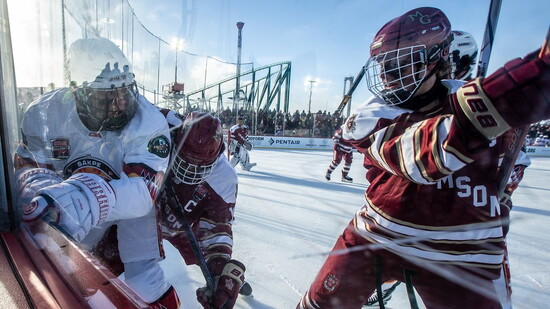
Plans call for turning the 2.5-acre Great Lawn and the area around it into an outdoor stadium with refrigerated ice, lights, bleachers for about 4,500 fans, and a Hockey Day Village of concessions, merchandise and live music under a heated tent. The skating loop and Central Park Lake will open for recreational skating, so visitors can watch the varsity teams, then lace up themselves.
Events will fill the days leading up to Hockey Day, traditionally a Saturday in mid- to late January. That day, Maple Grove’s boys and girls varsity teams will both play on live TV, along with one additional game. The exact date and full lineup will be announced in summer 2027.
Step Two: Raise the Money
The fundraising goal is roughly $1.5 million. Sponsorships are open to businesses across the region, and the event is a nonprofit 501(c)(3), with proceeds going to the Osseo-Maple Grove Hockey Association and Maple Grove High School hockey programs.
Step Three: Find the People
Maple Grove was announced as the 2028 host during Hockey Day Minnesota in Hastings, where Anzelc and Anderson were joined by Mayor Mark Steffenson, city leaders and members of the hockey community. Anzelc estimated the temperature that night at 22 below. By the next day, more than 50 people had asked about volunteering.
In Minnesota, 22 below apparently counts as a recruiting pitch.
They will need plenty more. Anderson, who spent part of her career with the Minnesota Wild, estimates more than 300 volunteers on event days. Some will scan tickets. Others will work hospitality. The rest will handle the dozens of jobs an event this size creates. The local organizing committee meets monthly now.
The last step isn’t printed on the box.
The high school teams will get the television cameras and the big crowds. Organizers want Maple Grove’s youngest players to get something of their own.
“Our goal is to raise the necessary money and provide each and every member of OMGHA the experience of skating on the stadium ice, on the same rink where the high school stars will play under the lights,” Anzelc said. “Years from now, that may be the hockey moment they remember most.”
For the oldest players, that could mean a game. For a six-year-old, it could be one skate around.
Brock Faber started smaller. By five, the Maple Grove native was skating on a backyard rink his dad, Jay, had built. He plays defense for the Wild now.
“It’s such a good thing for the City of Maple Grove and to watch your hometown team on Hockey Day, it doesn’t get much better than that,” he said.
Residents can help with any step: volunteering, sponsorships, merchandise, and individual or corporate donations to the Legacy Puck Wall at the Community Center.
The varsity teams will get their games. A six-year-old could get one skate around. And thousands of people will fill a stadium that, today, is still a lawn.
Some assembly required.
For event updates and ways to participate, visit experiencemaplegrove.com/hdm28.
“…to watch your hometown team on Hockey Day, it doesn’t get much better than that.”
— Brock Faber, Wild defenseman and Maple Grove native