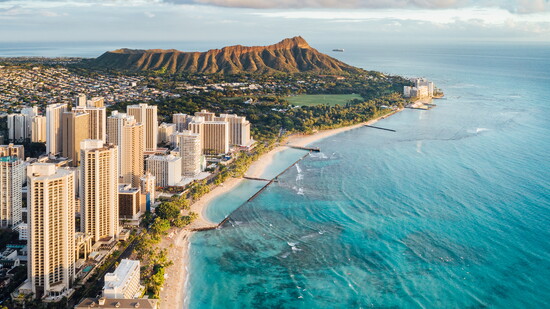
Waikiki has never had trouble staying in frame. Diamond Head rises beyond the palms, the Pacific folds into long, gentle waves, and by late afternoon, the light turns the whole beachfront cinematic. Nor has familiarity dulled its shine. As Honolulu’s most famous neighborhood, Waikiki remains at the heart of a city firmly on the U.S. travel radar: AAA included the state capital among its 50 top American destinations for 2026. And while its appeal may be well established, 2027 brings its history into sharper focus. Next year, two Honolulu institutions turn 100: The Royal Hawaiian, a Luxury Collection Resort, Waikiki, the “Pink Palace of the Pacific,” which opened on February 1, 1927, and the Honolulu Museum of Art (HoMA), which followed on April 8.
For the full nostalgia hit, check into the Royal Hawaiian, whose Spanish-Moorish arches and iconic pink façade still command one of the best positions on the sand, with guest rooms and historic suites being refreshed ahead of its 2027 centennial. The Royal Hawaiian is only one part of Waikiki’s story. Much of its history is best understood from the water. Easy-rolling waves helped make this one of Hawaii's classic places to learn to surf, while outrigger canoe rides and lessons continue a beachboy tradition that has shaped the shoreline for generations. The original beachboys were more than surf instructors: watermen, canoe steersmen, and lifeguards who introduced visitors to Waikikiī’s ocean culture, with figures like Duke Kahanamoku helping introduce surfing to audiences around the world. For Chuck Vause of Waikiki Beach Services, that legacy goes beyond what happens on a board or in a canoe. “It’s about more than service; it’s about genuine care and about honoring a legacy rooted in warmth and connection,” he says.
Waikiki's sense of place is just as strong away from the water. Few landmarks are more synonymous with the neighborhood than Lēʻahi (Diamond Head), also one of Honolulu’s classic hikes. Non-Hawaii residents need timed reservations for the State Monument, which can be booked up to 30 days ahead. If you go on a Saturday, an early climb can be followed by breakfast at the nearby KCC Farmers’ Market before continuing into Kaimukī, where independent shops and cafés offer a low-key counterpoint to the resort strip. Back in Waikiki, culture isn’t confined to museums. Royal Hawaiian Center sits on Helumoa, a historic site once shaded by a vast coconut grove and home to Hawaiian royalty. Its complimentary cultural programming includes hula classes and lei-making lessons. Come evening, House Without A Key, the open-air restaurant at oceanfront hotel Halekulani, offers a more languorous version: mai tais, sunset views, and Hawaiian music accompanied by nightly hula.
Waikiki's newer side is just as intriguing. Boutique hotel Romer House Waikiki channels a retro, neighborhood-clubhouse ambience, with restaurant 855-ALOHA serving playful takes on local comfort food, from Auntie’s Gau Gee wontons to North Shore Detour Shrimp, a nod to the garlic-shrimp food trucks synonymous with O’ahu. After dark, The Lei Stand at Romer House Waikiki—a lobby cocktail bar with roots in Chinatown—weaves Hawaii flavors and traditions through its modern drinks list. Follow that thread downtown, where AIA Honolulu’s monthly architectural Chinatown walking tour explores the styles and relationships between buildings that shape the neighborhood’s distinctive streetscape. Nearby, HoMA is worth seeing as much for its architecture as for the art inside. Chinese and Mediterranean courtyards sit on opposite sides of the museum, while lava rock from Kaimukī, Chinese granite, and other local materials are incorporated into a building conceived specifically for Hawaiiʻs climate and setting.
And then there is room to give something back. Mālama (to care for, protect or steward) feels more meaningful in action: nonprofit 808 Cleanups welcomes visitors to its public cleanup and restoration events around Oʻahu, while Mālama Maunalua organizes volunteer workdays in Maunalua Bay and at Koko Head District Park, east of Waikiki.
Visit a few times, and it becomes apparent the real pleasure of Waikiki isn’t in trying to discover some “hidden” version of the place; it’s in noticing what has been here all along: surf and canoe traditions still playing out just offshore, century-old institutions still shaping the city, and newer arrivals finding their place alongside them.
Diamond Head rises beyond the palms, the Pacific folds into long, gentle waves, and by late afternoon, the light turns the whole beachfront cinematic