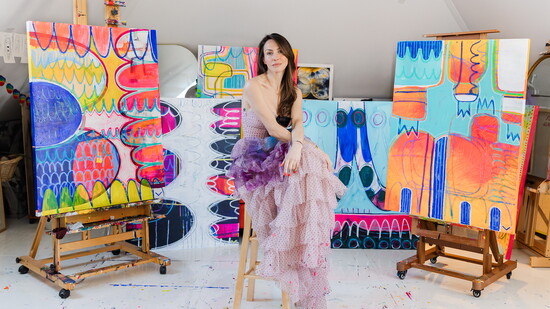
The air in Veta McFall’s studio doesn't just hold the scent of drying paint. It carries the electric hum of a woman who has broken her own mirror. For a decade, McFall was a master of precision. Within her studio, she was the architect of the exact, creating pristine portraits that captured the anatomy of an eyelash and the exact grain of dog fur. "I was a master of the outer likeness," she says.
But precision is a demanding ghost.
McFall immigrated from Russia as a child with her mother, Elena Efimova — the legendary fine arts teacher at Ann Arbor’s Rudolf Steiner school for decades. In their home, creation was never a practice; it was DNA.
Today, McFall’s home is a living archive of this inherited discipline: mosaics pieced together with her mother scale the walls, illustrations drawn in her Chicago years, portraits drawn in grade-school, and mirrored stone sculptures bound by a single haunting silhouette. Yet it’s the recent black-and-white portraits that reveal the true weight of her gift.
But as McFall approached 40, this technical mastery began to feel like a breath held a second too long. "I could wear clean clothes when I did this. I didn’t get dirty. My fingernails didn’t get dirty. My floor was white," she says. "And I wanted to be messy."
Painting the outer visage had become an internal camouflage. The inner noise and fiercely alive fragments of her spirit remained tucked behind the safety of a perfect line. It was time to crack herself open. "I wanted to challenge my ego to not need to display this skill that I had," she says.
The transformation was an odyssey: The 1985 Series. One hundred paintings acting as a spiritual audit, a bridge built of color and courage. Between “One” and “One Hundred,” McFall’s metamorphosis was profound; she hadn't just changed her style, she had re-coded her creative spirit to prioritize the pulse of the process over the polish of the result.
"The person I was at number one and the person I was at 100 is completely different,” she says. "It was my year of growing up.”
To find this new woman, McFall had to deconstruct. She set down the brushes to paint with her hands — swapping charcoal for a prism of color, embracing the rainbows that she loves so deeply.
When she unveiled the completed collection at a live showcase in Ann Arbor, the atmosphere mirrored her radical shift. Complete with aerial artists and a New York DJ, the event was a chic departure from the expected. “So many people said, ‘I can't believe this is Ann Arbor. I feel like I'm somewhere else,’” she says. But for McFall, planting that flag locally was exactly the goal. “The point is: this is Ann Arbor. Creating these kinds of experiences in Ann Arbor is what I want. I want people to come. I want strangers there.”
Today, her studio is a riot of Life-as-Medium. She describes her process as a dialogue with the unknown. "I just keep layering until I love it. Until I like it enough to stop," she says. “But every layer matters...there's no mistakes.” It is a luxurious lean into playfulness. McFall paints for the revelation. Once her signature is placed and she backs away, the lessons tumble into her mind. “I have a connection to the inner knowing now,” she says. “That allows me to do this without needing affirmation — I am gaining inner validation.”
McFall moves through the room now, circling her newest works. “Human Extinction” breathes with a quiet grit, its surface a mosaic of found objects and salvaged toys from a forgotten childhood. “Queen Sisters” glows with a regal, intuitive energy. An untitled piece stands front and center, no signature added yet, wet with paint.
There is a palpable shift as she discusses the future. The numbers of The 1985 Series offered a neutral bridge for the viewer, but those placeholders are falling away now. She is ready to let the narrative back in, on her own terms. The new collection will be an unbridled hybrid: spraypainted knickknacks, stonework, abstracts, portraiture, charcoal, paint, and watercolors. It is everything that calls to her, in whatever way she hears it.
McFall looks at the chaotic beauty of the canvases surrounding her — works pulled, quite literally, from the depths of her transformation.
"I will title this next collection Stories," she says.
The future is no longer a destination; it is a conversation.
Learn more at vetaart.com.
"I just keep layering until I love it. Until I like it enough to stop. But every layer matters…there’s no mistakes."