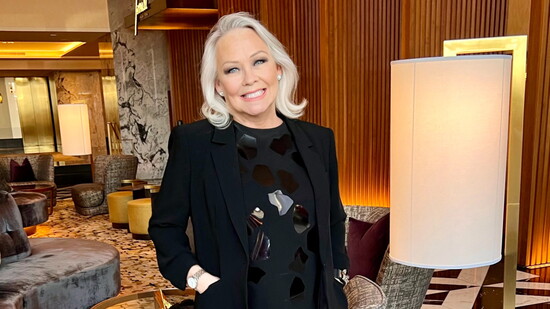
There are women who rise, and then there are women who lift. The distinction matters. Rising can be solitary. Lifting is relational. It assumes responsibility for who comes along. In this issue, our cover feature with Erin Coupe reflects on the power of living with intention. Here, we turn to two more women whose lives embody that ethos of purposeful uplift. Their paths are different, but their impact is unmistakable.
Candace Jordan and Laura Hendricks arrived here by very different routes. One built a career on being seen before learning how to see others. The other was forced, abruptly and brutally, into a reckoning that redefined what strength could look like. Together, their stories trace a larger truth about community, care, and the long arc of becoming.
Candace Jordan, the Connector
Candace Jordan has spent decades at the center of Chicago's cultural and philanthropic life, using her voice to amplify the people and institutions that shape the city. She founded and maintains the lifestyle blog CandidCandace.com and is a columnist for Crain's Chicago Business, associate publisher at Chicago Star Media, a contributor to WGN Radio, and host of "Candid Candace: The Podcast." Over the years, she has chronicled countless galas, fundraisers and openings.
Long before she became one of Chicago's most recognizable civic storytellers, Jordan was visible in a different way. She began modeling at 13 in St. Louis, eventually becoming Chicago's Playboy Bunny of the Year in 1976 and later a centerfold and cover model. That era, which included a close friendship with Hugh Hefner and residence at the Playboy Mansion, placed her inside a media world that prized image above all else. Today, she speaks about that chapter as formative, not defining.
"It taught me confidence," she says. "It taught me how to walk into a room and hold my own. But more than that, it taught me how quickly people form stories about you. I think that's why I'm so interested in telling the real stories now."
Those instincts emerged early. As an only child, Jordan wrote letters and reflections to her mother after moving to Chicago, describing the city so vividly that her mother could experience it alongside her. Those dispatches became a blog. The blog became a platform. The platform became a career.
"The heart of it hasn't changed," Jordan says. "I wanted to share experiences with someone I loved. Now I get to do that with the city I love."
Her writing style remains unmistakably her own. Conversational, warm, funny and deeply personal. "Readers can tell when something feels authentic," she says. "My goal is always to sound like myself."
Candace's credibility comes not from proximity to power, but from how she uses it. She rarely positions herself at the center of a story, preferring instead to redirect attention to the mission behind the moment. That instinct has earned her trust across Chicago's philanthropic landscape, where organizers know she will show up prepared, present and invested.
Jordan is candid about the ways her definition of success has shifted. "At this point in my life," she says, "I want to make things easier for people who are doing good work." It feels less like social currency and more like service, shaped by decades of watching what lasts and what doesn't.
Jordan has chaired or co-chaired hundreds of charity events, a number she downplays even as she lights up talking about record-breaking fundraisers. "I love being part of something good," she says. "And I love seeing people wrap their arms around causes they care about."
Every chapter of her career sharpened her sense of connection. Modeling taught presence. Acting taught empathy. Producing and hosting taught her how to step back and help others shine. Writing brought it all together. She was lifted by mentors who encouraged her to trust her voice, and for nearly four decades, buoyed by her husband, Chuck Jordan. "We're a package deal," she says, smiling.
Community, for Jordan, is not an event. It is a network of relationships built on trust and consistency. "It's people showing up again and again," she says. "That's how real impact happens."
Laura Hendricks, the Survivor Who Builds
On January 31, 2018, Laura Hendricks took her three young children to a routine pediatrician's appointment. A pause. A question. Blood work. Thirty-six hours later, on February 2, the day that would forever change her family's lives, she was in an emergency room hearing the words no one is prepared for: you have leukemia. She was 40 years old.
Within days, Hendricks, who lives in Northfield, was transferred to Northwestern Memorial Hospital, where she would spend much of the next six months undergoing intensive chemotherapy, radiation and a stem cell transplant. Five days into treatment, doctors told her the subtype of AML she had affected fewer than 3 percent of patients, with long-term survival rates often cited in the single digits.
"If I lived anywhere else, I don't think I'd be here," she says. "Cancer doesn't discriminate. Access to care does."
At the time, Hendricks was a VP of global sales at Oracle Data Cloud, accustomed to control and measurable outcomes. Cancer stripped that away. After treatment ended, the recovery was lonelier than expected. She took two years off work. Her body felt unfamiliar. Her household, supported by her family and a tight-knit community, no longer felt like her own.
"Some days I felt like I was living in someone else's house," she says. "My only job was to get better. That creates an identity crisis."
What surprised Hendricks most was not the physical toll of cancer, but the emotional disorientation after remission. Survival came with gratitude, but also with guilt, fear and a quiet isolation that no one prepares you for.
"People expect relief," she says. "But there's grief, too. You're grieving the version of yourself who didn't have to think this way." Naming that experience became the first step toward understanding how deeply unsupported survivors often feel once treatment ends.
Eighteen months into survivorship, Hendricks realized something that changed everything. Many survivors did not have what she had. No comprehensive survivorship clinics. No roadmap for rebuilding life after treatment.
Luminaries was born not from a business plan, but from gratitude and responsibility. Hendricks and her husband researched wellness practices that helped her heal, focusing on sleep, hydration, gratitude, movement, breath, focus and fuel, translating those ideas into practical, science-informed steps designed specifically for cancer survivors. (luminaries.life)
"When you've lost control, big goals feel paralyzing," she says. "Small habits help you rebuild."
Those practices are delivered in multiple ways: through bright orange tangible kits filled with journals, eye masks, water bottles and letters written survivor-to-survivor; through digital text and audio; and through a personalized survivorship app currently in development. More than 2,000 survivors have engaged with the program. Recognition has followed, including national media attention and participation in accelerator programs focused on cancer innovation. Hendricks remains most proud of the quiet moments.
"I'm proud when someone feels seen," she says. "Especially if they live somewhere without resources."
One survivor in Minnesota started a support group after completing the program, gathering others every six weeks to talk through each wellness practice. "That's exactly what we hoped for," Hendricks says. "Support delivered wherever you live."
Cancer taught her to accept help, to let go of control, and to be present. A planned relocation to London for work never happened. If it had, she says, "I would have woken up ten years later and said I wasn't the mom I wanted to be." Her children, now teenagers, are growing up watching their mother turn survival into service.
She calls her diagnosis a gift, with a pause. "I wish it came in different wrapping paper," she says. "But it taught me how I want to live."
In different ways, Candace Jordan and Laura Hendricks remind us that lifting is not a moment. It is a practice. A way of moving through the world with attention and care. As we celebrate women this month, we are reminded that the highest form of influence is not how brightly you shine, but how many others you help see their way forward.