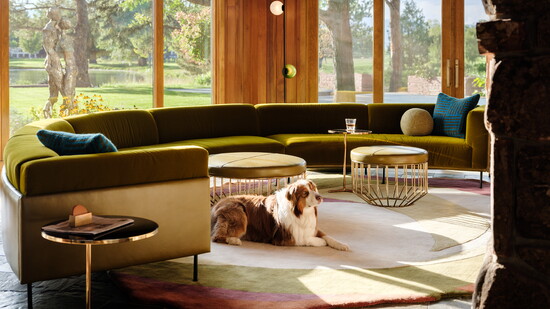
By the time a home feels effortless—like it’s always been that way—someone has done a great deal of intentional work behind the scenes. Furniture plays a large role in that feeling, shaping how people gather, rest, move, and live over time. For interior designer Jen Miller, furniture isn’t about filling a space—it’s about supporting life as it actually unfolds within it.
An interior designer and furniture procurement lead at Boulder-based HMH Architecture + Interiors, Jen’s influence is often subtle but deeply felt. She approaches furniture as a narrative tool—one that reflects daily rhythms, personal histories, and the way homes evolve rather than remain static.
Jen didn’t originally set out to work in furniture procurement. She studied fine art and later documentary photography, drawn to visual storytelling and the emotional resonance of objects. “I’ve always been drawn to unique and thoughtful spaces, the objects that inhabit them, and storytelling,” she says.
“I spent a lot of time at my grandmother’s house, and for 40+ years nothing moved from its place with the exception of the art,” Jen says. “She used an interior designer to create a home that was eclectic and timeless.” That experience left a lasting impression—one that still informs how she thinks about permanence, personality, and restraint.
At HMH, Jen’s work reflects a narrative-driven approach informed by the firm’s holistic view of architecture and interiors. “There’s a strong emphasis on spaces feeling personal and lasting, not overly styled or frozen in time,” she explains. Furniture plays a critical role in shaping that experience. “I’m deeply invested in individual pieces,” Jen says, “but always with an eye toward how they relate to one another—and how they support the way a home is actually lived in.”
When meeting new clients, Jen looks beyond stated preferences to understand daily rhythms and habits. “I’m listening to how they talk about their everyday life,” she says. “Do they entertain a lot? Are they homebodies? Do they have kids or pets? Do they go barefoot in the house, or are they always in shoes?” Even subtle cues offer insight into what will truly serve clients’ living spaces.
For Jen, intentional spaces resist perfection. “When everything matches perfectly, it can feel stiff,” she says. She gravitates toward mixing eras, textures, and materials, often incorporating clients’ existing pieces to create a more authentic conversation within the space. “Every piece should have a purpose—sometimes functional, sometimes purely for beauty—but always contributing to a cohesive experience that supports their lifestyle.”
Local relationships play a vital role in that process. Working with Colorado-based makers allows for deeper collaboration and transparency. Jen recalls projects in which clients met artists in their studios and witnessed processes firsthand. “It becomes a shared conversation,” she says, one that transforms objects into meaningful connections. “One example that comes to mind is working with local artist Liz Quan. Being able to see her slipcasting or hand-carving processes up close and hear her answer clients’ questions turns the artwork into more than a finished object.”
Comfort, too, is multilayered. “Comfort isn’t just about softness,” Jen notes. “Texture, layout, and how long people linger all matter. Furniture plays both a visual and functional role,” she says. “The best pieces have a strong point of view and encourage connection.
Perhaps most importantly, Jen designs with time in mind. She believes homes don’t need to feel finished all at once. “People grow into their homes, and the space should be able to shift with them,” she says, advocating for restraint and allowing art and objects to arrive organically.
Through her thoughtful approach to furniture and procurement, Jen helps create homes that don’t just look good when they’re complete—they continue to feel right as life unfolds within them.
For more information, visit HMHAI.com.
A Vintage Favorite: Finn Juhl 108 chair
Jen Miller on a Danish modern classic and why it still belongs in today’s homes.
The Piece
I’m always drawn to how human they feel. They’re understated, comfortable, easy to move, and quietly expressive. I especially love the brass pins and the horizontal wood bar juxtaposed with the upholstery on the back.
The Era
The chair was designed in 1946, during the rise of Danish modernism, a period when furniture was becoming more body aware. Comfort, craftsmanship, and proportion were central, not just how a piece looked in a room.
The Craft
The construction is deceptively complex. The materials—solid wood, upholstered elements, and the brass details age beautifully, which matters to me. Finn Juhl is known for saying, “The deviation is in the details.”
Why It Works Today
It brings warmth and character to contemporary spaces while feeling timeless. I often like to pair a fabric that pushes the notion of a vintage chair and a contrasting welt to really make the shape pop—this way it easily becomes an heirloom piece with the indelible mark of the generation that passes it down.
The Takeaway
When we use pieces that are built with lasting craftsmanship, we’re not adding to the landfill. Vintage pieces like this don’t date because they were never chasing trends. And of course, sometimes it’s just about the joy of finding something distinctive that delights us.