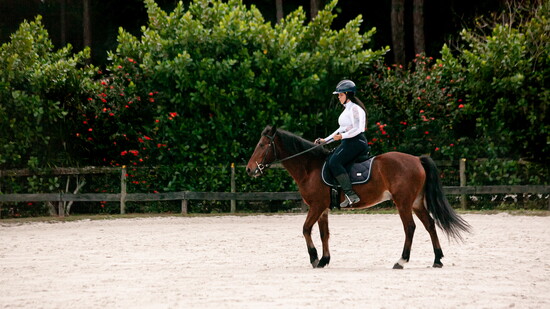
For Meghan Ross, healing has never been about fixing what is broken. It has always been about creating space—space to breathe, to slow down, to be honest about what is carried beneath the surface.
A U.S. Army veteran, registered nurse, and founder of Panthera Palm Beach, Meghan has spent her life in environments that demand strength. But over time, she has come to understand that true strength often reveals itself in quieter ways: patience, presence, and the willingness to sit with discomfort rather than rush past it.
That understanding deepened when she became involved with Operation Remount, formally known as the Operation Remount Corporation (ORC)—a nonprofit organization that supports U.S. military veterans and first responders coping with PTSD and anxiety. The organization offers a free, six-week residential equine-assisted program at the Mirrored K Legacy Ranch in Wyoming, pairing participants one-on-one with wild mustangs.
Meghan completed the ORC program herself in May 2024, an experience that reshaped not only her connection to the organization, but her understanding of healing. Today, she serves as an Operation Remount Ambassador for the Southeast Region, acting as a point of contact for those interested in learning more about or participating in the program. Her role is grounded not in abstraction, but in lived experience.
Operation Remount is built on the principle of reciprocal healing. Many of the veterans and first responders who arrive at the ranch carry trauma shaped by combat, crisis response, or prolonged stress. The mustangs they are paired with often arrive carrying fear of their own, having been gathered from the wild after years of surviving on instinct alone. The program does not rush either forward. Instead, it centers on gentling, trust-building, and emotional regulation—asking participants to slow their bodies and quiet their minds in order to meet the horse where it is.
For Meghan, that horse was Joker.
Joker was gathered in October 2021 from Wyoming’s Divide Basin Herd Management Area—a date that holds personal significance for Meghan, as it happens to be her birthday. Young, intelligent, and deeply curious, Joker arrived wary of people and slow to trust. During the early weeks of the program, he kept his distance. Meghan spent nearly half of the six weeks simply earning the right to touch him—a process that tested her patience and required her to stay grounded even when progress felt invisible.
From the beginning, the experience demanded presence.
“From the minute I got there, it wasn't just about working with the horses,” Meghan recalls. “It was an entirely different experience away from the noise of everyday life, and the ability to be present and focus on my patience and emotional regulation. It was a challenge, and it still is a challenge.”
Over time, that patience was met with trust.
“Horses respond to energy, consistency, and trust,” she says. “I wasn't even able to touch Joker for the first two to three weeks because we didn't trust each other, and he could tell I wasn't calm, so he wasn't calm. Horses work in the present, not the past or the future, and I had to learn to work the same way with him.”
By the end of the program, Meghan and Joker had formed a bond strong enough to carry beyond the ranch. She adopted him, committing to the long, ongoing work of partnership. Today, Joker—now four years old—continues to test boundaries in the way young horses do, curious and alert, always checking that she is paying attention. He has been under saddle for about a year, supported first by a trainer and now by a close-knit barn community in Florida. Their journey is a dynamic one—marked by progress, setbacks, and trust earned slowly, day by day.
That lesson—about meeting someone where they are—echoes through every part of Meghan’s life, including her work in aesthetics.
In 2019, she founded Panthera Palm Beach with a philosophy that runs counter to many assumptions about the industry. For Meghan, aesthetics is not about chasing perfection, but about restoring confidence in a way that feels grounded and respectful.
“Confidence is about feeling your best, and it is different for everybody,” she explains. “We all struggle with confidence throughout our lives at different points and for different reasons. Aesthetics done with integrity is about restoring a person's glow inside and outside and helping others feel good in their own skin again.”
That sense of integrity—of care without pressure—is what connects her work at Panthera to her advocacy for Operation Remount. In both spaces, healing is not imposed; it is invited.
“Consistency, respect, and being fully present,” Meghan says, when asked what allows people to feel safe enough to let their guard down. “People can feel when they’re being rushed or judged. Trust is built when someone knows they’re seen, heard, and never pushed beyond what they’re ready for.”
As a veteran, Meghan is acutely aware of the invisible wounds many carry long after service ends.
“Strength and struggle can exist at the same time,” she says. “Many carry internal struggles that don’t show up on the outside, such as hypervigilance, grief, guilt, or emotional exhaustion.”
That awareness informs how she approaches empowerment—not as a promise of transformation, but as a practice grounded in trust.
“Both are rooted in empowerment,” she says of Panthera Palm Beach and Operation Remount. “At Panthera, my goal is never to ‘fix’ someone—it’s to support them in feeling confident, informed, and in control of their choices. That same philosophy exists at Operation Remount: providing tools, space, and trust so healing can happen naturally.”
Through her experience with Operation Remount and her bond with Joker, Meghan’s understanding of healing has deepened.
“It is not one size fits all; even if we are going through the same experience, it is very individual, and sometimes it's uncomfortable,” she reflects. “That perspective has made me more patient, more intentional, and more sensitive to each person’s unique journey.”
In a culture that often celebrates resilience without acknowledging its cost, Meghan Ross offers a different model—one rooted in empathy, restraint, and deep respect for the process of healing. Whether beside a mustang on open land or across from a client in a quiet treatment room, her work is guided by the same belief: when people feel safe, real change becomes possible.
Strength and struggle can exist at the same time.