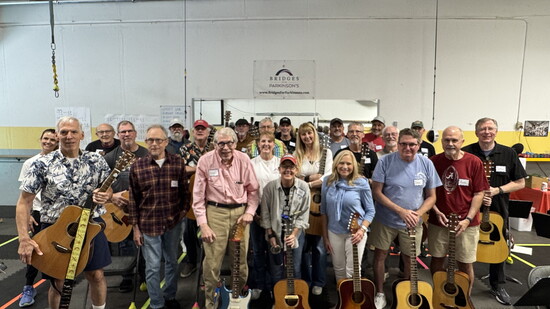
In a quiet industrial park off Seaboard Lane in Franklin, something meaningful is taking shape behind an unassuming door. Step inside Bridges for Parkinson’s and you will not find a typical fitness center. You will find a community built on movement, connection, and possibility. And, more importantly, you will find people learning how to move through life again with confidence.
Bridges for Parkinson’s was created with a simple but powerful mission: to help people living with Parkinson’s and other movement disorders stay active, engaged, and connected through specialized, neuro-based programming. At the heart of that mission is a guiding belief, “The miracle is in the movement.” It is a phrase that captures what happens there every day, going far beyond exercise. It is about restoring independence, rebuilding confidence, and creating a space where individuals are supported not just physically, but emotionally.
A cornerstone of the program is Rock Steady Boxing, a non-contact, boxing-based fitness approach designed specifically for those living with Parkinson’s disease. What might look like a traditional workout at first glance quickly reveals itself to be something far deeper. For many, it is hope in motion. The focus is not on competition, but on reclaiming strength, confidence, and independence.
Participants hit heavy bags, practice footwork, and move through carefully designed exercises that target balance, coordination, and mobility. The routines are neuro-based, intentionally designed to stimulate areas of the brain impacted by Parkinson’s. Many mirror drills used by professional boxers, improving speed, agility, coordination, and reaction time in ways that translate directly into everyday movement.
“I provide exercises that mirror everyday life so PD fighters can do the things they enjoy with greater ease and confidence,” says founder Colleen Bridges.
Parkinson’s is a progressive neurological condition that affects movement, balance, and coordination, often chipping away at a person’s confidence over time. Traditional exercise can feel intimidating or even unsafe. Rock Steady Boxing flips that narrative. Through intentional movement, rhythm, and repetition, participants work to strengthen not just their bodies, but their sense of control over the disease.
But to describe this as simply a workout would miss the point entirely.
“People walk in thinking they’re coming to exercise,” Bridges says. “But what they find is so much more. They find a place where they are seen, where they are capable, and where they are not defined by Parkinson’s.”
Bridges’ journey into this work did not begin as a business venture. It began as a calling. A certified personal trainer with a specialization in movement disorders and Parkinson’s, she brings nearly two decades of experience working with neurological conditions and has helped thousands of individuals regain strength and independence.
Bridges started at Steps Fitness in Nashville with three participants and, in 2017, brought Bridges for Parkinson’s and Rock Steady Boxing to the Franklin area. Today, Bridges for Parkinson’s offers 29 weekly exercise classes, including Rock Steady Boxing, yoga, and tai chi, along with stretching, massage, and educational workshops.
The mission is simple and deeply meaningful: to connect people living with Parkinson’s to a supportive community through movement that strengthens both body and mind. Participants are not treated as patients. They are “fighters.”
“There is something powerful about calling someone a fighter,” Bridges says. “It shifts the mindset. Parkinson’s becomes the opponent, not the identity.”
The team behind the program is highly specialized, including Parkinson’s Fitness Specialists, occupational and physical therapists, a massage therapist, a neuroscientist, and even a retired Olympic boxing coach.
“We don’t see limitations when someone comes in,” Bridges says. “We see potential. We see what’s still possible.”
The workouts are intentionally challenging. Bridges utilizes what she calls Forced Intense Exercise, gently pushing participants beyond what they might do on their own.
“Every class is a reminder that they can still do hard things,” Bridges says. “And that realization carries over into every part of their life.”
The benefits extend far beyond the physical. An estimated 90 percent of people living with Parkinson’s experience anxiety or depression. Here, that burden is met with something equally powerful: connection. “It makes their journey less lonely,” she says.
In many ways, the program functions as both a fitness class and a support system. Participants form friendships that extend beyond the gym, often meeting for dinners or social outings. Carepartners connect and join the class at no additional charge.
“It’s inspiring,” Bridges says. “They look at each other and think, if they can do it, I can do it.”
The impact reaches into everyday life. Participants travel, attend concerts, and spend meaningful time with their families, often doing things they once thought might no longer be possible.“I provide the necessary resources for them to live their best lives,” Bridges says.
And that sense of joy is what makes this space so special. It is not driven by fear of the disease, but by the possibility of living fully alongside it.
The program has grown steadily, and Bridges is actively looking to expand into a larger facility in the Cool Springs area, allowing even more individuals and families to benefit. As a nonprofit, Bridges for Parkinson’s is committed to accessibility, ensuring that no one is turned away. Donations through their website help make that possible.
At its core, the message remains simple. The miracle is in the movement.
“Parkinson’s may change the way someone moves,” Bridges says. “But it does not take away their ability to live a full, meaningful life. Our job is to help them see that again.”
BridgesForParkinsons.com