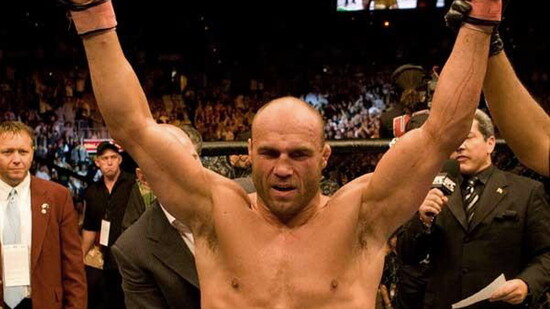
Randy Couture has six UFC championships, cauliflower ears, a SAG card, an Arizona ranch, and a granddaughter who calls him Champaw.
His next move?
He wants to be in a romantic comedy.
“It would be challenging and give me a chance to show some genuine emotion. We might have to explain the ears, but it would be fun," says Randy.
He has played mercenaries, fighters, villains and men you would never want to meet in a dark alley. He traded punches with Jet Li, learned filmmaking from Sylvester Stallone and graced the ballroom on Dancing with the Stars. Now he wants to make people laugh and perhaps even fall in love.
If people expect one thing from Randy, he seems most interested in showing them something else.
Randy entered the UFC at 34, when most athletes are told their opportunity has passed. He walked onto movie sets without formal acting training. He even sought to become a drag racer until a fiery crash.
“My family said, ‘You have grandkids. We would kind of like to keep you around,’” he says.
Beneath the many reinventions, however, is one identity Randy has never treated as a role... soldier.
Randy Couture served in the U.S. Army from 1982 to 1988, rising to the rank of sergeant and spending his final two years with the 101st Airborne Division at Fort Campbell.
He was even selected to lead the Honoring America’s Veterans Phoenix Veterans Day Parade as 2025's celebrity Grand Marshal.
“It was a huge honor. Now, at a different stage of my life, I have the chance through my foundation to help that community.”
Military service is not something he keeps in the past.
“Once you take that oath and make that commitment, you look at the world in a particular way. That is not a switch you just turn off.”
Randy was 19 when his life changed through a phone call.
He had won a state wrestling championship in high school and walked onto the team at Washington State University. During Thanksgiving break, his former girlfriend called to tell him she was pregnant.
“I didn’t want to be a deadbeat like my dad was, so I stepped up.”
The couple married. Their son, Ryan, was born in August 1982. Two months later, Randy left for basic training.
“I saw an opportunity through the Army to support a new and blossoming family. I have no regrets.”
Randy assumed joining the Army meant his wrestling career was finished.
Instead, it put him back on the mat.
“Wrestling and boxing were huge sports for the Army because of their combative nature. I ended up wrestling in Germany.”
He won a U.S. Army Europe Championship and earned a spot on the All Army wrestling team. That journey carried him to the 1988 Olympic trials, where he became an alternate for the United States Olympic team while still serving as a soldier.
The Army sharpened his wrestling, but it also gave Randy the leadership philosophy he still lives by.
“You lead by example. It is not about bravado. It is about doing what you expect other people to do. How do you expect to be a leader if you are asking people to do things you cannot or will not do yourself?”
Randy does not deliver the thought like a motivational slogan. That directness comes from his mother, who raised three children largely on her own.
“I grew up with three women, which gave me a unique perspective on divine femininity. I saw that strength every single day.”
His father’s absence created a different kind of motivation.
“I think I operated in some ways out of an inferiority complex that I was not good enough for my own dad. Rather than use that as an excuse to make poor decisions, I used it as gas for the fire.”
He had been testing that fire since he first began wrestling at 11.
“Aristotle talks about courage as the first of all human virtues because, without courage, none of the other virtues would exist. For me, that courage started as an 11 year old putting on a singlet, walking to the center of a mat by myself and potentially getting my a** beat in front of all my friends. You want to talk about courage? That is the sport of wrestling.”
After six years in the Army, he accepted a scholarship to Oklahoma State University. The decision meant leaving military stability with a wife and two children, but an Army coach urged him to take the chance.
“He could have been selfish and tried to keep me wrestling for the Army. Instead, he pushed me in the right direction.”
Randy continued pursuing the Olympics and came within one match of making the 1996 team. Then mixed martial arts appeared.
“I saw a couple of wrestlers I knew having success in this weird sport called no holds barred. In 1997, I got the chance to try it.”
At UFC 13, Randy won two fights in one night and captured the heavyweight tournament in his professional debut.
He was 34, which only made the opportunity more appealing.
“I have always looked at those numbers as just that. It is not about letting society or anybody else tell you what you can or cannot do.”
His age lowered everyone else’s expectations.
“Nobody expected anything from me. That frees you up to go out with no expectation. It was the same mentality I had as the kid trying to get his dad’s attention. You think I am going to get my butt kicked because I am 34? I will show you.”
He became a six time UFC champion.
After Randy defeated Vitor Belfort, a writer from Full Contact Fighter approached him with an idea.
“He said, ‘You are a natural. You adapted to his style. Can I call you that?’” Randy recalls. “I told him, ‘I have been called a lot worse, so why not?’”
“The Natural” fit. Even the way he talks about nerves feels completely on brand.
“I don’t get nervous. I get excited. Nervousness has a negative implication that something bad might happen. Excitement and nervousness have the same physical attributes, but one is positive.”
Before a fight, he returned to the same words.
“Breathe. Move your feet. Stay present. Stay in the moment. Stay relaxed. So many people forget to breathe in moments of tension.”
There is no elaborate ritual. Just oxygen, movement, and the next decision.
Hollywood then arrived almost by accident.
Randy’s first major film experience came in Cradle 2 the Grave with Jet Li and DMX. He had one line, a fight scene with Jet Li, and seven days on a Los Angeles set.
“I had been a moviegoer since I was a kid, and I was bitten by it,” he says.
More roles followed. Then Sylvester Stallone wanted a meeting.
“That is a call you do not skip,” Randy says.
Stallone was putting together The Expendables and initially considered Randy for a different character. When that role went to Terry Crews, Stallone returned to the script and wrote in Toll Road for him.
“I was amazingly honored that he would go to the trouble of writing me into the script.”
The film reached number one at the box office and became a franchise. Randy found himself surrounded by performers who had defined the action genre.
“We spend our whole lives as athletes boxing up our emotions, compartmentalizing them and putting them to the side. Then acting wants me to walk in front of a camera and let all of that out. I thought, I don’t know if I know how to do that.”
For a man celebrated for control, the new challenge was letting go of it.
The most important role Randy assumed off screen began after two encounters with wounded service members.
In 2006, he spent 12 days in Iraq. The following year, he visited Walter Reed and attended a barbecue at the Fisher House for the parents, spouses and caregivers of hospitalized service members.
“It was the first time I walked the wards and met soldiers fresh off the battlefield. I heard about the financial struggles they were facing as they transitioned from being soldiers back into civilian life while dealing with injuries sustained in combat.”
He understood the military culture and transition. And by then, he had a public platform large enough to be useful.
“That experience motivated me to start raising awareness about what these men and women were dealing with, but I also wanted to raise funds to take some of that pressure out of their lives.”
In 2007, Randy established the Xtreme Couture GI Foundation to support wounded veterans and their families.
The work is deeply connected to his own beginning. The Army once gave a 19 year old husband and father a way to support his family, rediscover wrestling, and build a future. Randy now uses the career that followed to help other military families find their footing.
Arizona has become part of Randy’s life, too. In 2020, he purchased a ranch outside Flagstaff, searching for a place to slow down.
“It is amazing.”
He still acts, supports veterans, and remains connected to the gym he turned over to Ryan after his son retired from professional fighting.
His favorite title these days comes from his granddaughter, Evie.
“She calls me Champaw. One of the best titles you could ever have.”
Ask what makes him proudest?
“My kids. They sacrificed a ton of time with me while I was chasing my Olympic dream and then my fighting dreams. That is time you do not get back.”
What he hopes they saw was a man willing to bet on himself without pretending to be someone else.
“Keep things simple and just be yourself. There is no sense in creating a persona.”
Randy’s route makes little sense on paper... Soldier, Olympic alternate, college wrestler, UFC champion, action star, drag racing student, veteran advocate, Flagstaff rancher, Champaw.
Possibly, someday, romantic lead.
“I did everything backward, but somehow it worked out exactly how it was supposed to.”
xcgif.org