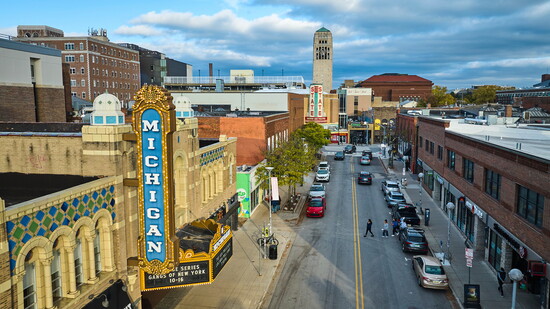
It takes just one Google image search of “Ann Arbor” to see it—the glowing marquees of the Michigan and State Theaters, splashed across the screen like the city’s own calling card. And it makes perfect sense. At 98 years young, these beloved venues are stitched into Ann Arbor’s cultural DNA.
But according to Executive Director and CEO Molly Rowan-Deckart, they’re far more than historic venues. “These theaters are emotional landmarks…they hold people's memories,” she says. “It’s a place for first dates and family traditions and midnight movies. And it’s been the backdrop of a century of community life here.”
Now, under Rowan-Deckart’s leadership, the theaters are entering a new chapter—one that honors their legacy while reimagining what community, creativity, and connection can look like in the years ahead.
When it comes to the Michigan Theater specifically, one cannot talk about the future without acknowledging its storied past. Designed by Detroit architect Maurice Finkel, the theater opened in 1928 as a silent movie house with its now-iconic Barton Pipe Organ providing music and sound. Despite its age—and the fact that it’s still played almost daily—Rowan-Deckart says the organ is one of the theater’s most innovative tools. “It's kind of the bridge between the arts,” she says. “It is a bygone era, but it's a great way to experiment with sound and history and live performance in a way that just isn't common anymore.”
With the past as her foundation, Rowan-Deckart is turning her attention to what the next 100 years will look like inside these theaters’ walls—imagining how the venues can evolve into a true third space for the community. Her first focus is accessibility, both financial and physical. “We want to make sure the arts truly are for everyone,” she says—and she’s making it real by pushing to make 30 percent of all programming free next year.
Physical accessibility enhancements are also underway, including improvements to the hearing loop and audio amplification systems, and ultimately the installation of an elevator to reach the mezzanine—a significant undertaking for a nonprofit stewarding a historic building. It remains a vital priority for Rowan-Deckart and her team as they create a theater that offers new and meaningful ways for the community to gather.
Accessibility is only the beginning. Central to Rowan-Deckart’s vision is transforming the theaters into spaces where the community doesn’t just attend programming, but helps shape it. She imagines local filmmakers, musicians, nonprofits, and creatives using the Michigan and State theaters as platforms for their own stories and ideas. To support that, the theaters are layering their spaces to serve multiple purposes, including a new stage in the Michigan’s screening room that will open the door to far more than film. The ultimate goal is a future where residents can self-program these spaces, curating cultural experiences themselves.
“Partnership is going to be our superpower,” Rowan-Deckart says, and it’s clear she intends for these historic venues to amplify the community’s voice, not just present content.
This shared-ownership mindset is already reshaping what audiences experience. While classics like Casablanca and White Christmas will always draw nostalgic crowds, Rowan-Deckart is equally committed to fostering discovery, opening the theaters to a wider mix of voices, genres, and creative expressions. That evolution includes the Michigan Theater producing more of its own live events, with a goal of 35 performances each year by 2027.
“The breadth and depth of what we are doing is enormous, and it's designed with Ann Arbor's artistic soul at the center of it,” she says. “These theaters don't just show movies—they shape the cultural life of our city.”
As Rowan-Deckart looks to the future, the glowing marquees serve as a symbol of what the theaters mean to Ann Arbor. They’ve always been beautiful, but under Rowan-Deckart’s direction, they are becoming something more: a beacon drawing residents to a shared cultural home. She calls it a “community living room”—a place where Ann Arbor can come together, exhale, and find a place to belong.
For the Michigan and State Theaters, the next 100 years aren’t just about preservation—they’re about expanding what community can look like inside these storied walls.
And the invitation is open to all of us to help shape what comes next.
To learn more visit marquee-arts.org.