The next breakthrough in biotechnology may begin right here in The Woodlands.
At Lone Star College-Montgomery, the Biotechnology Program, led by Director Daniel Bryan Kainer, Ph.D., is giving undergraduate students opportunities rarely found at the academic level while pursuing ambitious research with the potential to impact the future of medicine and biotechnology.
“We are proving that you don’t need a multi-million-dollar grant to move the needle on the future; a dedicated group of undergraduates on a lean budget can lay the groundwork for world-changing science,” says Kainer.
The biotechnology program is the first two-year training program of its kind in Texas. It has prepared students for careers in life sciences while helping build a talent pipeline for one of the state's fastest-growing industries. Today, many program graduates are making meaningful contributions across Texas's life sciences sector, whether in industry, research or academia.
A New Frontier: the Laboratory
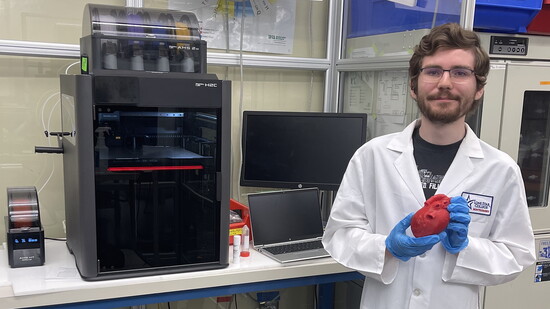
A key component of the program's success is its specialized biofabrication laboratory, which houses a cleanroom, bioreactors, and multiple state-of-the-art 3D bioprinters. The lab gives undergraduate students hands-on access to advanced bioprocessing hardware and opportunities to participate in cutting-edge biotechnology research—experiences that are often unavailable until graduate school.
“We are breaking the traditional mold of higher education by transforming community college undergraduates into active, passionate discoverers who operate the exact same advanced hardware found in top-tier pharmaceutical and biotechnology firms,” says Kainer.
Student research focuses on three primary areas: biofabrication, bioprinting and the circular bioeconomy. One current project explores how mealworms can be converted into biomaterials for use in medicine and biotechnology through an advanced process.
Building the Future of Medicine
While their research is in the early stages, their long-term vision is to create a sustainable way to support the next generation of regenerative medicine and healthcare technologies.
“If the global community of researchers fully realizes the goals of sustainable biomanufacturing and automated tissue engineering, it will completely rewrite how humanity treats organ failure, tests cancer drugs, handles waste and builds medical devices,” says Kainer.
Kainer often describes the program's research ambitions as a "moonshot," drawing inspiration from President John F. Kennedy's famous challenge before the Apollo Mission, "We choose to go to the moon in this decade and do the other things, not because they are easy, but because they are hard."
Launching a Moonshot in The Woodlands
"The scientific milestones we are reaching for—from manufacturing patient-specific drug-testing models to scaling master stem cells in rocking bioreactors—are incredibly complex and daunting,” says Kainer.
“But our undergraduate students are facing them head-on. Building on our legacy of training hundreds of successful industry professionals, these students are launching a lean-budget scientific moonshot right here in our community that has the potential to change the world forever.”
For local students interested in STEM, the program offers a unique opportunity to gain hands-on research experience, work with advanced biotechnology equipment and contribute to projects that address real-world challenges. As the life sciences industry continues to grow, Lone Star College-Montgomery is demonstrating that groundbreaking innovation doesn't only happen at major research universities—it can begin right here at a community college in The Woodlands.
For more information, visit Lonestar.edu.
“We are breaking the traditional mold of higher education by transforming community college undergraduates into active, passionate discoverers...” says Kainer.
"These students are launching a lean-budget scientific moonshot right here in our community that has the potential to change the world forever,” says Kainer.