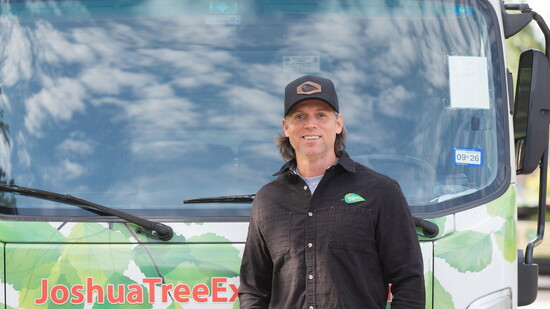
They give us shade, oxygen, and fruit. They stand tall in our outdoor spaces and offer a welcome sight with their sweeping canopies of leaves. Protecting your trees isn’t just about routine maintenance—it’s about TLC. We sat down with Scott Smith, owner and general manager of Joshua Tree Experts, to learn more.
Scott’s approach to landscaping is reflected by his motto: love where you live. By pairing his passion for seamless customer experiences with a deep appreciation for the outdoors, he helps educate homeowners on some of the most common, yet preventable, tree care mistakes.
Q: What’s the best way to prune trees?
“Professional tree pruning isn't cosmetic, it's structural. Untrained tree trimmers cut by appearance (topping, lion tailing), removing needed internal branches and creating large wounds that attract disease. Professional pruners use different tactics. We don’t prune more than 20% of the living tissue (that is, any limb that has green leaves, not dead wood). Some homeowners mistakenly prune from the inside out, which can reduce the tree’s ability to photosynthesize effectively. We prune from the outside in, allowing sunlight to filter through the canopy and shine on the grass below.”
Q: How much water is “enough”?
“Most people assume that "daily watering equals good care." In reality, compacted soil and poor drainage can cause hidden damage that only shows up later. Younger trees benefit from more frequent watering, while established or native trees may receive sufficient water from rainfall during non-drought seasons.”
Q: How do homeowners know if their trees are “stressed out”?
“Research consistently shows that 80-90% of struggling urban tree's issues are due to inadequate soil and root health. Soil compaction in our North Texas clay limits how roots absorb nutrients, water, and oxygen, which restricts growth and can even kill a tree. If you see the tips of limbs losing leaves, there are likely issues in the soil. Compacted soil can also lead to girdling roots, which wrap around the base of the trunk and can gradually choke the tree. At this point, the tree is unable to distribute the nutrients from the soil into the canopy, and we need to step in to loosen the soil.”
Q: Does adding nutrients to the base of the tree help?
“Improving soil health through aeration and the addition of both beneficial micronutrients (such as various trace minerals), beneficial fungi (mycorrhizae), and macronutrients (nitrogen, phosphorus, and potassium) can help. A lack of any one of these nutrients can significantly impact the long-term health of a plant. Trees also exhaust energy reserves fighting heat stress, but deep root fertilization restocks nutrient reserves that have been depleted. Soil aeration reduces compaction and increases oxygen to roots too.”
Not only are trees majestic, but they may also serve to increase a homeowner’s property value. Don’t wait till the summer heat strikes to reveal hidden issues. A tree health audit by a certified arborist can help you build a strategy now. Fewer than 100 arborists in Texas hold PPQ (prescription pruning qualification) credentials, and Joshua Tree Experts is one of them.
For more information, visit joshuatreeexperts.com, or call 972-640-9470.
Scott’s approach to landscaping is reflected by his motto: love where you live.