Eric Bachofner harvested his first deer when he was 12-years-old. A Kalispell native on his father’s annual hunting trip to Central Montana, Eric secured a small four point whitetail after some time in camouflage, quietly roaming across the landscape.
It’s one of many prominent memories from his childhood, he said, as he reminisced on his early hunting days.
Now 46, that moment was the first of many, as he’s continued to build a life dedicated to the hunt.
Becoming a sportsman and hunter takes development over time. For some, this is often discussed in a theory of six stages: the shooting stage, the limiting-out stage, the trophy stage, the method stage, the sportsman stage, and the giving-back stage.
It’s a story of evolution close to home for Eric. After the harvest of his first white tail, he entered the shooting stage, an era that lasted around seven years.
“That Stage One, the shooting stage, couldn’t have been named any better,” he reflected, remembering the thrill of shooting a rifle.
Eric explained that it’s not the most efficient stage of hunting, but a stage where a lot of initial growth happens and where a hunter learns to control their emotions and successfully execute a shot.
The limiting-out stage is when the main goal of the hunt shifts from practicing shots to filling tags and bagging the full limit. Eric said the limiting out stage probably lasted five years for him. In the shooting stage, a hunter will likely take any shot they can. In stage two, those initial skills are developed and are put to use to shoot bigger animals.
For Eric personally, the third and fourth stages, the trophy stage and the method stage, are flipped. After coming out of the limiting-out stage, Eric fell in love with bow hunting, specifically with elk: propelling him into that method stage, where how one takes the game becomes the most important aspect of the hunt.
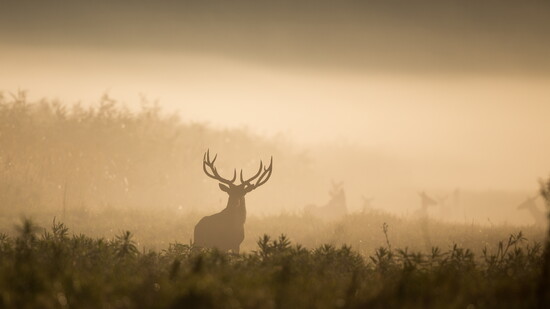
Eric spoke about his admiration for September bow hunting, when the elk are in the midst of their rut and rifle season hasn’t yet started. He recalled the feeling of finding a bugling bull elk against the calmness of the landscape, an excitement that immediately replaced rifle hunting for him.
“You could feel the bugle, it was so loud and intense, unlike a rifle hunt… It was so much cooler to be around that rutting activity even if I didn't take home anything,” he said.
After a few years of getting comfortable with a bow, Eric entered stage three, the trophy stage, in his 30s, where focus transitions from the quantity of a harvest to the quality and selectivity of a harvest.
He said one of the things that got him there was luck. He drew a moose tag, a bighorn sheep tag and a mountain goat tag all within a five year span. It was also before he had children, allowing him to devote a lot of energy and time to the hunts.
“The harder a goal, the more gratification at its outcome,” he said. “When it comes to be, it justifies all the work that went into it.”
The best harvest of Eric’s life was in this stage, when he pulled a mountain goat tag in the Cabinet Mountains. He had already harvested a moose and a big horn sheep in his career.
“It was no joke,” Eric said. Hunting with a bow in mountain goat country is about as extreme as it gets. The challenge of the hunt, at times, felt like it was more so against the mountain and the terrain than it was about the harvest.
On a whim one weekend, thanks to a window of good weather, Eric and a friend traveled west to the Cabinets. After 3,000 feet of elevation gain in three miles, the pair started glassing the horizon. They saw two billy goats in a place Eric thought he could get to.
It took him 45 minutes to get to where he last saw the goats, and he quietly looked around. One goat was just 30 yards away to his left. The goat stood up, but then sat down and looked at Eric. At full draw, he waited for a few more seconds and let go of the perfect shot.
“I’m pretty sure that yell can still be heard bouncing around the Cabinet Mountains,” Eric laughed, speaking on the celebration that occurred after.
When a hunter enters the sportsman stage, stage five, they usually feel proficient in almost every realm of what’s involved in being a “good” hunter. It’s at this point where the experience of the hunt matters more than the actual harvest. Right around age 40, Eric said, was when he realized that the size of antlers wasn’t as important as the enjoyment of the experience.
“You notice the sunrises, the sunsets, the owl that lands on the branch next to you… it’s things like that that become more fulfilling,” he reflected.
Not long after reaching that fifth stage, Eric experienced the sixth: the giving-back stage. Currently, Eric said he exists in a mix of stage five and six, something he doesn’t envision changing.
Using decades of knowledge, Eric gives back to the hunting community in his daily life. He works at Huntin’ Fool, a hunting resource company, where he advises members on applying for tags, hunting logistics and general hunting strategy. For Eric, hearing the successes of others is as fulfilling as harvesting his own animals. He also guides hunts, and remains passionate about bow hunting.
“You just get to a point where it's nice to be able to give back some information and knowledge that I've worked most all my life to procure,” he said.
Moving forward, Eric looks forward to taking his children out on a hunt, just like his own father did for him. He’s passionate about continuing his education and knowledge, furthering his expertise and continuing to help others as they experience the magic of a hunt in the mountain west. Respecting the animals, respecting the landscapes and respecting the hunt are pillars of his mindset.
“To those who want to get out there and try, just do it, and don’t worry about success. Success, I think, holds a lot of people back. But the important thing is to try,” he said. “You sure won’t have a successful hunt if you don’t try.”
The harder a goal, the more gratification at its outcome. When it comes to be, it justifies all the work that went into it.
To those who want to get out there and try, just do it, and don’t worry about success. Success, I think, holds a lot of people back. But the important thing is to try.