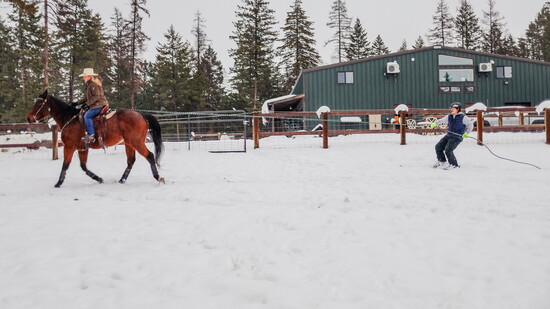
When Leah Mitchell tells me that Whitefish Skijoring started as a bar bet, I can't help but smile. Because of course it did. What else would inspire someone to strap on skis, grab a rope attached to a galloping horse, and launch themselves down a course dotted with jumps and gates at speeds that would make most of us reconsider our life choices?
"It was informal," Leah says, recounting how Norm Kurtz—the founding father of Whitefish Winter Carnival—challenged local ski legends and horsemen to saddle up for what would become one of Montana's most thrilling winter traditions. "There was no cowboy chic to it. Just dally up and go."
Twenty years later, that bar bet has evolved into something beautifully, uniquely Montana: an event that blends rodeo grit with downhill skiing precision, wraps it in community spirit, and serves it up with campfires, food trucks, and a side of pure adrenaline.
Leah has been competing in skijoring for over a decade, and you can hear the passion in her voice when she describes it. "Once you do this sport, you're hooked," she says. And she's not exaggerating. The sport has exploded across the West—from Canada to Southern Colorado, races draw hundreds of competitors and thousands of spectators every weekend throughout winter. Some athletes travel the circuit like rodeo competitors, chasing prize money and that coveted buckle.
But Whitefish? Whitefish does it differently.
"We want to keep it core to the tradition of how it started," Leah explains. As chair of the event committee—a role she stepped into three years ago—she's part of the fresh blood on the latest board determined to preserve the hometown spirit. They cap their event at 100 teams. As a non-profit, they host free practice Sundays in Columbia Falls all winter to teach newcomers and kids the ropes (literally). They draw mostly Montana and Canadian competitors rather than casting a wide net for out-of-staters.
"We call it Montana Extreme Winter Games," Leah says, and I love that. Because what makes this event special isn't just the sport itself, it's everything surrounding it. It’s the way Boy Scouts tend the fires while the women's rugby team throws penalty flags, and the way 4H volunteers manage parking and the whole thing operates as a nonprofit, with proceeds circling back through the community. It’s the Saturday night Calcutta auction at Fatt Boys in Kalispell where teams get auctioned off and bettors hold their breath through Sunday's runs.
The mechanics of the sport fascinate me: three heartbeats—rider, horse, skier—working as one. Horses thundering at 30 to 40 miles per hour while skiers navigate gates and jumps, one timed run to get it right. You can compete multiple times if you swap out one of those heartbeats, but there are limits. Strategy matters. Skill levels range from novice to open pro, where downhill ski racing backgrounds give competitors an edge at those speeds.
For the 20th anniversary this year, they're pulling out all the stops: dog sled rides, a live stream production so out-of-state friends and family can watch, a VIP area with heated trailer bathrooms (because Montana luxury means not freezing while you pee). It happens February 14th and 15th, and Leah promises what everyone who’s been already knows: "Thousands of people show up no matter the weather. You never know what you'll get."
That's the thing about Montana events like this; they exist because someone had a wild idea at a bar and because a community decided it was worth showing up for, year after year, regardless of the temperature or the wind or the odds. They exist because people like Leah volunteer hundreds of hours to keep traditions alive while making them better. They exist because sometimes the most Montana thing you can do is hold a rope attached to a horse, point your skis downhill, and trust that three heartbeats will find their rhythm.
If that's not uniquely Montana, I don't know what is.
Want to experience it yourself? Presale tickets are available now at whitefishskijoring.org. This is cheaper than buying at the gate. The website also has information about volunteering—and Leah says they always need help. Volunteers get a front-row seat to all the action, plus tickets for friends and family. Whether you're there to watch, compete, or help make it happen, you'll be part of something that's been 20 years in the making and still feels as wild as that original bar bet.
"It was informal. There was no cowboy chic to it. Just dally up and go."
"Thousands of people show up no matter the weather. You never know what you'll get."