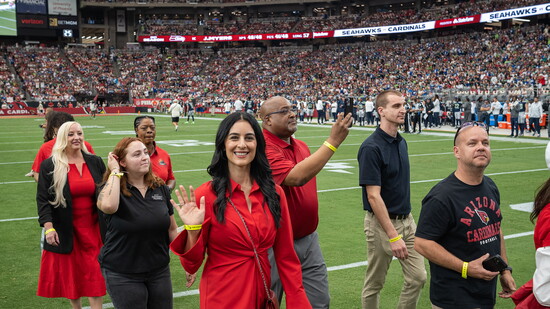
Back in September, hundreds of people arrived at State Farm Stadium preparing for the Arizona Cardinals home-opener. One day later, fans gathered at YouTube Theater before the Los Angeles Rams took the field.
But before kickoff, the conversation was about something that does not always appear on a scoreboard: the mental side of performance.
That is the idea behind the Training the Mind Series®.
We have spent years encouraging athletes to talk about mental health. The next step is making sure those conversations happen in the places where athletes, families, coaches, fans, and sports organizations already are.
Game day is one of those places.
Training the Mind brings experts in mental health, athlete development, advocacy, medicine, and sport directly into professional sports environments for practical conversations about psychological health and performance. Rather than separating mental health education from the sporting experience, we are embedding it within it.
Athletes are expected to tolerate discomfort. They are taught to compete through pressure, recover quickly from mistakes, manage public scrutiny, navigate injury, and perform even when circumstances are difficult. Those qualities can help create extraordinary performers. They can also make it harder to recognize when normal competitive stress has crossed into something requiring additional support.
An athlete can be performing well and still be struggling.
That is one of the most important messages I want people to understand.
Over the past two years, the Training the Mind Series® has expanded into game-day environments across professional sports, including events with the Arizona Cardinals, Los Angeles Rams, Phoenix Suns, Los Angeles Clippers and Houston Dynamo.
Each setting looks slightly different, but the objective remains consistent: move the conversation beyond simply telling athletes that mental health matters.
We talk about what to do next.
What does performance anxiety actually look like?
How can an athlete respond to a setback without allowing one moment to define the next?
When does poor sleep, irritability, avoidance, declining motivation, or difficulty concentrating warrant more attention?
How should a parent or coach approach an athlete they are worried about?
Where can someone turn when they decide they want help?
Those practical questions shaped our September events.
One of my favorite parts of these game day activations is that every age is welcomed into the conversation. Kids and teens raise their hands and ask the questions so many young athletes carry: How do I perform under pressure? How do I quiet the noise in my head?
At State Farm Stadium, Training the Mind partnered with the American Board of Sports and Performance Psychiatry, American Psychiatric Association Foundation, Morgan’s Message, PlaySafe USA, and Mental Health America of Arizona.
The following afternoon in Los Angeles, we partnered with the American Board of Sports and Performance Psychiatry, American Psychiatric Association Foundation, PlaySafe USA, and The Hidden Opponent.
Bringing organizations together is intentional. No single clinician, nonprofit, league, or program can address every need within athlete mental health. A better system requires people knowing what resources exist, how those resources complement one another, and how to connect an athlete with the right support at the right time.
Several panelists have helped crystallize that mission.
Rawle Andrews Jr., Esq. is the Executive Director of the American Psychiatric Association Foundation, who has repeatedly reinforced the importance of making mental health resources understandable and accessible. Awareness only goes so far if athletes and families do not know where to turn once someone says, “I need help.” The pathway from recognition to care must be clear.
Brandy Singleton, CEO of Playsafe USA, brings another important perspective: athlete safety cannot be separated into physical and psychological categories. We readily build systems to protect athletes from physical harm. Mental health deserves the same intentional infrastructure, education, and attention.
Leeann Passaro, Executive Director of The Hidden Opponent, has helped bring the athlete voice directly into these conversations through their Campus Captains program. One of the recurring lessons is that athletes are far more likely to speak honestly when they believe the people around them will respond with curiosity rather than judgment.
Dr. Mark Allen, Chairman of the American Board of Sports and Performance Psychiatry, represents the growing role of specialized sports and performance psychiatry. Athletes may experience the same psychiatric conditions as anyone else, but the context matters. Competition schedules, travel, injury, medications, performance expectations, team culture, and identity within sport can all influence assessment and treatment. Specialized knowledge allows clinicians to understand both the person and the performance environment surrounding them.
And from my own work as a sports and performance psychiatrist, my biggest message is that mental health and performance should not be treated as opposing conversations. Mental skills can help athletes manage pressure, attention, recovery, confidence, and setbacks. Clinical mental health care addresses something different when symptoms begin interfering with functioning, relationships, sleep, safety, or well-being. Athletes and the people around them should understand the difference and know that seeking clinical care is not a failure of mental toughness.
What stays with me most from these events is not what happens onstage, but what happens after.
Mental health programming in sports cannot only happen after a crisis. It cannot be reduced to an annual awareness campaign or a social media graphic reminding athletes that it is okay to ask for help.
The most effective systems normalize psychological health long before someone reaches a breaking point.
Imagine a sports culture in which athletes learn how to train attention and emotional regulation alongside strength and conditioning; coaches know how to recognize meaningful changes in behavior; parents understand how their language can either amplify or reduce performance pressure; and every athlete knows exactly where to go when they need clinical support.
That is where I believe we need to go next.
Training the mind should not be viewed as something separate from training the athlete.
And perhaps one of the most powerful places to make that message visible is exactly where athletes have always been taught that performance matters most: game day.
brookchouletmd.com