A freight brokerage owner in Fort Worth has two loan offers on her desk. Both are for a revolving line of credit, money she can borrow, pay back, and borrow again. Both come from respectable local banks. Her company moves about $14 million a year in freight, and she wants a cushion before the next push for growth.
One bank advertises a tiny fee for leaving the line unused. The other pays a higher rate on her savings. She is tempted to pick whichever sounds simpler. That is usually where the money leaks.
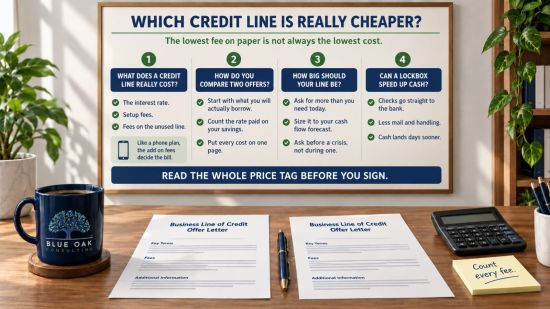
A line of credit works like a cell phone plan. The monthly rate gets the headline, but the add-on fees decide the bill. Adding them up takes ten minutes and can save thousands of dollars.
What Does a Business Line of Credit Really Cost Beyond the Interest Rate?
It costs every fee the bank attaches, not just the rate you pay when you borrow. Two fees matter most. An origination fee is a one time charge for setting up the line, usually a percent of the limit. A non-use fee is a small yearly charge on the part of the line you leave untouched.
One offer charged about 0.1 percent for non-use and nothing to open the line. The other charged no non-use fee but took roughly 1 percent up front. Neither number looks scary alone. The borrowing pattern decides which one hurts.
How Do You Compare Two Credit Lines When You Rarely Borrow the Full Amount?
Start with how much you expect to draw in a normal year, then price each offer against that number. Picture a $1 million limit. Most of the year she expects to borrow about $200,000 to cover the gap between paying carriers and collecting from shippers.
Under the first offer, the unused $800,000 carries a 0.1 percent fee. That is about $800 a year. Under the second, the 1 percent opening fee is $10,000 on day one. Spread over a three year term, it is still more than $3,000 a year before any interest. If she rarely touches the line, paying for idle space is the cheaper path. If she borrows heavily all year, the math can shift. The headline rate never tells you which.
One more number belongs in the comparison, because the bank holding your line usually holds your deposits too. One bank paid about 1.5 percent on savings. The other paid about 3 percent. On an average balance of $400,000, that gap is roughly $6,000 a year in extra interest. That can wipe out a large part of an opening fee.
So the cheaper line is not always the one with the smaller fee. It is the one with the lowest total cost once you add fees, borrowing, and interest earned. Put all of it on one page. Good cash flow management starts with seeing every dollar side by side.
How Big Should a Credit Line Be for a Growing Company?
Ask for more than you need today. She leaned toward a limit between $1.0 million and $1.5 million, well above her current use. A bigger line costs little when the unused fee is tiny, and it gives you room before a crisis arrives. Banks are far friendlier to a customer who asks early than to one who asks in a squeeze.
Size the line against your cash flow forecast, not your comfort level. Include the stretch when freight is booked and carriers must be paid before shippers send money. Asking early is how you stop reacting and start planning ahead.
Can a Lockbox Really Put Customer Cash in Your Account Faster?
Yes, because it removes days of mail and handling. A lockbox is a mailing address run by the bank. Customer checks go there, the bank deposits them, and your own mailroom is out of the loop. She priced one at about $150 a month for up to 100 checks.
Her sales run about $38,000 a day. If checks land three days sooner, that frees roughly $115,000. The lockbox costs $1,800 a year. Getting paid faster is often a cheaper source of cash than borrowing it. Ask whether the bank can route electronic payments to the same account, so every receipt lands in one place.
A Final Thought
Good stewardship means counting the cost before we sign, not after. Wisdom asks us to look past the attractive headline and weigh what a commitment will truly require. A business that borrows carefully protects the people who depend on it, from drivers to families waiting on a paycheck. Read the whole price tag before you sign.
Chris Thomas is the founder of Blue Oak Consulting, a fractional CFO firm serving small businesses across North Texas. Visit www.blueoakconsulting.net to learn more.