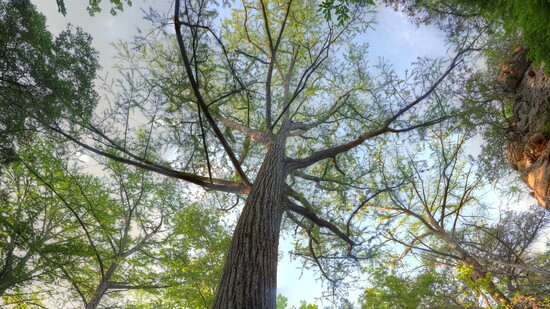
“Is this where the fairies live?” David Cook, who’s guiding our photography tour, says children often ask this question upon arriving at the stunning grotto at Westcave Preserve. And honestly, it’s hard to blame them.
As sunlight slips through the canopy of massive, ancient trees and glimmers across the grotto’s water, this hidden canyon—just 12 miles from Dripping Springs—takes on a magical quality.
Moss and ferns cling to the limestone walls embedded with fossilized oyster shells, and nearby, a 40-foot waterfall spills over a rocky edge into an emerald pool. The grotto is completed by the small cave for which it is named.
Taking in this enchanted scene, it’s quite clear why John Covert Watson, who bought the preserve’s original 25 acres in 1974, decided it needed protecting. At that time, the canyon was completely overgrown, with hundreds of trespassers and piles of trash destroying its natural beauty and polluting its ecosystem.
Enter John Ahrns, who became the first preserve manager at Westcave in 1976. After being recommended to Watson by a mutual friend, Ahrns relocated from Dallas to Westcave with his wife, Brenda, and their young children, Amber and Jeff, to begin the daunting work of cleaning up and restoring the land.
“It was getting loved to death,” says Amber Ahrns Gosselin, a Dripping Springs High School alumna who’s carrying on her father’s legacy as the preserve’s current director. Westcave has been part of her life since she arrived with her family at 2 years old.
Among her father’s many tasks vital to cleaning and opening up the preserve was installing approximately 120 steps that are still used today by visitors making the mile-long descent to the grotto. “He’d put me on a baby blanket and move me down as he built each step,” Gosselin says.
“It was an idyllic place to grow up for me and my brother,” she adds. “We ran all over the property like Tom Sawyer and Huck Finn.”
She wishes she could give her own children that same type of childhood: “I was very lucky. I didn’t realize it at the time.”
However, thousands of children have had the opportunity to experience Westcave’s magic since it opened five decades ago. Last year, the preserve welcomed approximately 17,000 visitors, including 2,700 students.
Visitors typically begin their Westcave adventure at the nationally-renowned Warren Skaaren Environmental Learning Center (ELC), which opened in 2003. The 3,000-square-foot, award-winning green building was designed by Austin architect Robert Jackson and houses hands-on activities and stations that tell the story of Westcave’s geological history, introduce local species of birds and animals, and more. Gosselin says you can easily fill a half day at the preserve by taking a canyon tour, having a picnic, and exploring the ELC.
On this morning, I’m one of 15 people who arrived at Westcave at 6:45 on a Saturday morning to photograph its beauty (totally worth it). The guided photography grotto hike is usually offered twice a year and attracts both novice and experienced shutterbugs.
We descend into the canyon, guided by Cook (a photographer who has led tours at Westcave for several years), who informs us that all four types of venomous snakes in Texas live here! On a more comforting note, we can hear a symphony of bird song, including the canyon wren, Louisiana water thrush, and acadian flycatcher. Westcave is a birder’s paradise.
As we pass an enormous, 300-year-old bald cypress tree, the grotto opens up before us. It is a sight to behold. Cook offers our group pointers on great spots to shoot from and suggestions about lighting and camera settings.
Rafael, a fellow hiker who’s visiting from a suburb of Fort Worth, says he’s interested in shooting landscapes, wildlife, and macro photography. It’s his fourth trip to the preserve in three years, and he plans to return in the future.
Thanks to the Ahrns and Watson families, that future looks solid. In the mid-1980s, they had the foresight to partner with the Lower Colorado River Authority, which bought the property and gave Westcave a 99-year lease for $1 per year.
Fifty years on, this now 76-acre local gem remains protected, ensuring future generations can continue to learn, explore, and find a deeper connection with nature through guided canyon tours, monthly star parties, photography and night hikes, and more.
Visiting Westcave—located at 24814 Hamilton Pool Road in Round Mountain—is by reservation only through the online portal.
Westcave.org | @westcave